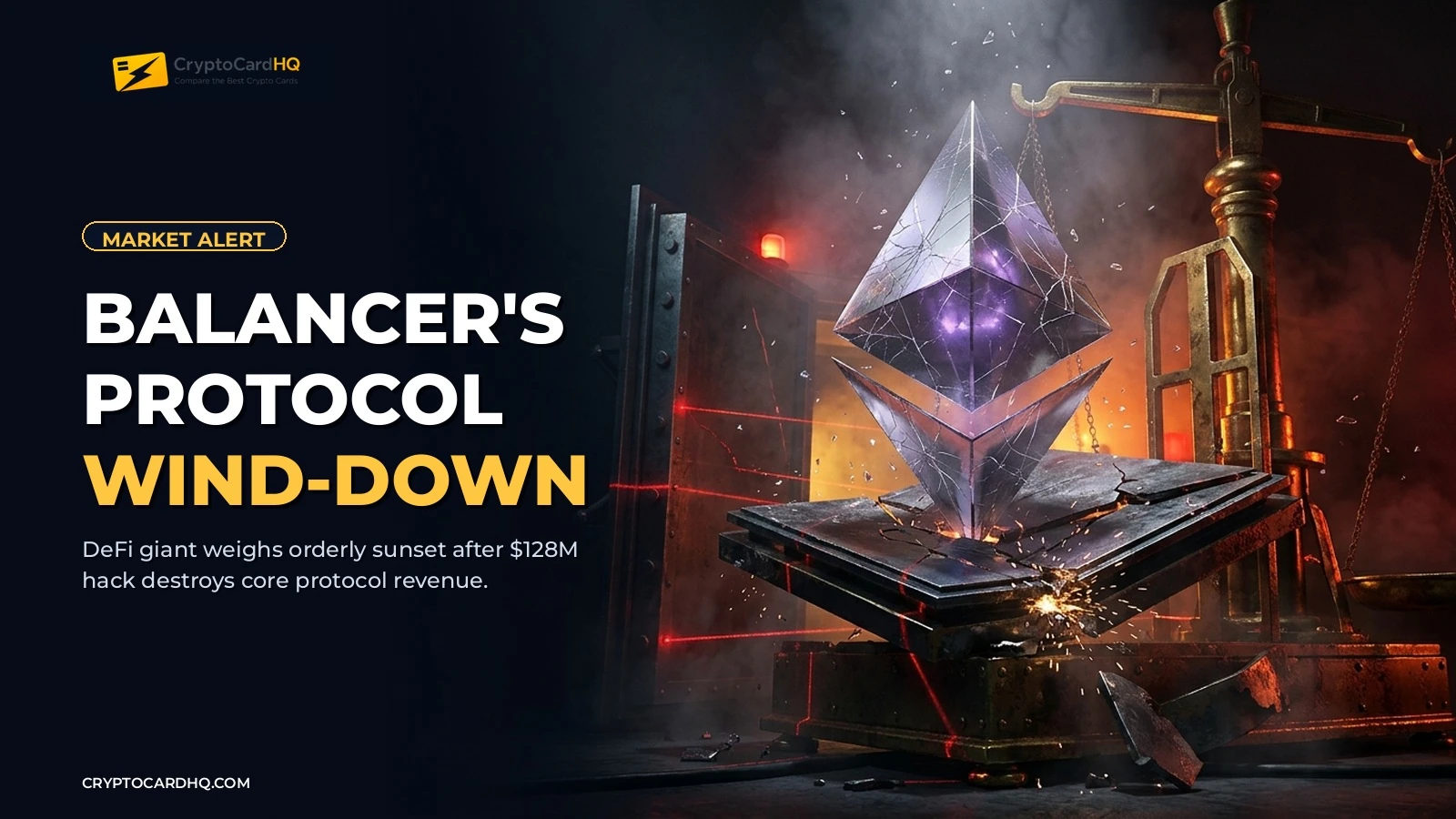
In an abrupt escalation of decentralized finance distress, Balancer—one of Ethereum's foundational automated market makers (AMMs)—is formally evaluating a complete protocol wind-down. The move follows months of aggressive internal cost-cutting, structural reorganizations, and the launch of Balancer v3, none of which succeeded in reversing catastrophic revenue decay triggered by a devastating $128 million exploit last November. For liquidity providers, treasury managers, and decentralized asset managers who long treated Balancer's custom pool architectures as indispensable infrastructure, the announcement signals an unprecedented retreat by a blue-chip DeFi pioneer.
Key Takeaways
- Formal Wind-Down Under Evaluation: Balancer contributors and core stakeholders are considering an orderly sunset of the protocol after deep cost cuts failed to restore financial viability.
- Failed v3 Architecture Turnaround: The deployment of Balancer v3 failed to attract meaningful liquidity or replace legacy fee streams, with total active usage remaining severely depressed.
- The Ghost of November's Exploit: Protocol economics never recovered from the $128 million exploit in November, which shattered institutional trust and hollowed out core liquidity reserves.
- Immediate Liquidity Hazards: Liquidity providers face severe pool slippage and drying secondary liquidity across yield-bearing asset pairs over the next 24 to 48 hours.
Market Snapshot at Time of Reporting: At the time of reporting, BTC ($77,811.57, +0.31% 24h | Range: $77,379.41 - $79,600.00), while ETH ($2,504.13, -0.17% 24h | Range: $2,487.84 - $2,615.00).
Anatomy of a Collapse: Failed Restructuring After a $128 Million Blow
The crisis came into public view after internal discussions confirmed that Balancer's leadership is weighing a comprehensive wind-down of operations, as first reported by Cointelegraph. The governance ecosystem entered a structural tailspin in November when an attacker compromised core pool logic, draining approximately $128 million across multiple network deployments.
In response to the exploit, the foundation and allied development studios enacted severe austerity measures. Headcount was slashed. Grant distributions paused. Operational budgets shrank to preserve dwindling treasury runway. Core developers fast-tracked Balancer v3, pitching modular pool hooks, 100% gas-rebated swaps, and optimized custom liquidity curves intended to lure back yield-bearing token issuers and institutional partners.
Instead, user adoption stagnated. Trading volume refused to migrate from rival AMMs like Uniswap v4 and Curve, leaving protocol fee capture virtually nonexistent. Without fee revenue to subsidize smart contract maintenance, continuous security audits, and developer compensation, protocol governance hit an inescapable mathematical wall: continued operations would inevitably wipe out remaining treasury reserves.
Immediate Liquidity Timeline and Market Repercussions
The revelation triggered rapid positioning shifts across decentralized exchanges. BAL, the protocol's native governance token, absorbed heavy selling pressure within minutes of the news, as liquidity providers rushed for the exits. Similar to the security stresses analyzed when Liquid Network resumed block production after its $320M exploit, smart contract exploits cast long, systemic shadows that capital markets struggle to forgive.
Automated liquidity trackers recorded substantial capital flight from Balancer's flagship weighted pools and composable stable pools. Arbitrage bots initiated aggressive rebalancing maneuvers to extract uncollateralized capital, widening price discrepancies on secondary markets for wrapped and liquid staked tokens. For traders operating against broader market volatility, where macro liquidity remains fragile as documented in CryptoCardHQ's analysis of Bitcoin's technical pressure points below key structural levels, protocol-level dissolutions amplify contagion risk across interconnected smart contracts.
Operational Breakdown: From Blue-Chip Hegemony to Wind-Down
Balancer's trajectory illustrates how quickly economic security evaporates once automated fee flywheels break down:
| Metric / Factor | Pre-Exploit Standard (Early 2024) | Post-Exploit Reality (2025–2026) | Wind-Down Proposal Impact |
|---|---|---|---|
| Core Architecture | Balancer v2 Multi-Token Pools | Balancer v3 Modular Hooks | Phased deprecation & pool closure |
| Fee Capture Engine | Robust swap & flash loan fee share | Sub-economic daily fee collection | Complete cessation of protocol fees |
| Operating Runway | Multi-year treasury runway | Rapidly dwindling operational reserves | Capital return to DAO / treasury distribution |
| Security Footprint | Multi-firm recurring audit retainers | Austerity-driven maintenance budgets | Phased code freeze & contract pauses |
| Liquidity Ecosystem | Tier-1 LST / LRT liquidity venue | Low single-digit pool utilization | Orderly LP capital withdrawal window |
Strategic Implications and 24-48 Hour Holder Hazard Warnings
The immediate priority for any participant with capital routed through Balancer contracts is defensive asset preservation. Protocols that rely on Balancer pools for pricing oracles face immediate vulnerability if pool depth collapses, creating risks of oracle manipulation and bad-debt generation on lending markets.
Key hazards over the next 24 to 48 hours include:
- 1Asymmetric Pool Drainage: In multi-asset pools, opportunistic bots often exit using the most liquid underlying asset, leaving remaining passive liquidity providers holding illiquid or de-pegged tokens.
- 2Oracle Desynchronization: Decentralized lending desks and synthetics platforms utilizing Balancer time-weighted average price (TWAP) oracles could suffer faulty liquidations if pool depth drops beneath critical thresholds.
- 3BAL Token Governance Vacuum: As the protocol shifts toward sunset discussions, governance voter quorum may fracture, complicating emergency security patches or treasury redemptions.
Practical Steps for Crypto Holders and Everyday DeFi Users
For everyday investors tracking developments through our Ethereum News category, this unfolding event provides a stark lesson in proactive counterparty hygiene. Investors holding capital in active Balancer pools should immediately review their exposure, revoke stale approvals via token allowance managers, and manually withdraw LP positions to cold storage or stable sovereign environments.
Active Web3 participants who use DeFi yields to fund daily spending through digital payment mechanisms must isolate operational balances from exposed smart contracts. Those looking to keep day-to-day capital liquid, accessible, and decoupled from smart contract liquidation spirals can consult our Best Crypto Cards guide to examine non-custodial and prepaid alternatives that safeguard personal liquidity against decentralized infrastructure disruptions.
Catalysts & What to Watch Next
Market participants should watch several critical milestones over the coming days:
- Official DAO Governance Vote: The formal introduction of a Balancer Improvement Proposal (BIP) specifying whether pool factories will be paused or permanently deprecated.
- Treasury Allocation Plan: Details on how remaining DAO treasury assets, protocol-owned liquidity, and intellectual property will be handled or distributed.
- Integrated Protocol Migrations: Emergency migrations by integrated liquid staking protocols and yield aggregators moving reserves to alternative AMM designs.
- Smart Contract Timelocks: Execution of any administrative multi-sig or timelock transactions shifting protocol parameters to emergency withdraw-only status.