
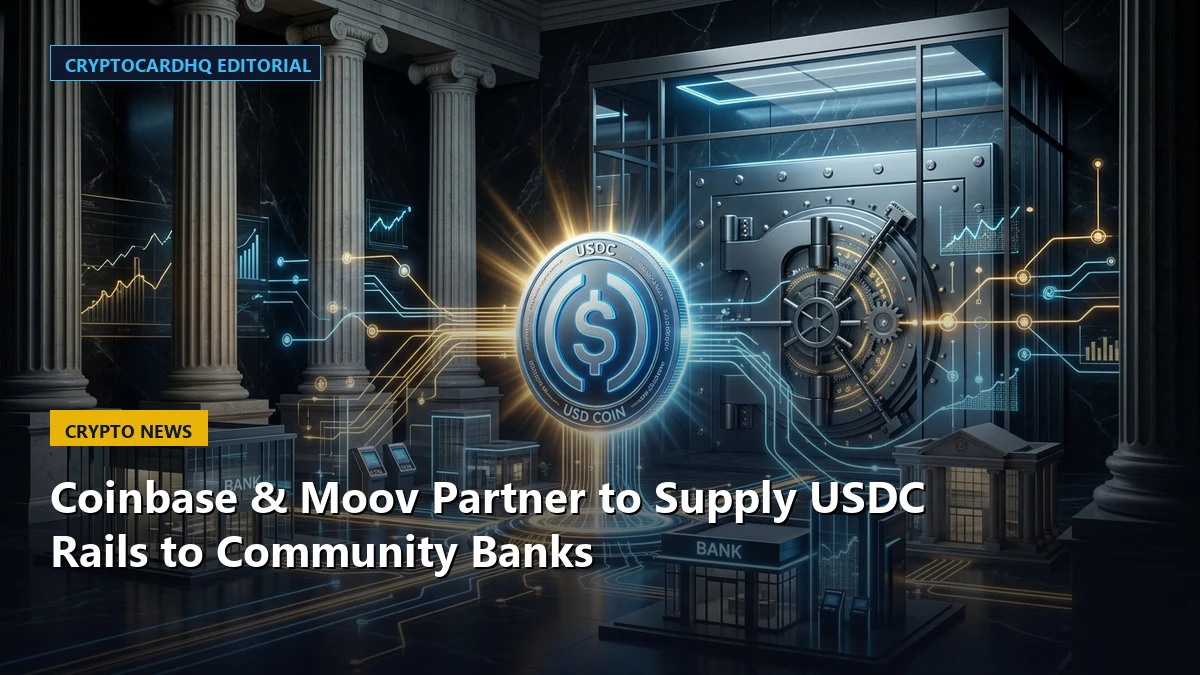
America’s regional and community banks have spent the past decade fighting a war of attrition on two distinct fronts. On one side, money-center giants like JPMorgan Chase and Bank of America have leveraged massive balance sheets and multi-billion-dollar technology budgets to capture corporate liquidity. On the other, agile payment fintechs—from Stripe to Block—have gradually eroded local institutions' merchant processing margins and commercial treasury accounts. A new strategic alliance between Coinbase and payment infrastructure engine Moov aims to level that playing field by embedding tokenized digital dollar rails directly into standard commercial banking platforms.
What Happened
Under the partnership, Coinbase is integrating its institutional crypto infrastructure directly into Moov’s developer-focused payment platform. The joint framework provides US community banks, regional lenders, and credit unions with turnkey access to Circle’s USD Coin (USDC). By embedding stablecoin payment rails directly into existing core banking software, local financial institutions can now execute 24/7/365 settlement, offer real-time cross-border remittances, and process merchant clearing in digital dollars—all without building custom blockchain architecture or holding unhedged digital assets on their balance sheets.
The initiative represents a pragmatic shift in how mainstream banking systems interact with tokenized dollars. Rather than forcing conservative bank executives to navigate complex smart contract environments or manage private key custody natively, the Coinbase-Moov integration wraps blockchain settlement inside the familiar regulatory and technical interfaces of traditional commercial banking.
To understand why this partnership is emerging now, one must look at the structural vulnerabilities plaguing the US regional banking stack.
For decades, community banks relied on a reliable revenue loop: gathering low-cost retail deposits and deploying them into local commercial loans, mortgage portfolios, and short-term paper. However, the modernization of payment networks exposed serious operational friction. Standard Automated Clearing House (ACH) transactions remain subject to multi-day batch processing cycles, while Fedwire operates on restricted business-hour windows and charges hefty per-transaction fees.
When corporate treasurers and mid-market merchants require instantaneous weekend settlement or low-cost cross-border payments to international suppliers, legacy bank rails fall short. Commercial clients increasingly migrate those treasury balances to non-bank fintech platforms or large money-center banks with custom real-time gross settlement (RTGS) capabilities.
| Architectural Dimension | Legacy Correspondent Banking Stack | Integrated Moov + Coinbase USDC Stack |
|---|---|---|
| Settlement Velocity | 1 to 3 business days via ACH / Fedwire | Near-instant / sub-second on-chain finality |
| Operating Availability | Limited to traditional banking hours | 24/7/365 continuous programmable availability |
| Intermediary Costs | High correspondent fees & wire spreads | Flat, near-zero smart contract transaction fees |
| Counterparty Path | Multi-hop correspondent bank ledger sync | Direct API call with automated fiat-to-USDC conversion |
Moov, which provides modular payment software allowing financial institutions to receive, store, and disburse funds via a single API, serves as the intermediary bridge. By connecting Moov’s orchestrator directly to Coinbase’s liquidity engine and wallet architecture, community banks can interface with public blockchains via standard REST APIs.
The macro implications are significant:
- 1Treasury Deposit Retention: By enabling corporate clients to move funds 24/7 via USDC, regional banks eliminate the incentive for treasurers to move liquidity off-platform during weekends or bank holidays.
- 2Core Integration Compatibility: The joint platform connects into legacy core banking providers (such as Jack Henry, FIS, and Fiserv) without requiring institutions to rewrite their base accounting ledgers.
- 3Disintermediation Defense: Local acquirers can offer local merchants instant settlement at a fraction of standard credit card interchange fees, keeping merchant processing business within the community banking ecosystem.
Market Reaction and On-Chain Data
Initial market sentiment across both traditional fintech desks and crypto-native trading desks has centered on the structural volume shift this integration could drive toward regulated stablecoins.
Until recently, institutional stablecoin volume was heavily concentrated in speculative trading setups and offshore capital flight. However, off-chain to on-chain payment rails have steadily matured. USDC volume has increasingly migrated toward programmatic settlement and corporate treasury management.
By integrating Coinbase’s deep order books and institutional liquidity pools, community banks gain access to tight conversion spreads between fiat USD and USDC. When a commercial client initiates a cross-border wire via their local bank's Moov-powered portal, the system converts fiat to USDC on the back end, transmits the tokens over low-cost blockchain layers (such as Base or Solana), and converts the funds back into local fiat at the receiving institution within seconds.
The Coinbase-Moov integration marks the transformation of stablecoins from speculative trading instruments into a frontline defensive asset for regional banks seeking instant, 24/7 liquidity.
From a liquidity perspective, this model minimizes systemic market risk for participating institutions. Community banks do not need to maintain volatile crypto positions; instead, they utilize Coinbase as an instant execution layer where digital dollars function strictly as a transient settlement instrument.
Operational Comparison: Legacy Rails vs. Moov-Coinbase USDC Settlement
| Operational Metric | Legacy ACH / Domestic Wire | Legacy SWIFT International | Moov + Coinbase USDC Rail |
|---|---|---|---|
| Settlement Speed | 1 to 3 Business Days | 2 to 5 Business Days | Sub-minute / Near Instant |
| Availability | Mon–Fri, Standard Hours | Business Hours Across Time Zones | 24/7/365 Continuous |
| Average Cost Structure | $15 – $30 per wire | $35 – $75 + FX Spread | Fraction of a cent to $0.50 |
| Counterparty Friction | Multiple Intermediary Banks | Correspondent Banks Required | Direct Cryptographic Verification |
| Balance Sheet Risk | None | FX Volatility Exposure | Instant Conversion (Fiat-to-Fiat) |
What It Means for Crypto Cards & Everyday Spending
While the underlying plumbing of the Coinbase-Moov partnership is institutional, its structural effects ripple directly into retail banking, merchant acquiring, and point-of-sale dynamics.
For commercial small businesses—such as local manufacturing plants, agricultural suppliers, and regional e-commerce merchants—the capability to clear payments on a continuous basis drastically alters cash-flow management. Under legacy clearing systems, a merchant selling goods on Friday afternoon might not see settled fiat capital hit their working balance until Tuesday morning. Under the integrated USDC stack, those funds clear instantaneously, freeing up working capital and reducing dependence on expensive short-term lines of credit.
This infrastructure shift also intersects directly with consumer-facing financial products and modern card programs:
- Lower Interchange Drag: Instant stablecoin settlement allows local acquirers to offer lower transaction processing rates to regional merchants, creating competitive pressure on traditional credit card networks.
- Hybrid Card Programs: Regional banks can now launch dual-currency debit and credit products that settle against both standard FDIC-insured demand deposits and stablecoin balances seamlessly. Consumers looking to evaluate market-leading card products can browse our updated benchmark of the best crypto cards.
- Cross-Rail Interoperability: Merchants utilizing Moov’s infrastructure can accept digital asset payments at checkout while receiving fiat USD in their account instantly, bypassing complex accounting overhead. To see how various providers compare on real-time execution fees and conversion spreads, check out our interactive crypto card comparison tool.
Furthermore, as stablecoins gain traction as an underlying payment network for domestic FIs, macroeconomic focus remains anchored on how reserve assets like Bitcoin interact with payment infrastructure. While USDC serves as the primary transactional medium due to its dollar peg, broader market liquidity dynamics continue to be tracked via our dedicated Bitcoin news hub, which monitors asset flows between stores of value and transactional rails.
Where the Risk Hides
Despite the obvious operational efficiencies, the integration of public blockchain rails into community banking systems introduces legal, technical, and balance-sheet risks that risk managers must navigate carefully.
| Risk Category | Primary Operational Threat | Bank-Grade Risk Mitigation |
|---|---|---|
| Regulatory Compliance | FDIC, OCC, and BSA/AML scrutiny on stablecoin balances | Real-time transaction surveillance and automated FinCEN reporting |
| Operational Reliability | API dependencies, RPC nodes, and smart contract bugs | Redundant node clustering and automatic fallback to FedNow/ACH rails |
| Deposit Run Risk | Accelerated flight-to-safety outflows during panic | Granular treasury limits, dynamic collateral, and circuit breakers |
1. Regulatory Scrutiny & Legal Uncertainty
While regulatory clarity regarding payment stablecoins has improved, federal regulators—including the Federal Reserve, FDIC, and Office of the Comptroller of the Currency (OCC)—maintain rigorous oversight regarding bank-affiliated digital asset activities.
Bank compliance officers must ensure that real-time USDC transactions strictly adhere to Bank Secrecy Act (BSA) and Anti-Money Laundering (AML) standards. Transaction monitoring across public blockchains requires sophisticated chain-analytics integration to prevent illicit address interactions—an operational burden that smaller institutions must outsource entirely to partners like Coinbase.
2. Deposit Friction and Liquidity Acceleration
One unintended consequence of continuous, 24/7 liquidity is the acceleration of potential deposit flight during market panics.
In a traditional banking framework, friction in the ACH and wire systems acts as an operational speed bump during stress events. If commercial clients can convert and transfer millions of dollars in treasury capital into self-custodial USDC wallets in seconds outside of banking hours, regional banks could face accelerated liquidity runs during localized credit scares.
3. FDIC Insurance Boundaries
A key point of consumer and business confusion involves deposit insurance boundaries.
While fiat deposits held at an FDIC-insured community bank are covered up to standard statutory limits ($250,000 per depositor), funds converted into USDC and transferred onto public blockchains exit the FDIC safety net. If an intermediary issuer or smart contract infrastructure fails, holders of tokenized dollars face balance-sheet exposure that traditional bank deposits do not carry. Institutions must maintain transparent disclosure standards to prevent misleading commercial clients regarding where coverage ends.
A Practical Checklist for Users
Whether you are a commercial banking customer, a retail depositor, or a business owner evaluating tokenized payments, here is an actionable roadmap for navigating this shift:
- 1Audit Your Bank's Settlement Capabilities: Ask your business banker if your institution supports real-time API settlement via Moov or similar middleware to reduce pending merchant balances over weekends.
- 2Review FDIC Disclosures Carefully: Ensure you clearly understand which portions of your balance reside in FDIC-insured demand deposits versus non-insured, tokenized stablecoin rails during transit.
- 3Optimize Cash-Flow Windows: Commercial treasurers should leverage 24/7 USDC execution to negotiate better supplier terms by offering instant vendor payouts on weekends.
- 4Compare Card Payment Mechanics: If you utilize payment cards linked to digital assets, verify whether backend execution converts assets at point-of-sale or pre-settlement to avoid hidden FX spreads.
Our takeaway
The partnership between Coinbase and Moov highlights a critical evolution in financial infrastructure: the quiet integration of public blockchain rails into traditional banking software. Rather than replacing traditional banks, stablecoins are becoming an essential component of their underlying technical architecture.
By enabling community banks to move digital dollars without taking direct crypto exposure onto their balance sheets, this alliance provides local lenders with a powerful tool to defend their liquidity against both Wall Street giants and Silicon Valley fintechs. For everyday consumers and business owners, it signals a future where money moves with the same continuous speed as the internet itself—securely, instantly, and around the clock.
How does the Coinbase-Moov partnership work for community banks?
The partnership integrates Coinbase’s crypto liquidity engine and USDC infrastructure into Moov’s API-driven payment platform. This allows regional banks and credit unions to offer 24/7 real-time settlement, cross-border payments, and merchant clearing using stablecoins directly within their existing banking interfaces.
Do participating community banks have to hold crypto on their balance sheets?
No. The integrated system allows financial institutions to use USDC purely as a transient settlement rail. Fiat currency is converted to USDC, transmitted across the blockchain, and converted back into fiat currency almost instantaneously, eliminating balance-sheet digital asset volatility risk for the bank.
How does this affect everyday merchants and small business bank customers?
Small businesses receive faster access to capital. Instead of waiting several business days for credit card or wire settlements to clear over weekends and holidays, merchants can achieve sub-minute 24/7 settlement finality at significantly reduced transaction fees.
Are USDC balances stored through this system covered by FDIC insurance?
No. Traditional bank deposits held in checking or savings accounts are FDIC-insured up to $250,000 per depositor. However, once funds are converted into USDC and held or moved on a blockchain ledger, they fall outside the FDIC insurance system. Banks utilizing this technology are required to clearly communicate these regulatory boundaries to clients.