

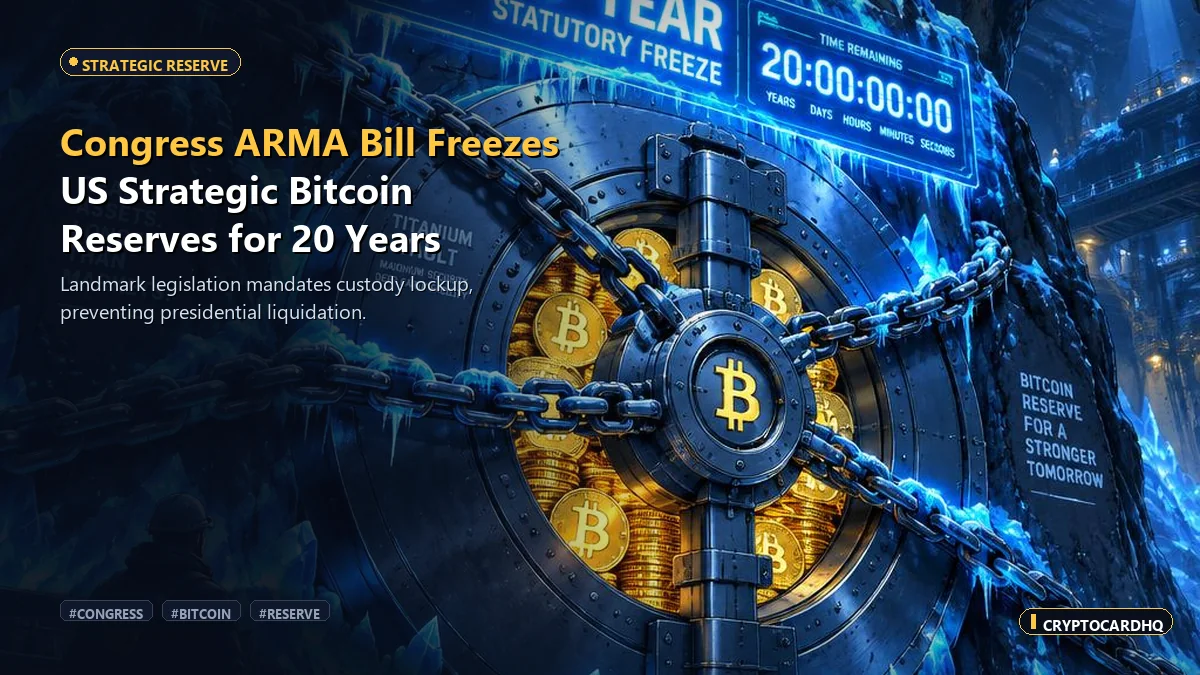
Capitol Hill just delivered a massive structural shock to the digital asset market. In a decisive vote, lawmakers passed the ARMA bill, imposing a strict statutory freeze on qualifying federal Bitcoin reserves for the next twenty years upon formal enactment. By locking up sovereign holdings for two decades, Congress effectively erased the multi-billion-dollar supply overhang that has dogged spot markets for years, setting up a de facto strategic sovereign lockup.
Key Takeaways
- 20-Year Legal Lockup: ARMA legally prohibits any sale or auction of qualifying federal Bitcoin reserves for two decades post-enactment.
- Mandatory Annual Audits: The statute requires rigorous, publicly accessible annual audits detailing all seized and held sovereign Bitcoin treasuries.
- Treasury Purchases Under Review: Direct sovereign open-market purchases remain under formal legislative review rather than immediate execution.
- Supply Overhang Erased: Removes the constant threat of spot-market dumping from high-profile civil and criminal asset forfeitures.
Market Snapshot at Time of Reporting: BTC traded at $76,847.67 (+1.45% 24h | Range: $75,064.82 - $77,179.47).
Immediate Market Reaction and Order Book Repositioning
Trading desks did not hesitate. The moment the wire crossed, spot order books thinned out across major institutional execution venues as market makers pulled down their ask walls. Derivatives traders were caught off guard. Perpetual swap venues experienced sharp short squeezes within minutes as automated strategies stripped out their long-standing sovereign auction discounts.
For nearly a decade, traders lived with an invisible ceiling. Every few quarters, news broke that the U.S. Marshals Service was preparing another tranche of forfeited coins for auction, sparking panic selling and localized price drops. As explored during earlier legislative movement in CryptoCardHQ's coverage of congressional crypto deals, legislative clarity impacts liquidity far faster than central bank rate decisions. Over the next 24 to 48 hours, market participants must navigate heightened spot volatility, basis widening between physical spot and futures contracts, and forced liquidations across unhedged short desks that assumed sovereign supply would keep leaking into exchanges.
Inside the ARMA Legislation: Core Mandates
The passage of ARMA marks an abrupt break from decades of standard asset forfeiture policy, as reported by CryptoSlate. Federal agencies previously treated seized cryptocurrencies like perishable goods, routing them through administrative forfeiture channels and liquidating them via sealed-bid auctions or direct custodial exchange sales.
Under ARMA's statutory framework, qualifying sovereign holdings move into an untouchable escrow architecture for twenty years. The bill establishes two main pillars: 1. Statutory Custodial Freeze: Strict legal ban stopping federal agencies from selling, liquidating, or entering private exchange tenders for qualifying Bitcoin reserves for twenty years. 2. Mandatory Custody Audits: Directs federal comptrollers to publish transparent, audited reports detailing cold-storage addresses, chain of custody verification, and precise coin balances.
Critically, lawmakers drew a line between freezing existing assets and launching new buy programs. Rather than mandating immediate sovereign accumulation on secondary markets, the bill directs committees to run formal economic impact assessments. These studies will examine how ongoing federal market purchases could influence currency reserves and international settlement.
Macro Repercussions and Sovereign Game Theory
This statutory freeze rewires the geopolitical playbook for sovereign digital assets. Until today, governments holding confiscated digital tokens faced an uncomfortable dilemma: liquidate early to pocket fiat revenue, or hold and endure political heat over custodial security. Washington has now set a firm 20-year lockup precedent, pulling hundreds of thousands of coins completely out of circulating supply.
This development accelerates trends highlighted in CryptoCardHQ's report on institutional Bitcoin adoption, where corporate balance sheets continue locking up secondary float. When the world's preeminent financial superpower legally forbids itself from selling its stash for two decades, every rival sovereign treasury faces real pressure. Foreign finance ministries must now decide whether to match this reserve posture or concede a compounding monetary advantage.
Operational Breakdown: Pre-ARMA vs. Post-ARMA Mandate
| Operational Dimension | Pre-ARMA Legal Protocol | ARMA Statutory Mandate | Structural Market Impact |
|---|---|---|---|
| Asset Disposition | Discretionary public auctions via U.S. Marshals | 20-year legal lockup upon enactment | Eliminates risk of sovereign spot market dumps |
| Custodial Auditing | Fragmented departmental disclosures | Mandated annual audited reporting | Delivers absolute custody verification for institutions |
| Treasury Acquisition | Ad-hoc civil and criminal forfeitures only | Active buying under formal legislative study | Lays ground rules for future strategic reserve programs |
| Volatility Premium | Chronic discounting due to auction overhang | Overhang discount completely neutralized | Compresses downside structural market volatility |
Custodial Realities and Implementation Hurdles
While eliminating auction overhang is overwhelmingly constructive for price discovery, freezing sovereign assets for twenty years introduces serious operational questions:
- Vault Architecture & Key Governance: Securing tens of billions of dollars across multiple presidential administrations demands multi-signature, multi-institution threshold cryptography that outlasts political cycles and bureaucratic churn.
- The Acquisition Waiting Period: By putting active accumulation into study committees rather than buying immediately, Congress leaves the door open for private balance sheets and foreign entities to absorb remaining market liquidity.
- Classification Disputes: The 20-year clock starts the moment the bill receives executive signature. Regulatory agencies will need to draft clear classification rules defining exactly which civilly and criminally forfeited assets qualify as federal reserves.
What This Means for Everyday Crypto Holders
For everyday investors, Washington's shift from an active seller to a locked custodian changes long-term supply math. It validates Bitcoin as an enduring balance-sheet asset at the highest tier of government.
- Short-Term Caution: Expect choppy price action and aggressive whipsaws over the next 24 to 48 hours as algorithmic engines recalculate available float. Keep leverage low.
- Managing Everyday Liquidity: While governments lock down reserves for decades, retail participants need flexible access to capital. If you want to spend and earn rewards without selling off core holdings, check out our Best Crypto Cards guide for practical everyday spending options.
- Monitoring Policy Shifts: Track ongoing regulatory developments in our Bitcoin Macro & Geopolitics News category as other nation-states prepare their own legislative answers to the ARMA freeze.
Key Catalysts to Watch
- Executive Signing & Enactment: The official presidential signature that starts the twenty-year countdown clock.
- Agency Audit Guidelines: Rules establishing which independent auditors and federal watchdogs verify on-chain storage balances.
- Reserve Acquisition Hearings: Findings from congressional studies evaluating direct federal Bitcoin market purchases.
- Global Policy Responses: Announcements from foreign central banks and G7 treasuries responding to the U.S. sovereign reserve freeze.