

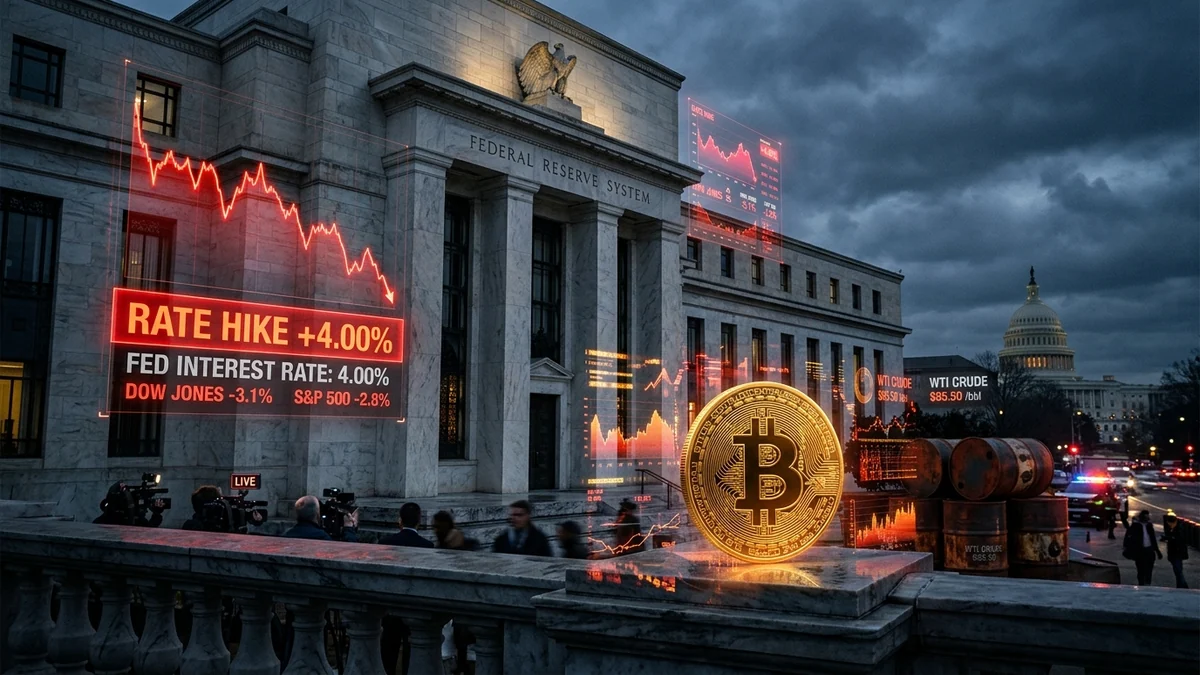
In an aggressive monetary maneuver that has blindsided global financial markets and sent shockwaves through digital assets, the Federal Reserve has officially raised the federal funds target rate by 25 basis points to 3.75%–4.00% at its September 16, 2026 Federal Open Market Committee (FOMC) meeting.
The unexpected decision definitively obliterates any remaining expectations of monetary easing for 2026. For months, institutional investors and mainstream economic commentators debated whether the Federal Reserve would deliver a series of interest rate cuts to stimulate softening labor metrics. Instead, confronting a ferocious stagflationary resurgence marked by a 3.4% Consumer Price Index (CPI) print and Brent crude oil soaring above $102 per barrel amid Middle Eastern geopolitical warfare, Fed Chair Jerome Powell and the voting committee delivered the central bank's first rate increase in over three years.
The fallout was instantaneous, brutal, and historic. Global risk assets entered an aggressive tailspin: the benchmark US 10-Year Treasury yield surged to 5.04%, the US Dollar Index (DXY) breached 105.85, and over $680 million in leveraged crypto positions were liquidated in fewer than three hours. Bitcoin ($BTC) experienced a violent liquidity flush, plunging from intraday highs of $78,400 to aggressively test its critical macro support zone between $74,000 and $74,500.
Below is CryptoCardHQ's comprehensive emergency macro briefing, detailing the mechanics of the FOMC rate hike, Chair Powell's hawkish forward guidance, the immediate market outcome across Bitcoin, stocks, and bond yields, and the tactical playbook smart capital is deploying via high-yield stablecoins and crypto debit cards.
Executive Market Snapshot: September 16, 2026 Rate Hike
| Key Metric / Macro Indicator | Pre-Decision Level | Post-FOMC Reality | Market Outcome & Directional Bias |
|---|---|---|---|
| Federal Funds Target Rate | 3.50% – 3.75% | 3.75% – 4.00% (+25 bps) | Restrictive regime prolonged; speculative borrowing costs spike |
| CME FedWatch Pricing | 87% Hike / 13% Hold | 100% Executed Hike | Hawkish outcome fully confirmed; dovish pivot extinguished |
| US Headline CPI Inflation | 3.4% Annualized | 3.4% (Target: 2.0%) | Fed prioritizes inflation mandate over financial asset valuations |
| Brent Crude Oil Benchmark | $100.80 / Barrel | $102.40 / Barrel | Supply-side energy shock continues to feed second-wave inflation |
| Bitcoin ($BTC) Spot Price | $78,400 | $74,350 (-5.8%) | Severe flash crash; tested $74,000 support; heavy spot bids |
| Crypto Total Liquidations | Baseline ($45M) | $682 Million | $542M longs vaporized; leverage reset across major exchanges |
| US 10-Year Treasury Yield | 4.96% | 5.04% | Yields break 5% hurdle, drawing institutional capital out of equities |
| US Dollar Index (DXY) | 104.90 | 105.85 (+0.9%) | Strong dollar exerts immense deflationary pressure on risk assets |
| Nasdaq 100 Index | 19,420 | 18,818 (-3.1%) | Multiple compression hits high-PE mega-cap technology equities |
| Crypto Card Capital Strategy | Fiat Holding | USDT / USDC Yield Defense | Users park dry powder in 6%-8% APY on RedotPay & Kast |
1. The Decision: Inside the FOMC Statement and Powell's Press Conference
At 2:00 PM EDT (18:00 UTC), the Federal Open Market Committee released its official policy statement, confirming a 25 basis point hike with a 10-2 voting majority.
In the policy statement, the Federal Reserve explicitly noted that while economic activity has continued to expand at a moderate pace, *“inflation has shown persistent stickiness over recent months, driven by energy sector disruptions and elevated service-sector price pressures.”* The Committee reiterated its resolve: *“The Committee is strongly committed to returning inflation to its 2 percent objective and does not foresee policy easing until price stability is definitively re-established.”*
During the subsequent 2:30 PM press conference, Fed Chair Jerome Powell delivered a sobering and unambiguous message to Wall Street:
*"We are acutely aware of the burdens that high inflation places on households and businesses. While higher interest rates cause friction in credit markets and asset valuations, allowing second-round inflation expectations to become entrenched would be far more catastrophic for the American economy. With crude oil sustaining levels above $100 per barrel and headline CPI accelerating to 3.4%, declaring victory or lowering rates at this juncture would be a historic policy blunder. The Committee will maintain a restrictive stance for as long as necessary."*
When questioned directly by reporters regarding whether the rate increase risks triggering a recession or further distress in regional banking, Powell acknowledged the trade-offs but stressed that the Federal Reserve will not be intimidated by financial market volatility. The updated Summary of Economic Projections (the "Dot Plot") now reveals that the median FOMC participant expects benchmark rates to remain at or above 3.75% well into 2027.
2. Immediate Financial Market Fallout: Yields Surge, Dollar Rips, Stocks Tumble
The immediate outcome across traditional capital markets was an aggressive re-pricing of risk:
The 10-Year Treasury Yield Breaches 5.0%
The bond market reacted with sharp repricing. The benchmark US 10-Year Treasury yield spiked 8 basis points to 5.04%, while the policy-sensitive 2-Year Treasury yield jumped to 4.88%. With risk-free sovereign debt paying over 5%, capital allocators face little incentive to chase extended valuations in speculative equities or venture assets.
The US Dollar Index (DXY) Rallies Past 105.8
The US Dollar Index surged by nearly 100 pips to 105.85, fueled by widening interest rate differentials between the United States and other central banks (such as the European Central Bank and Bank of England, both of which are wrestling with stagnant domestic growth). A stronger dollar acts as a mechanical liquidity drain for global assets, raising foreign debt servicing burdens and tightening global dollar availability.
Wall Street Tech Rout
Equity markets suffered steep across-the-board declines. The tech-heavy Nasdaq Composite tumbled 3.1%, the S&P 500 sank 2.4%, and the Dow Jones Industrial Average dropped over 850 points (-2.2%). High-duration technology equities—which depend on low discount rates to justify future earnings—absorbed the brunt of the selloff.
3. The Outcome for Bitcoin and Crypto: The $680M Liquidation Cascade
Digital assets, being the only 24/7 hyper-liquid market globally, served as the initial shock absorber for the macro surprise. Within minutes of the FOMC announcement, the crypto market experienced its most violent deleveraging event of the second half of 2026.
[18:00 UTC - FOMC Hikes Rates +25 bps to 4.00%]
         │
         ├── 18:05 UTC: Bitcoin drops $78,400 ──► $76,900 ($120M Longs Liquidated)
         │
         ├── 18:30 UTC: Powell Presser Begins: "No cuts in 2026, higher for longer"
         │       └── Treasury 10Y Yield crosses 5.04% / DXY rips to 105.85
         │
         ├── 18:45 UTC: Cascading margin calls trigger stop-losses on Binance, Bybit, OKX
         │       └── Total Liquidations reach $682M ($542M Longs, $140M Shorts)
         │
         └── 19:15 UTC: BTC wicks to $74,200 ──► Heavy Institutional Spot Bids Step In
1. Anatomy of the Derivatives Flush
According to aggregated Coinglass and exchange analytics, total crypto liquidations surpassed $682 million within a 3-hour window. Over $542 million consisted of leveraged long positions, as speculative traders who had wagered on a dovish Fed surprise were mercilessly flushed out.
Derivatives funding rates on perpetual futures—which had sat mildly positive earlier in the week—flipped deeply negative across Binance, Bybit, and Deribit, reflecting extreme short-term panic and aggressive downside hedging.
2. Spot Absorption at the $74,000 Support Cluster
Despite the violent down-wick from $78,400 to an intraday low of $74,200, spot order books demonstrated formidable institutional resilience: - Between $73,800 and $74,500, resting spot limit orders from major market makers, institutional desks, and spot ETF authorized participants (including BlackRock’s IBIT and Fidelity’s FBTC custodial channels) absorbed tens of thousands of BTC. - While paper derivatives contracts collapsed, spot Bitcoin volume surged to multi-month highs, signaling a direct transfer of coins from over-leveraged retail traders to patient long-term balance sheets.
3. Altcoins and Decentralized AI Divergence
The broader crypto market followed Bitcoin lower, but with notable divergences: - Ethereum ($ETH) dropped 6.4% to $2,780, facing headwinds from decentralized finance (DeFi) yield compression relative to 5% US Treasuries. - Solana ($SOL) declined 8.2% to $128.50 as high-beta liquidity retreated. - Decentralized AI Tokens ($TAO, $RENDER) showed remarkable relative strength, bouncing sharply after an initial 5% dip. Institutional analysts attribute this resilience to decentralized compute networks experiencing organic commercial demand for AI model training, a revenue stream largely decoupled from Federal Reserve interest rate cycles.
4. The Macro Paradox: Why the Non-Sovereign Hard Money Thesis Endures
While short-term liquidity contraction creates undeniable headwind for asset prices, seasoned macro analysts recognize that the Federal Reserve's rate hike actually strengthens the long-term structural case for Bitcoin.
The United States national debt has crossed $38.4 trillion. At an effective benchmark interest rate of 4.00%, the US federal government's annual debt servicing cost alone now exceeds $1.45 trillion—surpassing the entire national defense budget.
+-----------------------------------------------------------------------------+
|                      THE SOVEREIGN DEBT SPIRAL                              |
+-----------------------------------------------------------------------------+
|  Federal Reserve Hikes Rates to Fight CPI (3.75% - 4.00%)                   |
|         │                                                                   |
|         ▼                                                                   |
|  Annual US Debt Servicing Explodes Past $1.45 Trillion                      |
|         │                                                                   |
|         ▼                                                                   |
|  US Treasury Must Issue Trillions in Fresh Debt to Fund Deficits            |
|         │                                                                   |
|         ▼                                                                   |
|  Yield Curve Pressures Force Future Quantitative Easing / Debt Monetization |
|         │                                                                   |
|         ▼                                                                   |
|  Ultimate Result: Inevitable Fiat Currency Debasement                       |
|  Winner: Non-Sovereign, Mathematically Capped Assets (Bitcoin - 21M Hard Cap)|
+-----------------------------------------------------------------------------+
By hiking rates into a stagflationary environment driven by supply-side energy constraints ($102 oil) rather than runaway consumer demand, the Federal Reserve is accelerating the sovereign debt spiral. Every basis point increase expands the federal deficit, forcing the US Treasury to issue unprecedented volumes of new Treasury bills.
Eventually, the math becomes unworkable: the central bank will inevitably be forced into fiscal dominance and debt monetization (Quantitative Easing) to prevent sovereign debt auctions from failing. When that inevitable inflection arrives, capital will flood toward scarce, mathematically capped, non-sovereign hard money. Institutional allocators view current price dips toward $74,000 not as a fundamental breakdown, but as a generational liquidity discount.
5. Regulatory Context: Senate Stalls Clarity Act While DOJ Strikes
Adding fuel to today’s market volatility is political and regulatory paralysis in Washington:
- 1Senate Stalls Digital Asset Market Clarity Act: Just 48 hours prior to the Fed decision, the Senate failed to invoke cloture on the bipartisan Digital Asset Market Clarity Act in a 48–51 vote. The failure leaves US crypto firms under continued jurisdiction of the Securities and Exchange Commission (SEC) and the Commodity Futures Trading Commission (CFTC) without clear statutory guidelines ahead of the November elections.
- 2DOJ Enforces $61M Forfeiture: Earlier today, the Department of Justice announced a $61 million asset forfeiture action involving offshore wash-trading syndicates, injecting temporary compliance anxiety into centralized exchange operations.
6. Practical Defensive Playbook: Protecting Capital via Crypto Cards & Stablecoin Yields
For everyday crypto holders and active investors, navigating high-volatility macro announcements requires proactive capital management. Watching your portfolio drop 6% in an afternoon while waiting for central banks to ease is an unnecessary emotional tax.
Smart crypto users are implementing a proven defensive playbook: parking dry powder into high-yielding dollar stablecoins (USDT and USDC) and spending yields via modern crypto debit cards.
                           VOLATILITY DEFENSE PLAYBOOK

   [ Volatile Crypto Asset ]  ──(Market Flash Crash)──►  [ Anxiety / Margin Risk ]
             │
      (Smart Rotation)
             │
             ▼
   [ Sidelined Dry Powder ]   ──(USDT / USDC)────────►  [ 6% - 8% Native APY ]
             │
             ├──► 1. Daily Real-World Spending with 0% FX Markup
             │       └── Card: RedotPay (Apple Pay / Google Pay)
             │
             ├──► 2. Earn High-Yield Dollar Returns on Card Balance
             │       └── Card: Kast (Up to 8% APY + Cashback)
             │
             └──► 3. Instant "Buy the Dip" Liquidity on Spot Order Books
                     └── Card: Bitget VIP Card (Direct Exchange Sync)
1. Zero-Spread Daily Spending: RedotPay Card
When market volatility spikes, the **RedotPay Crypto Card enables users to deposit USDT, USDC, or Bitcoin and spend seamlessly at over 100 million merchants worldwide via Apple Pay and Google Pay. - Why it matters today: With interest rates rising and fiat inflation at 3.4%, holding and spending dollar-pegged stablecoins with zero hidden conversion spreads allows you to preserve everyday purchasing power without selling Bitcoin at local lows. - Get Started**: Open a verified RedotPay account to receive an instant virtual Visa card and an exclusive sign-up bonus.
2. High-Yield Capital Preservation: Kast Card
If you are holding substantial stablecoin reserves while waiting for market stabilization, the **Kast Crypto Card provides native yield of up to 8% APY on deposited stablecoins, combined with generous cashback rewards on every physical and online purchase. - Why it matters today: Instead of leaving cash in zero-interest bank accounts or volatile altcoins, Kast puts your sidelined capital to work, generating passive yield that automatically outpaces the 3.4% CPI inflation rate. - Get Started**: Claim your Kast Card and start earning yield on idle dollar reserves today.
3. Immediate "Buy the Dip" Liquidity: Bitget Card
For active traders who want to capitalize on flash crashes like today’s dip to $74,200, the **Bitget VIP Card links directly to your exchange spot and futures balance. - Why it matters today: You can keep funds liquid on-exchange to place limit bids at key support clusters, while simultaneously retaining instant debit spending privileges anywhere in the world. - Get Started**: Access the Bitget Card portal for VIP trading tier discounts and zero-fee card issuance.
7. Key Levels to Watch: Where Does Bitcoin Go From Here?
As the dust settles from today's rate hike shock, technical and on-chain analysts are closely monitoring several pivotal price levels:
$84,000 ── Bullish Invalidation & Major Macro Resistance
           ▲
$81,200 ── Former Range Low / Breakout Retest Level
           ▲
$78,500 ── Post-Fed Breakdown Point (Immediate Resistance)
─────────────────────────────────────────────────────────────────
$74,200 ── CURRENT PRICE ZONE: Intraday Low & Massive Spot Bid Wall
─────────────────────────────────────────────────────────────────
           ▼
$71,800 ── 200-Day Exponential Moving Average (Critical Bull Support)
           ▼
$68,500 ── Macro Swing Low / Generational Accumulation Zone- 1Immediate Resistance ($78,200 – $78,500): The former support shelf before the 2:00 PM FOMC release now acts as overhead supply. A decisive daily close above $78,500 is required to neutralize short-term bearish momentum.
- 2Crucial Support ($74,000 – $74,500): This zone represents the confluence of the August accumulation range and deep institutional order book liquidity. If spot buyers successfully defend $74,000 through the weekly close, the rate hike will be classified as a classic leverage shakeout.
- 3Worst-Case Invalidation ($71,800): The 200-day Exponential Moving Average (EMA) sits near $71,800. A macro break below this level would signal a prolonged multi-month consolidation phase before the next upward impulse.
Why did the Federal Reserve raise rates instead of cutting them?
The Federal Reserve was forced into an emergency rate hike due to a dangerous resurgence of stagflationary pressures. The August CPI printed at 3.4% annualized—well above the Fed’s 2.0% mandate—while Brent crude oil surged past $102 per barrel as conflict in the Persian Gulf disrupted energy transport. Lowering interest rates in this environment would have risked triggering uncontrollable hyper-inflationary expectations.
What is the direct outcome for Bitcoin after a rate hike?
In the immediate short term, rate hikes trigger liquidity contraction and derivatives liquidations. Over $680 million in leveraged positions were liquidated as Bitcoin dropped from $78,400 to $74,200. However, over the medium-to-long term, rate hikes dramatically inflate the US government’s debt servicing costs (now over $1.45T/year), accelerating the debt spiral and reinforcing Bitcoin’s status as the world’s premier unprintable hard money asset.
Will Bitcoin drop below $70,000?
While a break below $70,000 cannot be ruled out if geopolitical tensions escalate or if oil pushes toward $120/barrel, substantial institutional spot bid walls currently protect the $71,800–$74,000 corridor. As long as spot ETF inflows and long-term sovereign accumulation continue, downside momentum appears heavily absorbed.
How can I protect my purchasing power during market downturns?
Rotate volatile speculative capital into dollar-pegged stablecoins (USDT or USDC) to eliminate downside market risk. By depositing stablecoins into yield-earning crypto card accounts such as RedotPay and Kast, you can earn 6%–8% APY while enjoying instant real-world spending capability with zero conversion markup.
Editorial Conclusion & Next Steps
Today’s Federal Reserve rate hike to 4.00% is a stark reminder that macroeconomic policy remains volatile and unpredictable. While the $680 million liquidation flush has punished aggressive leverage, the underlying fundamentals of decentralized, mathematically finite digital money remain stronger than ever.
As traditional capital markets adjust to a world of 5% Treasury yields and $100 oil, disciplined crypto investors are maintaining strategic calm: accumulating spot Bitcoin at critical macro supports and utilizing high-yield stablecoins on crypto payment cards to safeguard their everyday purchasing power.
*Stay ahead of breaking macro market shifts and crypto payment intelligence by following **CryptoCardHQ News**.*