
If you have ever tried explaining a decentralized order book to a traditional risk committee over a lukewarm Zoom call, you already know the existential dread of modern finance. Wall Street loves the idea of crypto yields, but until recently, the banking suits treated on-chain data like a strange medieval dialect—fascinating from a distance, but entirely too hazardous to touch without a full hazmat suit.
That wall just took a sledgehammer to the face.
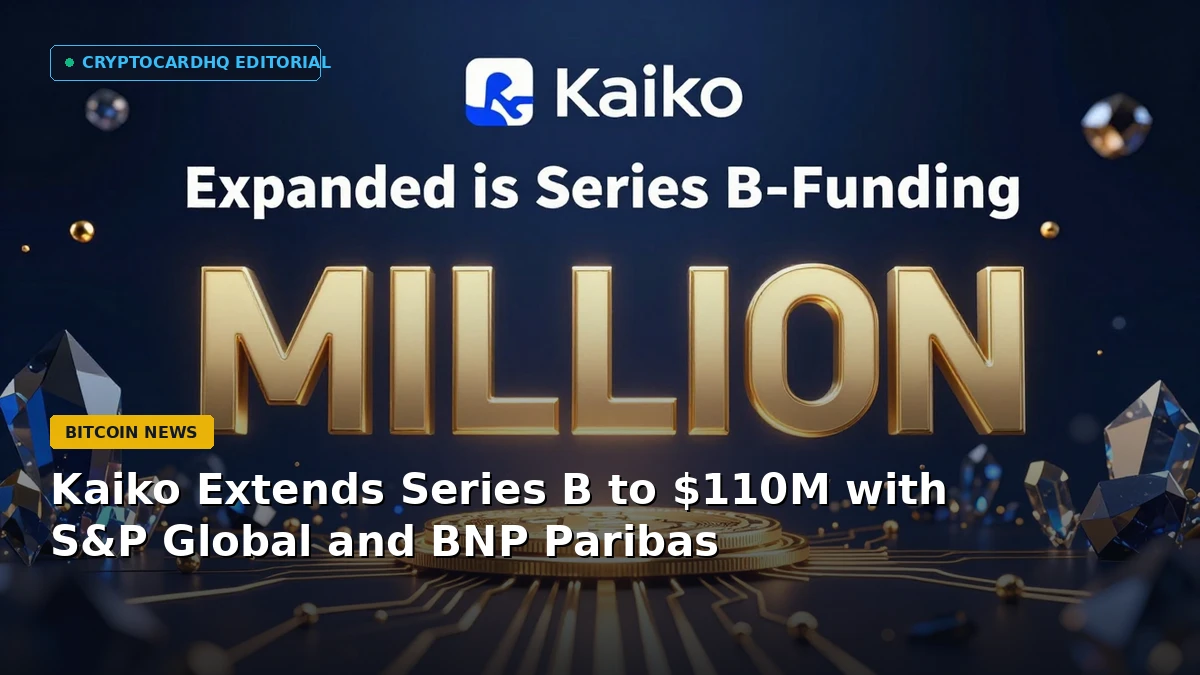
On September 14, 2026, market data provider Kaiko announced it successfully extended its Series B funding round to a cool $110 million. The real story isn't just the cash. It's the check writers. Rating titan S&P Global and legacy powerhouse BNP Paribas just stepped up to the plate, proving the old guard is finally tired of guessing what Bitcoin is doing at 3:00 AM on a Sunday.
Let's be completely candid: treating Bitcoin like a speculative casino token while ignoring institutional data infrastructure is like flying a supersonic jet using a rearview mirror. It's loud, it's thrilling, and it usually ends with everyone crying inside a Bloomberg terminal.
What Happened: Why Wall Street Needs Clean Pipes
For years, institutional adoption of digital assets hit a brick wall not because banks hated making money—let's be real, they love it—but because compliance departments broke out in hives at the mere mention of decentralized liquidity pools.
When you manage trillions of dollars in retirement funds, insurance reserves, or sovereign wealth portfolios, you can't just plug your risk models into a random Telegram trading bot. You need auditable, granular, institutional-grade data feeds. You need the exact tick-by-tick depth of Bitcoin order books across global exchanges, the exact spread basis, and the precise settlement flows.
Enter Kaiko. By pulling in strategic capital from names like S&P Global and BNP Paribas, Kaiko isn't just scaling its server racks; it's building the plumbing that connects TradFi balance sheets directly to decentralized rails. BNP Paribas doesn't write multi-million-dollar checks for fun. They need continuous, uncorrupted market data because their clients—asset managers, pension funds, and corporate treasuries—are demanding direct exposure to Bitcoin and digital assets without stepping on regulatory landmines.
This round changes the game. The bridge between Wall Street and crypto isn't being held together by duct tape anymore. It's being poured with reinforced concrete.
Market Reaction and On-Chain Data
When institutional giants back data infrastructure, the ripple effects hit liquidity pools almost instantly. Let's look at the mechanics. Cleaner data means compressed risk spreads. Compressed risk spreads mean institutional capital allocators finally feel comfortable deploying massive blocks of Bitcoin and Ethereum without suffering catastrophic slippage.
Here is how the institutional data landscape has evolved over the past few market cycles:
| Metric / Era | 2020-2021 Bull Run | 2024 Institutional Pivot | 2026 Expansion Phase |
|---|---|---|---|
| Primary Data Source | Retail aggregators & APIs | Basic exchange feeds | Verified multi-venue institutional feeds |
| TradFi Participation | Exploratory / Desks only | ETF custody integration | Direct equity & infrastructure backing |
| Order Book Depth | Fragmented & volatile | Moderate consistency | Deep, audited, low-latency streaming |
The old narrative of "crypto moves independently of traditional macro" has completely imploded. Bitcoin trades like a high-beta technology asset fused with a global monetary hedge. When macro liquidity tightens or loosens, Bitcoin reacts.
Consequently, traditional financial institutions cannot afford blind spots. S&P Global understands that credit ratings and risk assessments in a tokenized economy require the exact same rigorous data standards applied to corporate debt. By backing Kaiko, they are standardizing the metrics by which digital assets will be measured, traded, and leveraged across global banking systems.
What It Means for Crypto Cards & Everyday Spending
You might be sitting there wondering: *This is great for BNP Paribas risk officers, but how does this help me buy my morning coffee with sats?*
Fair point. Let's connect the dots between high-level institutional market data and your everyday digital wallet.
When infrastructure providers like Kaiko scale their analytics capabilities, the entire digital asset ecosystem becomes more stable. Price discovery sharpens. Exchange spreads tighten. This structural stability directly benefits anyone utilizing the best crypto cards to spend their digital assets in the real world.
Think about how a crypto debit card actually works behind the scenes. When you swipe your card at a restaurant, the issuer has to convert your Bitcoin, Ethereum, or stablecoins into fiat currency in milliseconds. If market data is fragmented, slow, or prone to manipulation, issuers have to pad their conversion rates with massive risk buffers to protect themselves against sudden flash crashes.
Cleaner, institutional-grade data feeds mean tighter spreads, lower conversion fees, and fairer exchange rates for retail users. If you want to see how different card providers stack up when executing these live fiat conversions, our crypto card comparison tool breaks down the real-world costs, fees, and network rails. Better data at the top tier trickles down into cheaper, faster, and more reliable payment rails for everyone else.
"Institutional data integration is the silent engine of crypto adoption, transforming speculative volatility into predictable, enterprise-grade financial rails."
Where the Risk Hides
Before we pop the champagne and crown BNP Paribas the kings of decentralized finance, let's inject a healthy dose of skepticism. Because if there is one thing the crypto industry excels at, it's drinking its own Kool-Aid.
First, centralization is a mixed blessing. When legacy financial giants take equity stakes in critical crypto infrastructure providers, they inevitably bring their institutional culture, regulatory paranoia, and compliance mandates with them. Purists will argue that inviting S&P Global and BNP Paribas into the heart of crypto data analytics invites regulatory capture. When the arbiters of traditional finance also control the data standards for digital assets, the boundary between permissionless innovation and TradFi oversight starts to blur.
Second, data concentration carries systemic risks. If a handful of consolidated providers dominate institutional crypto analytics, a single outage, API vulnerability, or compromised data pipeline could cascade across automated trading desks and lending protocols, triggering artificial liquidations.
We saw this movie play out in traditional finance in 2008. When rating agencies and data providers get it wrong, the shockwaves aren't confined to a single blockchain—they ripple straight through global balance sheets.
A Practical Checklist for Users
Navigating an increasingly institutionalized crypto market requires discipline. Keep these actionable steps in mind:
- ✓Audit Your Card Provider: Use transparent platforms and check issuer fees via our comparison tools to ensure you aren't paying hidden spreads built into poor data feeds.
- ✓Monitor Slippage: When trading or rebalancing portfolios during high-volatility events, rely on venues backed by deep, multi-source institutional liquidity.
- ✓Stay Informed on Regulatory Shifts: Watch how institutional data standardization impacts reporting requirements for tax and compliance frameworks.
- ✓Diversify Custody: Keep your long-term holdings in self-custody wallets while keeping only active operational funds on centralized or card-linked platforms.
Our takeaway
Cash talks, but reliable data builds empires. The $110 million injection into Kaiko is a clear signal that the financial old guard isn't trying to crush crypto anymore—they are quietly rewriting the data manual to own it. For everyday users and institutional giants alike, the maturation of market data infrastructure marks the definitive end of the Wild West era and the dawn of a structured, scalable digital asset economy.
What is Kaiko and why is this funding round significant?
Kaiko is a leading digital asset market data provider that supplies granular, institutional-grade analytics to financial institutions, exchanges, and funds. Expanding its Series B to $110 million with backers like S&P Global and BNP Paribas highlights the accelerating integration of traditional finance into crypto market infrastructure.
How does institutional market data affect retail crypto users?
Better and cleaner market data reduces volatility risks and exchange spreads. For everyday users, this translates to tighter conversion rates, lower fees, and more reliable pricing when using crypto payment cards or executing trades on decentralized and centralized venues.
Why are traditional banks like BNP Paribas investing in crypto data providers?
Legacy financial institutions need robust, auditable compliance and risk management tools before deploying capital into digital assets. By backing infrastructure providers, they ensure their operations meet regulatory standards while gaining direct access to continuous crypto market intelligence.
Does institutional backing compromise crypto's decentralization?
It's a valid debate. While institutional participation brings legitimacy, liquidity, and stability, critics argue it introduces TradFi bureaucracy and centralization risks into open-source ecosystems. However, robust data standards are ultimately necessary for mainstream financial integration.