
Metis spent years building in one of crypto’s least fashionable corners. Now, as autonomous AI agents begin to transact, pay for services, and operate independently, that contrarian decision suddenly looks remarkably well timed.
Crypto has an incurable habit of forgetting.
Projects disappear from timelines. Narratives rotate at breakneck speed. Capital instinctively floods toward whatever presents the newest ticker, the loudest launchpad, or the freshest venture capital buzzword.
Then, occasionally, the market rediscovers an established protocol and realizes something profound changed while nobody was watching.
Metis may be approaching one of those generational inflection points.
For years, most market participants knew Metis simply as another Ethereum Layer 2—one of dozens of networks competing on the commoditized battlefield of making EVM transactions slightly cheaper and faster.
That description is now fundamentally obsolete.
Behind the familiar METIS ticker, the project has spent several quiet years assembling something considerably more ambitious: a specialized, full-stack economic architecture purpose-built for a world populated not only by human end-users, but by autonomous AI agents capable of owning non-custodial wallets, purchasing real-time computation, leasing proprietary data, hiring peer agents, and conducting continuous economic trade without waiting for a human hand to click "Confirm."
And suddenly, the frontier of artificial intelligence is accelerating directly into that reality.
The defining question of this cycle is no longer whether autonomous AI agents will achieve economic relevance.
The question is this:
When billions of autonomous software agents require persistent identity, programmatic capital, decentralized inference, and instant settlement, who provides the financial rails beneath them?
Metis is positioning directly for that answer.
Yet, anchored by multi-year market apathy and historical price drawdowns, the broader crypto market is still pricing METIS like yesterday's forgotten Layer 2.
1. The AI Revolution: Moving From Talking to Transacting
The first era of consumer generative AI was essentially conversational.
You typed a prompt into a text field.
The large language model generated an answer.
ChatGPT turned that simple input-output loop into the fastest-growing consumer phenomenon in software history.
Then, foundation models learned to utilize external developer tools. They started executing Python code, browsing live web indexes, querying SQL databases, inspecting local filesystems, and triggering webhooks.
The next structural leap is vastly more consequential: Artificial Intelligence is transitioning into autonomous agency.
Instead of passively answering isolated prompts, modern agents are given broad, high-level objectives and empowered with the algorithmic autonomy to execute them end-to-end.
Consider a practical commercial scenario:
*"Launch an omnichannel marketing acquisition campaign for our new enterprise SaaS release with a $10,000 monthly budget."*
A capable autonomous agent system must research competitors in real time, hire third-party creative design models, license specialized market datasets, generate multimedia creatives, negotiate programmatic advertising inventory, monitor CPC/CAC telemetry, and dynamically reallocate treasury reserves.
There is one fatal structural bottleneck in this vision.
Money.
The legacy global banking architecture was designed exclusively for legal entities and flesh-and-blood human beings:
- Bank accounts require verified physical signatories, articles of incorporation, and Proof of Address.
- Credit cards require individual cardholders, SSNs, and fraud-detection models that immediately trigger security locks on rapid micro-charges.
- Payment gateways enforce rigid KYC/AML thresholds and charge minimum merchant fees of $0.30 plus 2.9% per swipe.
- Enterprise SaaS subscriptions require multi-step checkout forms, CAPTCHAs, and human billing authorizations.
Autonomous software agents cannot function within this legacy friction.
Crypto can.
Give an autonomous AI agent a non-custodial cryptographic keypair, and it immediately inherits the superpower of programmable money:
- 1Autonomous Custody: It holds treasury assets directly on-chain.
- 2Cryptographic Signing: It signs programmatic commitments with asymmetric cryptography.
- 3Frictionless Micro-Settlement: It settles fractions of a cent ($0.002) instantly with zero merchant basis fees.
- 4Machine-to-Machine Commerce: It executes bilateral transactions with peer machines 24 hours a day, 365 days a year, completely independent of banking holidays or regional clearinghouses.
This is the bedrock upon which the Metis thesis is built.
2. Metis Isn't Just "Putting AI on Chain": The 3-Tier Architecture
There is an enormous difference between an opportunistic "AI-themed" blockchain (which simply uses artificial intelligence in marketing copy) and an institutional infrastructure stack engineered specifically around the economic realities of autonomous machines.
Metis structures its ecosystem as a unified, three-tiered technological stack:
- 1Andromeda — *The Foundational Settlement Layer*
- 2Hyperion — *High-Performance Parallel Execution*
- 3LazAI — *Decentralized AI Applications, Inference & Data*
Each component directly addresses a distinct technological hurdle facing the emerging machine economy.
┌─────────────────────────────────────────────────────────────┐
│                   METIS 3-TIER AI STACK                     │
├─────────────────────────────────────────────────────────────┤
│  [LazAI]      Decentralized Inference, DATs, Agent Identity  │
│               & x402 Machine-to-Machine Commerce            │
├─────────────────────────────────────────────────────────────┤
│  [Hyperion]   Parallel Execution Engine for High-Throughput  │
│               Continuous Micro-Transactions                 │
├─────────────────────────────────────────────────────────────┤
│  [Andromeda]  Production Ethereum L2 with Decentralized     │
│               Sequencers & ~$0.01 Final Settlement          │
└─────────────────────────────────────────────────────────────┘
Layer 1: Andromeda — The Proven Economic Foundation
Andromeda is Metis’s battle-tested production Layer 2 network.
Serving as the economic anchor of the system, Andromeda delivers Ethereum-level security settlement with average transaction fees circling one cent ($0.01) and block finality clocking in under two seconds. Crucially, Andromeda was a pioneer in deploying a decentralized sequencer pool, mitigating the single-point-of-failure and censorship vulnerabilities that continue to plague centralized Layer 2 competitors.
Think of Andromeda as the supreme court of the Metis economy: the rock-solid base where final values, balances, and dispute resolutions settle.
However, ordinary human blockchain activity and high-frequency autonomous AI interactions possess radically divergent throughput requirements.
Humans are slow. Machines are not.
A diligent crypto native might submit five or ten transactions across an entire week. An autonomous arbitrage agent, data-scraping crawler, or automated researcher can easily trigger thousands of discrete economic interactions in an hour.
Now imagine millions of agents continuously purchasing: - GPU inference cycles, - Vector database retrievals, - Real-time market data feeds, - Cryptographic verification proofs, - Specialized sub-agent labor, - Off-chain storage leases.
The aggregate transaction volume explodes exponentially. Standard EVM execution architectures immediately bottleneck under this load.
That fundamental realization gave birth to Hyperion.
Layer 2: Hyperion — High-Performance Execution for Machines That Never Sleep
Hyperion represents Metis’s decisive architectural pivot into the machine age.
Rather than merely attempting to build another generic, monolithic EVM roll-up, Metis engineered Hyperion as an AI-optimized, parallel execution environment.
Hyperion incorporates: - Parallel State Execution: Breaking serial EVM bottlenecks to process non-conflicting agent transactions concurrently across multi-core architectures. - Advanced Opcode Handling: Tailored cryptographic primitives designed specifically to reduce the computational overhead of zero-knowledge ML proofs and signed API authorizations. - Ultra-Low Micro-Fee Architecture: Eliminating fee floors that make sub-penny transactions economically unfeasible on legacy networks.
Why is this parallel architecture indispensable?
Because the economics of the agent economy are built upon granular micro-interactions.
Consider an autonomous quantitative research agent conducting market intelligence:
| Sub-Task | Service Provider | Micro-Cost |
|---|---|---|
| Historical Orderbook Query | On-Chain Data Agent | $0.003 |
| Cross-Chain Sentiment Analysis | Fine-Tuned NLP Model | $0.004 |
| Formal Logic Verification | ZK-Prover Node | $0.001 |
| Deep Neural Inference | Decentralized GPU Node | $0.008 |
| Real-Time Volatility Feed | Oracle Network | $0.002 |
| Total Composite Execution Cost | 5 Coordinated Agent Calls | $0.018 |
In traditional finance, running this task through credit cards or PayPal would generate $1.50 in base processing fees alone, rendering the entire workflow unviable.
Under Hyperion’s machine-native rails, an aggregate workflow costing less than two cents across five independent service providers becomes trivial.
Metis is not building infrastructure for humans buying tokens. It is building infrastructure for software continuously transacting with software.
Layer 3: LazAI — Where Machines Conduct Business
If Hyperion is the superhighway, LazAI is the marketplace where machines conduct commerce.
The LazAI framework tackles the hardest unresolved problem in decentralized AI: How does an autonomous agent discover, authenticate, and purchase compute from an untrusted third party without centralized API keys?
In today's Web2 paradigm, accessing an advanced foundation model requires creating an enterprise account with OpenAI or Anthropic, depositing a corporate credit card, acquiring a centralized API token, and accepting unilateral terms of service.
LazAI replaces this centralized choke point with an open, decentralized inference network:
- 1Agent Discovery: An agent queries the LazAI registry for verified compute nodes meeting its latency, memory, and precision requirements.
- 2Signed Payment Authorization: The requesting agent prepares its payload and cryptographically signs a payment guarantee header.
- 3Execution & Proof: The remote GPU node verifies the signature on-chain, executes the inference batch, and returns the result alongside cryptographic execution metadata.
- 4Cryptographic Settlement: The provider submits the signed authorization for instant settlement.
This is not marketing theory. Metis's technical documentation details the exact cryptographic schemas for generating signed settlement headers, executing inference node discovery, and programmatic settlement.
This introduces a monumental primitive: pure machine-to-machine commerce.
No human intermediaries. No centralized billing accounts. No monthly credit card statements.
One machine requires intelligence. Another machine possesses surplus compute. Cryptographic rails facilitate the trade.
3. The Identity & Data Moats: ERC-8004 & Data Anchoring Tokens (DATs)
Autonomous commerce cannot thrive without verifiable trust.
When two autonomous software agents interact on an open network, why should Agent A trust the integrity of Agent B's output?
In Web2, trust is rented from centralized monopolies: - Amazon vets e-commerce merchants. - Uber rates taxi drivers. - Airbnb certifies apartment hosts. - Upwork guarantees freelancer credentials.
In an autonomous economy, agents cannot inspect Star ratings. They require machine-readable, cryptographic trust.
Verifiable Agent Identity: ERC-8004
To solve this, Metis integrated ERC-8004 across its infrastructure—establishing on-chain primitives for persistent agent identity and verifiable interaction histories.
Under ERC-8004, an agent carries an immutable on-chain track record. Another agent can enforce strict programmatic risk parameters before releasing funds:
IF Provider.CompletedRequests >= 50,000
AND Provider.UptimeHistory >= 99.8%
AND Provider.SlashHistory == 0
THEN AuthorizePayment(0.005 METIS)
Trust ceases to be a subjective feeling; it becomes a mathematically verifiable condition.
Data Anchoring Tokens (DATs): Turning Data Exhaust into Capital
Artificial intelligence models consume petabytes of information, yet the creators of that data rarely receive ongoing economic participation. Once data is scraped, the economic relationship ends.
LazAI introduces Data Anchoring Tokens (DATs): programmable cryptographic assets that tie datasets, proprietary algorithmic weights, and specialized models directly to revenue-sharing smart contracts.
When an autonomous agent accesses a specialized financial dataset, medical corpus, or proprietary trading algorithm wrapped in a DAT: - The access event is verified on-chain. - Payment is executed automatically via micro-rails. - Royalties are programmatically distributed to the underlying data contributors.
Data ceases to be passive exhaust to be exploited by centralized giants; data becomes private property, with autonomous agents operating as paying customers.
4. GMPayer & The Awakening of HTTP 402 ("Payment Required")
One of the most explicit validations of Metis's agentic trajectory is GMPayer.
GMPayer is an x402-powered multi-currency payment hub designed specifically to enable autonomous agents to pay for web resources dynamically.
The significance of this standard cannot be overstated.
When HTTP was created in the 1990s, the engineers reserved the HTTP status code `402 Payment Required` for digital cash. Because the internet lacked native digital money, the 402 code sat virtually dormant for over three decades while the web mutated into an ad-driven surveillance economy.
AI agents are finally waking up HTTP 402.
When an autonomous agent requests a paywalled analytical endpoint: ```http GET /api/v1/deep-market-analytics HTTP/1.1 Host: data-provider.io
HTTP/1.1 402 Payment Required X-Payment-Address: 0xMetisAgentTreasury... X-Payment-Amount: 0.005 METIS ```
The agent's local wallet evaluates the price, signs a transaction via GMPayer, delivers the payment hash, and the server immediately fulfills the response: ```http HTTP/1.1 200 OK Content-Type: application/json
{ "alpha_metric": 94.2, "status": "settled" } ```
No login forms. No Stripe checkouts. No CAPTCHAs. Pure native web commerce.
5. Tokenomics: The Extraordinary 10 Million METIS Supply
In cryptocurrency investing, infrastructure is intriguing, but infrastructure whose economic throughput directly accrues value to a mathematically scarce token is where institutional capital focuses.
Metis has unified its entire technological stack around the native METIS asset: - METIS serves as the native gas token for the mature Andromeda settlement layer. - METIS powers the parallel execution environment of Hyperion. - METIS functions as the default settlement unit and gas currency across LazAI.
As agent applications proliferate: $ ext{More Agents} \longrightarrow ext{More Inference Cycles} \longrightarrow ext{More DAT Access} \longrightarrow ext{Higher Transaction Velocity} \longrightarrow ext{Accelerated METIS Utility}$
┌─────────────────────────────────────────────────────────────┐
│                 METIS VALUE ACCRUAL FLYWHEEL                │
├─────────────────────────────────────────────────────────────┤
│                                                             │
│       ┌───────────────┐           ┌───────────────┐         │
│       │  Autonomous   │ ────────> │ LazAI Compute │         │
│ │ AI Agents │ │ & Inference │ │ │ └───────────────┘ └───────────────┘ │ │ ▲ │ │ │ │ │ │ │ │ ▼ │ │ ┌───────────────┐ ┌───────────────┐ │ │ │ Unified METIS │ <──────── │ Parallel Gas │ │ │ │ Gas & Demand │ │ on Hyperion │ │ │ └───────────────┘ └───────────────┘ │ │ │ └─────────────────────────────────────────────────────────────┘ ```
Crucially, this flywheel operates on one of the most uniquely compressed token supplies in the entire blockchain sector:
| Metric | Metis ($METIS) | Typical VC Layer 2 Competitor |
|---|---|---|
| Maximum Total Supply | ~10,000,000 METIS | 10,000,000,000 – 100,000,000,000 Tokens |
| Circulating Supply | ~7,100,000+ METIS (~71%) | 10% – 20% (Massive Future Unlocks) |
| Inflationary Dilution Risk | Minimal / Supply Capped | Billions in Scheduled Venture Vesting |
| Gas Utility | Single Native Asset Across Stack | Often Fragmented Across Sub-Tokens |
Modern venture-backed Layer 2 roll-ups routinely launch with 10 billion token caps, floating a meager 10% to retail while billions of dollars in insider allocations hang over the market like a sword of Damocles.
Metis is the polar antithesis: an established, battle-tested network with only 10 million total tokens ever to exist, over 70% of which are already fully liquid in circulation.
Scarcity without utility is irrelevant. But mathematical scarcity paired with a surging machine economy creates extraordinary asymmetric torque.
6. Technical Analysis: The Multi-Year DexScreener Compression
To understand the contrarian opportunity, one must confront the brutal multi-year reality of the chart.
A technical analysis of the daily (1D) DexScreener chart for Metis/m.USDC on Netswap reveals the full cyclical journey:
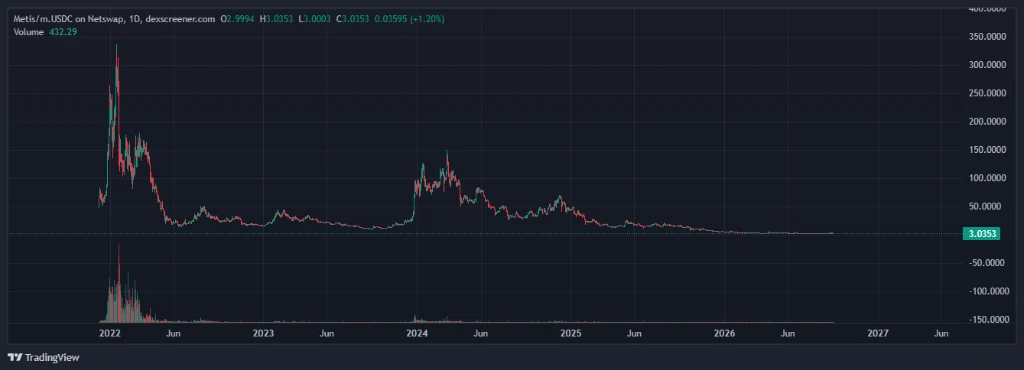
*Figure 1: Metis/m.USDC 1D chart on Netswap via DexScreener illustrating the multi-year macro arc: the historic 2022 high above $300, the early-2024 expansion to $130+, and the multi-year compression channel consolidating at the $3.03 (+1.20%) cycle demand baseline.*
Key Chart Observations:
- 1The Historic Drawdown: During the euphoric 2021–2022 market cycle, METIS surged above $300 per token. The ensuing structural bear market, coupled with broader Ethereum Layer 2 valuation compression, drove the price into an extended, multi-year deflationary decline.
- 2The 2024 Secondary Peak: In early 2024, METIS demonstrated rapid market torque, rallying violently from the $15 region to over $130, confirming that when liquidity returns to the asset, its low-float supply structure facilitates explosive upward expansions.
- 3The Historical Baseline Floor ($3.00 – $3.03): As visible on the daily timeframe, METIS has spent recent months grinding sideways along a definitive structural demand shelf at $3.0353 (+1.20%).
- 4Volume Exhaustion: Selling volume has completely dried up along this baseline. In technical accumulation theory (Wyckoff), prolonged sideways price compression accompanied by microscopic volume indicates terminal seller exhaustion—the point where weak-handed retail participants have completely exited, leaving the remaining float locked in the hands of high-conviction entities.
The Psychological Novelty Bias in Crypto
The crypto market suffers from a notorious behavioral bias: it overvalues novelty and undervalues reinvention.
Traders gladly bid brand-new Layer 1s and Layer 2s to multi-billion-dollar fully diluted valuations simply because there is no overhead chart to remind them of previous bear markets. There is no historical resistance, no bagholders, and no scars.
Older protocols, conversely, carry heavy psychological baggage. Every trader remembers where they bought, where they sold, or how much it fell from the peak.
Yet technology and fundamental development do not respect chart psychology. If a veteran protocol successfully pivots into the most explosive macroeconomic trend of the decade while its valuation remains anchored to historical apathy, an immense pricing disconnect emerges.
The market is currently pricing Metis based on its 2022 memories. The technology being deployed belongs entirely to 2026.
7. The Critical Risk: Hyperion Mainnet Execution
No serious institutional analysis can omit the fundamental execution risks.
Metis’s bullish thesis relies heavily on the full-scale mainnet production release of Hyperion.
While Andromeda is fully operational, Hyperion’s parallel execution environment has progressed through extensive testnet phases and architectural refinement. The transition from an innovative testnet environment to a globally adopted, battle-tested production network is notoriously treacherous: - Competitor Layer 2s and high-performance Layer 1s (Solana, Base, Monad, Aptos) are also aggressively vying for developer mindshare in AI agent tooling. - Agent developers require robust SDKs, comprehensive Python/TypeScript client libraries, and immediate fiat-to-crypto off-ramps. - The gap between building an agent-friendly blockchain and convincing autonomous developer ecosystems to deploy millions of active software agents is substantial.
Metis does not merely need to launch Hyperion; it must cultivate a sticky, self-sustaining ecosystem of autonomous software agents that drive real economic turnover.
8. Bridging AI Agents to Real-World Commerce: The Role of Crypto Cards
As autonomous agents begin earning, trading, and managing capital, their operations cannot remain trapped in a closed on-chain sandbox.
To execute real-world commercial tasks—such as purchasing hosting from traditional cloud providers, procuring physical hardware, paying SaaS fees, or distributing profits to human stakeholders—agents and their operators require seamless crypto-to-fiat spending rails.
This convergence is driving unprecedented adoption in crypto-linked debit solutions: - Autonomous agents can be programmatically funded via virtual Visa/Mastercard rails with strict daily spending limits. - Solutions like **SolCard provide instant, No-KYC virtual cards funded with on-chain crypto, enabling automated systems to pay for OpenAI, Claude, and Midjourney subscriptions without traditional corporate banking accounts. - To compare how top crypto payment rails facilitate real-world spending, explore our comprehensive guide to the Best Crypto Cards and our institutional analysis of the Best Crypto Cards in the USA**.
9. Conclusion: The Asymmetrical Contrarian Play
The narrative trajectory of artificial intelligence is unmistakably clear:
$ ext{Static Models (2023)} \longrightarrow ext{Interactive Assistants (2024)} \longrightarrow ext{Autonomous Economic Agents (2026+)}$
Machines do not care about sleek consumer user interfaces. Machines do not require mobile apps, face-ID logins, or marketing influencers.
Machines require: - Cryptographic keypair identity, - High-speed parallel settlement, - Sub-penny execution fees, - Machine-readable reputation (ERC-8004), - HTTP 402 native payment rails (GMPayer), - Decentralized intelligence discovery (LazAI).
Metis didn't pivot to this vision last week. It spent years constructing the foundations while the rest of the market chased fleeting trends.
With a strictly capped supply of only 10 million tokens and an asset base consolidating at historical cycle lows, Metis represents one of the most compelling contrarian infrastructure theses in modern decentralized finance.
The market has spent years ignoring Metis. If the agent economy arrives with the force many anticipate, the market may soon be forced to pay attention.
What is Metis and how has its vision evolved?
Metis began as an Ethereum Layer 2 roll-up focused on decentralized sequencers and low-cost EVM transactions (Andromeda). It has since expanded into a specialized 3-tier architecture (Andromeda, Hyperion, LazAI) designed to provide the financial, execution, and inference rails for the autonomous AI agent economy.
What is the difference between Andromeda and Hyperion?
Andromeda is Metis’s mature, production-ready settlement Layer 2, delivering ~$0.01 transaction costs and sub-2-second finality with a decentralized sequencer. Hyperion is an AI-optimized parallel execution layer engineered to handle high-frequency, sub-penny micro-transactions generated continuously by autonomous software agents.
What is LazAI?
LazAI is Metis’s decentralized AI application and data layer. It provides an open marketplace for decentralized model inference, enables agents to pay for computation using signed cryptographic authorizations, introduces Data Anchoring Tokens (DATs) for verifiable data ownership, and integrates ERC-8004 for on-chain agent identity and reputation.
What is ERC-8004 and why does it matter for AI agents?
ERC-8004 is a token standard on Metis establishing verifiable on-chain identity and reputation for autonomous AI agents. It allows agents to inspect the historical performance, uptime, and reliability of counterparty machines programmatically before executing payments, removing the need for centralized intermediaries.
What is the maximum token supply of METIS?
METIS has a strictly capped maximum supply of approximately 10,000,000 tokens, with over 7.1 million already in circulating supply (~71%). This makes it significantly scarcer than competing Layer 2 protocols that carry 10 billion to 100 billion token supplies.
Where can I view the Metis / m.USDC chart?
The Metis/m.USDC pool trades on Netswap, the premier decentralized exchange on Metis Andromeda, and can be tracked in real time on DexScreener.