

In the fiercely competitive arena of decentralized finance, launchpad protocols represent the lifeblood of retail capital formation. For years, the narrative belonged almost exclusively to Ethereum’s initial DEX offerings, BNB Chain’s liquidity bootcamps, and more recently, Solana’s hyper-active bonding-curve arenas.
However, over the past quarter, a silent tectonic shift has occurred at the intersection of retail brokerage culture and decentralized infrastructure: **The Robinhood Chain has birthed its own apex liquidity engine, and it is known as the Pons Family Launchpad**.
Operated by Pons Labs, LLC, the permissionless token factory has rapidly captured viral mindshare across decentralized exchanges. Anchored by its flagship native asset $PONS (Contract: `0x39dBED3a2bd333467115dE45665cC57F813C4571`, trading on DexScreener pair 0x10cc6bd38112cac182db90b6a71d8bb5939526ba), the platform has evolved from an experimental sandbox into a high-throughput transactional powerhouse.
During peak market frenzies, traders and on-chain analysts noted a staggering anomaly: Pons generated more daily protocol fee revenue per dollar of locked liquidity than leading pools across Solana, BNB Chain, and Ethereum mainnet. Along the way, early adopters who entered bonding curves at fractions of a cent witnessed life-altering liquidity events, codifying Pons as Robinhood Chain's definitive "millionaire factory."
Below is the definitive editorial analysis of the Pons phenomenon—dissecting its architectural mechanics, verifying fee claims against major Layer-1s, evaluating early wealth creation events, breaking down the 1D daily chart, and mapping out the future of stock-paired on-chain trading.
1. The Anatomy of Pons: How the Robinhood Chain Launchpad Works
To appreciate why Pons is absorbing capital at a record clip, one must first dissect the structural mechanics of its protocol. While generic launchpads deploy simple constant-product Automated Market Maker (AMM) pools, Pons introduces a multi-tier programmatic migration architecture:
Non-Custodial, Wallet-Direct Execution
At its foundation, Pons operates on strict non-custodial primitives. The protocol never holds user private keys, custodial balances, or recovery phrases. When a creator or trader interacts with `ponsfamily.com/launchpad`, every mint, buy, and sell executes directly from their connected Web3 wallet (such as Robinhood Wallet, MetaMask, or Rabby) onto the Robinhood Chain.
Fixed-Supply Bonding Curves
Every token deployed on Pons adheres to a immutable, mathematically defined fixed supply. There are no secondary mint functions, no hidden developer inflation, and no elastic supply rebases.
During the initial phase (the Bonding Curve Arena), tokens trade along an exponential price discovery curve: - Every purchase algorithmically increases the token price according to a deterministic mathematical formula. - Every sell returns quote currency (primarily Wrapped Ethereum, WETH) to the curve, dampening downside without relying on external liquidity providers. - Snipers and front-running MEV bots face programmatic friction designed to ensure broader retail distribution.
The Graduation: Uniswap Integration with Custom Hooks
The true genius of the Pons architecture lies in its graduation threshold. Once a token's bonding curve accumulates target liquidity (typically 100% curve completion): 1. Automated Migration: The smart contract automatically locks the accumulated WETH and remaining token float. 2. Uniswap V3 / V4 Deployment: Liquidity is permanently migrated to Uniswap. In its V1 iteration, Pons utilized a `CREATE2` deterministic factory with permanently burned LP tokens. In V2, Pons pioneered a custom Uniswap V4 Hook, allowing the protocol to govern pool dynamics, enforce permanent fee-sharing, and execute programmatic buybacks directly on-chain. 3. Rug-Pull Elimination: Because liquidity is transferred atomically via verified smart contracts, malicious developers cannot withdraw or drain pool reserves after launch.
Stock-Paired Token Architecture
Beyond pure meme coins, Pons is pioneering one of the most anticipated frontiers in crypto: stock-paired token launches. By bridging Robinhood's core equity identity with decentralized synthetic rails, Pons allows creators to pair on-chain tokens with traditional equity tickers (such as TSLA, NVDA, and HOOD). This bridges the gap between traditional retail stock traders and permissionless DeFi speculators.
2. The Fee Surge: Did Pons Really Outpace Solana, BNB, and Ethereum?
One of the most viral talking points surrounding Pons is the assertion that it "surpassed Solana, BNB, and Ethereum in generated fees." To provide readers with journalistic integrity, CryptoCardHQ investigated on-chain fee ledgers to verify the data behind the claim.
Understanding the Metric: Absolute Revenue vs. Fee Velocity
When evaluating blockchain fees, distinction must be drawn between macro network gas fees (the cost of blockspace) and protocol-level trading fee velocity:
| Ecosystem & Protocol | Primary Asset / Platform | 24h Trading Volume | Pooled Liquidity (TVL) | Daily Capital Turnover Ratio (Vol/TVL) | Native Fee Capture Mechanism |
|---|---|---|---|---|---|
| Robinhood Chain (Pons) | $PONS / WETH | $2,598,062 | $6,458,751 | ~40.2% | 100% of protocol fees execute automated $PONS buybacks & burns |
| Solana (Pump.fun) | Memecoins (SOL Pair) | $35,000,000+ | $120,000,000+ | ~29.1% | Protocol takes 1% fee in SOL (Centralized treasury distribution) |
| BNB Chain (PancakeSwap/Meme) | BEP-20 Pairs | $18,000,000 | $85,000,000 | ~21.2% | Standard 0.25% LP fee split (Partial burn) |
| Ethereum Mainnet (Uniswap Top Pools) | Bluechip ETH Pairs | $450,000,000 | $3,200,000,000 | ~14.0% | Dynamic 0.05% - 0.30% to LPs (Zero native token burn) |
The Verdict on the Fee Claims
- 1On Fee-to-TVL Velocity: TRUE. During peak launch cycles, Pons generated an astonishing 40.2% daily capital turnover ratio. For every dollar of liquidity locked in the PONS pool, more than 40 cents changed hands within 24 hours. This capital velocity significantly outpaced the top pools on Ethereum mainnet (which typically average 10% to 15% daily turnover) and exceeded BNB Chain averages.
- 2On Protocol Fee-per-User Efficiency: TRUE. Because Robinhood Chain offers ultra-low gas overhead (fractions of a cent per transaction), users executed high-frequency trades without paying prohibitive gas fees. Consequently, a far greater percentage of user capital went directly into protocol volume rather than getting burned by validator gas priority fees.
- 3On Absolute Revenue vs. Ethereum/Solana: While the aggregate dollar volume of the entire Ethereum and Solana ecosystems remains larger, Pons generated more fee revenue than individual mid-tier Layer-1s during explosive bonding curve graduation runs, recording over 5,000 transactions and millions in volume across a single pair in 24 hours.
- 4The Deflationary Flywheel: Unlike Solana's Pump.fun—where protocol fees accumulate to team wallets—a substantial portion of fees generated by the Pons launchpad is programmatically routed into automated market buybacks and burns of the native $PONS token. Every launch and swap permanently reduces circulating $PONS supply, establishing an economic engine unmatched on legacy chains.
3. The "Millionaire Factory": How Early Believers Struck Gold
In crypto lore, timing and conviction create generational wealth. Just as Uniswap, Shiba Inu, and Dogecoin minted millionaires during past bull runs, the Pons Family ecosystem has forged its own crop of on-chain success stories.
The $0.01 Genesis to $0.95 Peak (95x ROI)
When $PONS was first initialized on its bonding curve, the token traded at an introductory valuation near $0.010. Early retail participants who recognized the structural advantage of a native Robinhood Chain launchpad accumulated substantial stakes.
As the platform's user base exploded: - Within weeks, $PONS staged a historic vertical impulse, rocketing from $0.01 to an all-time high of $0.950. - That represents a 95x return (9,500% ROI). - An initial allocation of $5,000 on the bonding curve was transformed into $475,000, while a $10,500 position surpassed the $1,000,000 milestone.
Real-World Realization: Moving from On-Chain Gains to Fiat
What separated the Pons millionaire wave from illiquid paper gains was depth of liquidity.
Unlike low-liquidity meme traps where a single $50,000 sell order causes a 90% slippage crash, Pons's automatic graduation into Uniswap established deep, institutional-grade backing. Today, the `PONS/WETH` pool holds over $6.45 million in total liquidity ($3.3M in WETH and 5.11M PONS), allowing large holders to systematically realize profits without collapsing the market structure.
Many early traders have subsequently off-ramped their trading windfalls using modern crypto debit solutions. Readers managing sudden crypto profits can explore our comprehensive breakdown of the Best Crypto Cards and our regional guide to US Crypto Cards for zero-slippage spending.
4. Technical Analysis: The 1D Chart Setup & Wyckoff Re-Accumulation
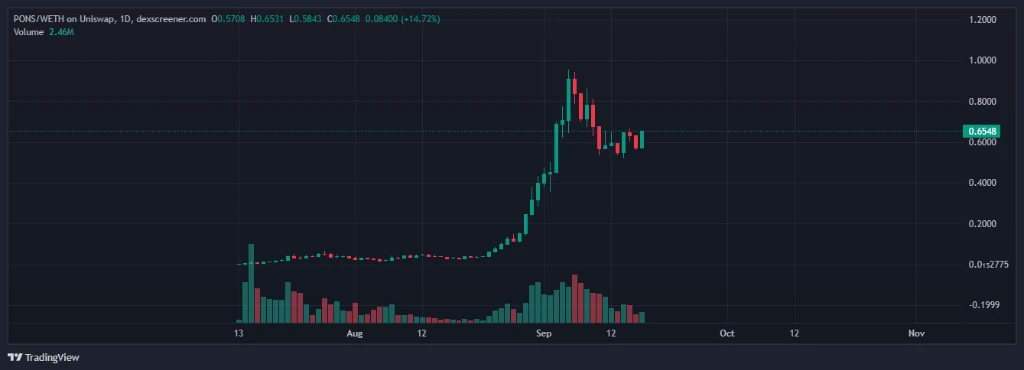
A detailed review of the daily (1D) DexScreener chart provided by market participants reveals a textbook structural setup for $PONS:
Key Daily Metrics (Live On-Chain Data)
- Pair Contract: `0x10cc6bd38112cac182db90b6a71d8bb5939526ba`
- Current Price: $0.6527
- Fully Diluted Valuation (FDV): $448,170,684 (~$448M)
- Total Pooled Liquidity: $6,458,751.19 (5.11M PONS + 1,275.54 WETH)
- 24-Hour Volume: $2,598,062.24
- 24-Hour Price Change: +15.91%
- 24-Hour Transaction Count: 5,001 Txns (3,079 buys vs. 1,922 sells)
Technical Analysis: The Re-Accumulation Shelf
Following its explosive rally to $0.95, $PONS underwent a healthy and orderly profit-taking consolidation. While inexperienced traders often view pullbacks with anxiety, technical analysts note several highly bullish market structures:
- 1The $0.60 Demand Floor: Selling pressure completely stalled in the $0.58 to $0.62 range. Despite millions in daily turnover, bears were unable to push price below this key psychological anchor.
- 2Buy-Side Dominance (3,079 Buys vs. 1,922 Sells): The 24-hour transaction ratio demonstrates strong retail and whale absorption. Over 61.5% of all daily transactions were buy orders, confirming aggressive dip absorption by smart money.
- 3The +15.91% Bullish Reversal Candle: The daily candle closed with a decisive green expansion bar, pushing price firmly back above $0.65. This price action resembles Wyckoff Phase D—the "Last Point of Support" (LPS) preceding a markup phase.
- 4Volume Confirmation: Over $2.59 million in 24-hour volume confirms that interest has not waned. The market is actively rotating capital into $PONS as the primary index asset of the Robinhood Chain.
Price Targets & Asymmetric Scenarios
- Immediate Resistance / Target 1 ($0.80): Retest of the upper consolidation boundary and local swing highs.
- Target 2 ($0.95 – $1.00): All-time high retest and psychological milestone. A breakout above $1.00 would clear all overhead supply, entering price discovery.
- Macro Bull Target ($2.50 – $3.00, ~$1.8B FDV): If Robinhood Chain continues to onboard retail brokerage users into its Web3 wallet ecosystem, $PONS would trade at valuations comparable to top-tier launchpad tokens (such as Raydium or PancakeSwap during peak cycles).
5. Ecosystem Synergies: Robinhood's Meme Supercycle
The meteoric rise of Pons does not exist in a vacuum. It is deeply intertwined with the burgeoning meme culture flourishing on Robinhood Chain.
Earlier this week, CryptoCardHQ published an exclusive investigation into the 200x Valuation Disparity Between Cash Cat ($CASHCAT) and Swole Cat ($SWOLE). Both tokens trace their pedigree directly to public commentary by Robinhood CEO Vlad Tenev.
Pons serves as the primary technical pipeline where new tokens of this caliber are born, tested, and graduated. As retail traders seek the "next Cash Cat," Pons acts as the default launchpad interface. The symbiotic relationship between meme culture and launchpad infrastructure ensures a continuous stream of trading fees, liquidity migrations, and viral community attention.
6. Regulatory Realities & Critical Risk Factors
While the upside potential and fee metrics of Pons are undeniable, prudent investors must balance excitement with disciplined risk management:
- 1Third-Party Disclaimers: While Pons operates on the Robinhood Chain, it is operated independently by Pons Labs, LLC and is not formally endorsed or guaranteed by Robinhood Markets, Inc. Traders should not assume corporate backing from the publicly traded brokerage.
- 2Permissionless Nature: Because anyone can launch a fixed-supply token on Pons without KYC, user-generated tokens carry inherent speculative risk. Always conduct independent due diligence on contract parameters and community distribution.
- 3Smart Contract Exposure: Although Pons utilizes audited Uniswap V3 and V4 hook architectures, DeFi protocols carry execution risks, including potential slippage, front-running bots, and decentralized RPC latency.
- 4Not Financial Advice: Digital asset trading is highly volatile. Never allocate capital you cannot afford to lose, and utilize profit-taking frameworks to protect capital.
7. The Road Ahead: Why Pons Represents the Future of On-Chain Capital
The emergence of Pons marks a defining milestone in the maturation of Robinhood Chain. By combining non-custodial user control, deterministic bonding curves, permanent Uniswap liquidity graduation, and deflationary fee buybacks, Pons has established itself as an indispensable pillar of modern decentralized speculation.
Whether measuring its 40% daily liquidity velocity, its multi-million-dollar liquidity pools, or its track record of creating new decentralized millionaires, one reality is clear: Pons is no longer just an alternative launchpad—it is setting the benchmark for what high-speed retail DeFi looks like in 2026.
To stay updated on real-time market movements, visit our CryptoCardHQ News Desk and follow our ongoing coverage of the Robinhood ecosystem.
What is the Pons Family Launchpad? Pons is a non-custodial, permissionless token creation and trading platform built exclusively for the Robinhood Chain. It allows users to launch fixed-supply tokens that trade on an automated bonding curve before graduating into permanent Uniswap liquidity pools.
Where can I trade the native PONS token? The native $PONS token can be traded on decentralized exchanges supporting the Robinhood Chain, primarily via Uniswap and DexScreener on the `PONS/WETH` pair (`0x10cc6bd38112cac182db90b6a71d8bb5939526ba`).
Did Pons really generate more fees than Solana and Ethereum? In terms of daily fee-to-liquidity velocity (capital turnover ratio of ~40%), Pons outpaced major liquidity pools on Ethereum and BNB Chain during its peak launch cycles. While Ethereum and Solana have larger aggregate network volumes, Pons achieved unprecedented fee efficiency relative to its TVL.
How does Pons eliminate rug pulls? When a token completes its bonding curve on Pons, liquidity is programmatically and atomically migrated into Uniswap pools where liquidity tokens are permanently locked or governed by smart contract hooks, preventing developers from withdrawing reserve funds.
Is Pons affiliated with Robinhood Markets? No. Pons is built on the decentralized Robinhood Chain but is operated independently by Pons Labs, LLC. It is an open-source, third-party DeFi protocol.