If you have been staring at your portfolio dashboard this week wondering why everything feels like a game of musical chairs orchestrated by caffeinated macro traders, you are not alone.
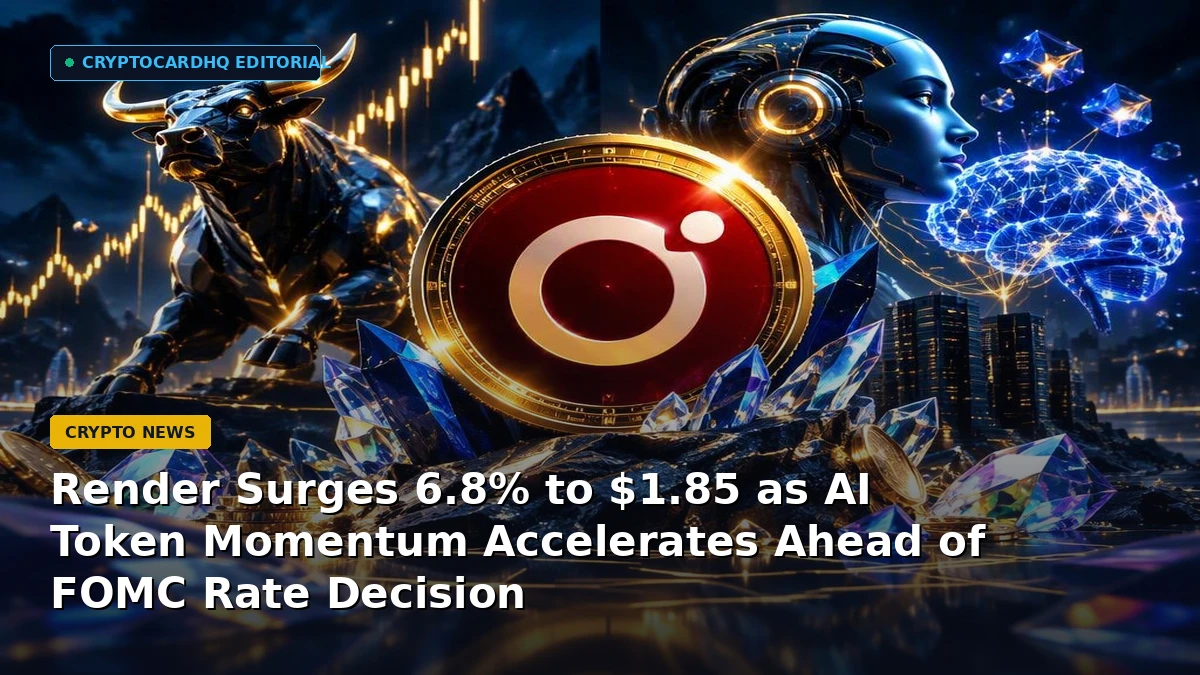
Render ($\text{RENDER}$) just punched through resistance to reclaim the $\$1.85$ mark, booking a spicy $6.81\%$ gain over the past twenty-four hours. TradFi pundits love to pretend that digital assets live in a frictionless vacuum of pure code and libertarian daydreams, but let's be candid: crypto dances to the Federal Reserve’s tune whether we like it or not.
With tomorrow's FOMC rate decision looming larger than a leveraged whale on a low-liquidity exchange, decentralized AI infrastructure tokens are suddenly absorbing a fresh tidal wave of institutional capital. Wall Street wants to play the artificial intelligence trade, but traditional equities are starting to look as bloated as a multi-signature treasury wallet run by teenagers. So, where does the hot money bleed? Right into GPU compute networks and decentralized rendering pipelines.
Treating Render like a basic utility token is roughly like calling a Ferrari a motorized grocery cart—technically true, but missing the point entirely. Let's pull back the hood and examine what is actually driving this momentum, why the derivative desks are currently sweating through their designer loafers, and how all of this impacts your everyday spending habits.
Why This Matters to Markets
Let's address the elephant in the trading floor. Macro markets are holding their collective breath for tomorrow's Federal Reserve rate decision. Treasury yields are twitching, liquidity flows are pivoting, and risk-on assets are bracing for impact.
For the past six months, the correlation between macroeconomic policy shifts and high-beta crypto sectors has been tighter than a smart contract audit with zero budget. When the Fed hints at loosening the liquidity spigots—or even pausing the pain—speculators rush to front-run the liquidity influx. But this time, the capital isn't just spraying randomly across every meme coin minted on a whim. It is clustering around infrastructure plays that actually do real-world heavy lifting.
Enter decentralized AI compute. Training large language models and rendering hyper-realistic neural graphics requires an ungodly amount of processing power. Traditional cloud providers like AWS or Azure are expensive, bottlenecked, and about as flexible as a concrete slab. Render steps in as a decentralized marketplace connecting idle GPU horsepower with creators who need to melt pixels at scale.
When macro uncertainty spikes, investors look for assets backed by actual utilization metrics rather than vibes alone. That is why a $6.8\%$ pop to $\$1.85$ isn't just a random statistical blip on a Sunday night chart. It is a calculated capital rotation. TradFi suits are finally waking up to the reality that decentralized networks can lease out computing power faster, cheaper, and with fewer corporate middlemen than their legacy counterparts.
Market Reaction and On-Chain Data
Behind every sharp green candle on a price chart lies a graveyard of broken leverage positions. The move to $\$1.85$ was not achieved through polite retail accumulation alone; it was catalyzed by a textbook short squeeze.
Derivative exchanges lit up yesterday as aggressive bears piled into short positions, betting that macro dread ahead of the FOMC meeting would drag the entire altcoin market down into the abyss. They assumed wrong. As $\text{RENDER}$ broke past key intraday resistance levels, stop-losses triggered a cascade of forced liquidations. When a short position gets liquidated, the exchange automatically buys back the asset to close the trade, turning a slow upward grind into a rocket-fueled vertical spike.
| Metric / Indicator | Current Status | Market Implication |
|---|---|---|
| Spot Price | $\$1.85$ | Reclaimed key technical resistance |
| 24-Hour Performance | $+6.81\%$ | Outperforming broader altcoin stagnation |
| Derivative Activity | High Short Liquidations | Forced buybacks accelerating upside momentum |
| Sector Focus | Decentralized AI / Compute | Institutional capital rotation into utility assets |
On-chain metrics tell a fascinating story beneath the derivatives theater. Large wallet addresses have quietly accumulated during the consolidation phases of late August. While Twitter was busy arguing about regulatory theater and memecoin supercycles, smart money was accumulating foundational utility tokens with real-world enterprise demand.
Liquidity depth on major centralized and decentralized exchanges has stabilized, meaning this move had enough organic muscle behind it to avoid an immediate flash crash back to support. Still, order books remain jumpy. Until Jerome Powell speaks tomorrow afternoon, every single technical indicator is just a suggestion.
What It Means for Crypto Cards & Everyday Spending
You are probably wondering what a macro-driven pump in a decentralized rendering token has to do with buying your morning coffee or booking a flight using your digital assets. The connection is more direct than you might think.
When high-beta utility tokens like $\text{RENDER}$ surge, network activity follows. Creators paying for rendering tasks and node operators cashing out their rewards create an immediate friction point between decentralized ledgers and real-world commerce. Everyday crypto card users know that sudden market volatility is a mixed blessing. On one hand, a surging portfolio balance makes funding your digital asset debit card feel like playing Monopoly with house money. On the other hand, rapid price swings complicate the boring math of spending without triggering unexpected taxable events or awkward conversion slippage.
If you are actively managing your digital wealth across multiple chains, chasing yield, and spending from your crypto balance, you need tools built for velocity. This is precisely why savvy participants lean on reliable best crypto cards to smoothly bridge the gap between volatile token holdings and fiat checkout terminals.
Macro conditions dictate when the liquidity taps open, but network utility decides who actually gets to keep the water.
Before you reallocate your entire stack into high-flying compute tokens, take a second to evaluate your spending rails. Compare fee structures, reward yields, and custody models using our comprehensive crypto card comparison tool so you aren't leaking value every time you swipe.
Where the Risk Hides
Let's remove the rose-colored glasses for a moment and look at what could go horribly wrong. Because in crypto, optimism is a great marketing strategy, but skepticism keeps you solvent.
First, let's talk about the macroeconomic cliff. If tomorrow's FOMC rate decision surprises the market—say, the Fed keeps rates higher for longer or strikes a hawkish tone that spooks equity desks—risk-on assets will take a swift trip to the woodshed. Decentralized AI tokens are not immune to systemic liquidity shocks. When a macro panic hits, correlations go to 1.0, and even the most innovative GPU compute network will get dragged down alongside garbage-tier assets.
Second, execution risk in decentralized infrastructure is real. Render relies on distributed GPU nodes operated by third parties. While the protocol has scaled impressively, it faces fierce competition from centralized cloud giants who can slash prices overnight if they feel threatened by decentralized alternatives.
Finally, let's address valuation inflation. A $6.8\%$ gain is nice, but technical resistance at $\$1.85$ has historically proven sticky. If volume dries up post-FOMC, $\text{RENDER}$ could easily retrace back to its local support range, leaving late-stage leverage chasers holding heavy bags. Never mistake a tactical short squeeze for a secular bull market confirmation.
A Practical Checklist for Users
Where do we go from here? The playbook for the next forty-eight hours is straightforward, provided you keep your emotions locked in a hardware wallet:
- ✓Monitor FOMC Reactions: Watch the basis points and the tone of the press conference for any liquidity pivots.
- ✓Track Open Interest: Keep an eye on perpetual swap funding rates to avoid getting caught in overleveraged long flushes.
- ✓Verify Card Rails: Ensure your spending setup is optimized for volatility by reviewing your current limits, conversion fees, and top-up mechanics.
Our Takeaway
The convergence of macroeconomic liquidity shifts and foundational decentralized infrastructure creates fascinating trading setups—but it also amplifies portfolio volatility. Whether you are trading AI utility tokens or funding everyday purchases through digital asset payment rails, maintaining discipline is vital. Let utility dictate your long-term thesis, and let strict risk management protect your capital when the macro winds shift.