
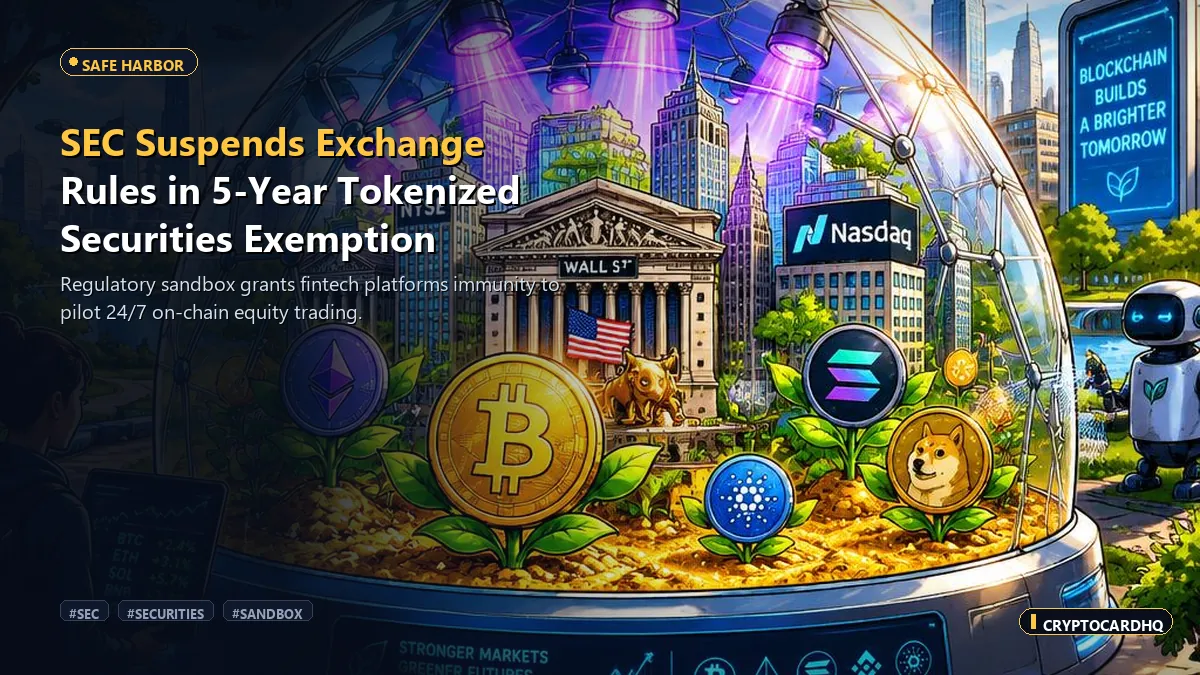
In a decisive break from years of aggressive enforcement, the Securities and Exchange Commission just handed digital asset markets an unexpected relief valve: a blanket five-year "innovation exemption" for tokenized securities venues. Under the framework, platforms can list, trade, and settle digital representations of securities without having to register as national securities exchanges. The sudden order caught trading desks off guard, sparking an immediate scramble across institutional order books and fundamentally altering how firms price on-chain capital market infrastructure.
Key Takeaways
- Five-Year Safe Harbor: The SEC established a formal five-year innovation exemption relieving qualifying tokenized securities platforms from traditional national securities exchange registration.
- Unimpeded Secondary Trading: Venues can facilitate secondary trading and settlement for digital securities without the looming threat of registration-related enforcement actions.
- Direct On-Chain Market Structure: The policy provides immediate relief for real-world asset (RWA) protocols and secondary tokenization venues that were previously stalled by legacy broker-dealer rules.
- Mandatory Compliance Guardrails: Venues taking advantage of the safe harbor must still maintain investor safeguards, basic KYC/AML protocols, and verifiable cryptographic audit trails.
Market Snapshot at Time of Reporting: BTC traded at $76,860.00 (+1.37% 24h | Range: $75,064.82 - $77,179.47).
Breaking Shock: Liquidation Cascade and Market Response
The market reacted within minutes across spot desks and derivatives venues. Traders holding short positions against institutional tokenization infrastructure were caught flat-footed, triggering rapid short-covering rallies across secondary desks.
Bitcoin held steady around $76,860, but the real action unfolded across decentralized credit protocols and alternative trading networks. Proprietary desks moved fast to deploy capital into platforms capable of settling tokenized Treasuries and corporate credit notes directly on-chain. Market makers tightened spreads across tokenized collateral products almost instantly, reflecting the sudden removal of existential regulatory risk that had hung over secondary trading desks for years.
Anatomy of the SEC Innovation Exemption
The formal relief, reported by CoinDesk, carves out a clean five-year operational window designed specifically around distributed ledger technology. Under the Securities Exchange Act of 1934, any system that brings together multiple buyers and sellers using non-discretionary methods has historically faced a rigid fork in the road: undergo the grueling process of registering as a full national securities exchange, or squeeze into an Alternative Trading System (ATS) broker-dealer model. Neither setup made much sense for smart-contract protocols running automated, non-custodial liquidity pools.
The newly granted innovation exemption breaks that logjam. Venues operating under the safe harbor can run secondary order books, peer-to-peer liquidity networks, and clearing mechanisms without bearing full exchange status. In return, the SEC requires regular surveillance feeds, verifiable asset-backing proofs, and clear anti-manipulation controls.
This administrative shift reflects years of mounting institutional and legislative pressure. As detailed in CryptoCardHQ's analysis of landmark guidance on crypto asset classification, regulators have spent months fielding sharp critiques from Capitol Hill over enforcement actions that drove compliant trading experiments offshore.
Structural Market Evolution: From ATS Constraints to On-Chain Venues
For nearly a decade, regulated digital securities trading in the United States lived inside the narrow walls of the ATS broker-dealer model. It was an awkward fit. ATS platforms were hobbled by rigid three-party settlement chains, severe restrictions on retail participation, and an outright ban on direct, self-custodial wallet settlement. With this five-year blanket carve-out, the agency is finally letting firms test direct wallet-to-wallet execution, atomic DvP (delivery versus payment), and shared liquidity layers.
This regulatory relief aligns with broader statutory shifts taking shape in Washington. As explored in our coverage of congressional statutory breakthroughs for digital assets, lawmakers have steadily demanded an administrative posture that supports capital formation rather than stifling it.
Key Figures & Operational Breakdown
The shift from legacy exchange and ATS structures to the SEC's five-year safe harbor changes the operational landscape for trading venues across several key operational fronts:
| Metric / Factor | Standard National Exchange / ATS | 5-Year Innovation Exemption | Practical Market Impact |
|---|---|---|---|
| Registration Requirement | Form 1 Exchange or Form ATS Broker-Dealer | Blanket Safe Harbor Exemption | Removes multi-year bureaucratic delays and millions in upfront legal fees. |
| Operating Runway | Protracted, uncertain review cycles | Guaranteed 60-month operating window | Gives venture capital and institutions the regulatory clarity needed to build. |
| Settlement Mechanics | T+1 legacy clearing, DTCC centralized clearing | Real-time atomic clearing and on-chain settlement | Slashes counterparty default risk and removes intermediary clearing fees. |
| Asset Coverage | Heavily restricted, isolated private placements | Tokenized securities, RWAs, and debt pools | Unlocks secondary liquidity for trillions in traditional yield-bearing instruments. |
| Surveillance & Audits | Manual reporting and quarterly paper filings | Cryptographic audit logs and programmatic feeds | Replaces manual compliance checks with transparent, machine-readable verification. |
Strategic Implications and Platform Hazards
While the industry is celebrating, the exemptive order is far from an unregulated free-for-all. The SEC attached precise conditions that require strict operational discipline from any participating venue:
- 1Identity and Sanctions Verification: Platforms must enforce strict KYC and AML compliance at the smart-contract or gateway level. Purely anonymous, permissionless pools listing tokenized securities are explicitly barred from the safe harbor.
- 2The 60-Month Expiration Clock: The relief comes with a firm deadline. Venues must design their technology stacks with the understanding that these rules will either be permanently codified or allowed to lapse when the clock runs out.
- 3Zero Leeway for Smart Contract Vulnerabilities: Protocol exploits, reentrancy bugs, or compromised administrative keys will receive zero regulatory leniency. Any catastrophic loss of user funds due to flawed smart contract architecture could trigger immediate revocation of a platform's exempt status.
Firms moving to launch secondary venues will have to walk a tightrope between rapid product rollouts and rigorous smart contract security.
Practical Utility for Crypto Holders and Investors
For individual investors, everyday holders, and digital market participants, the SEC's decision marks a direct bridge between traditional yields and accessible digital assets. Tokenized money market funds, sovereign bonds, and real estate tranches that were previously sequestered in closed institutional silos will now see viable secondary liquidity across compliant platforms.
As on-chain securities and sovereign debt tokens become liquid, holders can increasingly use yield-bearing tokenized instruments as underlying collateral for spending and daily financial operations. Those seeking to optimize their personal balance sheets can review the top-tier solutions in our Best Crypto Cards guide, which illustrates how digital assets transition from capital appreciation vehicles into day-to-day liquidity.
To track how shifting sovereign policies, monetary decisions, and regulatory mandates impact broader market stability, readers can follow the comprehensive coverage in our dedicated Bitcoin Macro & Geopolitics News section.
Catalysts & What to Watch in the Next 24-48 Hours
- Notice Filings with the SEC: Keep an eye on public regulatory disclosures for the first batch of ATS operators and decentralized platforms filing for safe harbor protection.
- Wall Street Desk Announcements: Expect statements from tier-one prime brokers and traditional custodial banks detailing plans for tokenized equity and debt trading.
- Secondary Market Depth: Monitor bid-ask spreads and liquidity pool balances on tokenized Treasury protocols over the coming trading sessions.
- State-Level Reactions: Watch for potential pushback or coordinating statements from state securities commissioners and international financial authorities.