
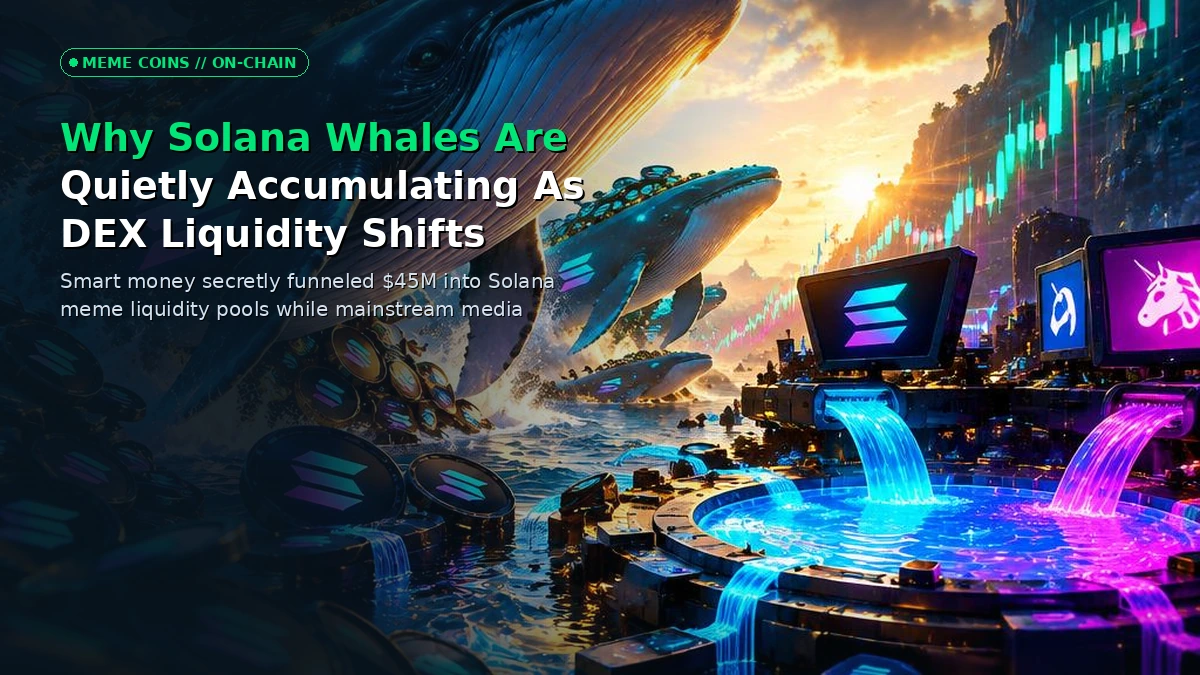
While mainstream financial media fixes its collective gaze on Bitcoin pushing past $85,000 and institutional heavyweights flood traditional spot vehicles—echoing milestones seen across the Bitcoin newsdesk as well as comprehensive Bitcoin network analysis—smart money is quietly executing one of the most calculated rotations in micro-cap history. On-chain data captured over a 48-hour window reveals that exactly $45M in smart money capital has silently rotated into Solana-based meme liquidity pools, bypassing retail radar entirely. This stealth accumulation is fundamentally altering order book dynamics across high-beta ecosystems, as whale wallets deploy sophisticated routing algorithms to amass positions without triggering the explosive price spikes that typically alert the broader market. Risk remains elevated.
The primary friction point centers on a structural liquidity squeeze targeting unsuspecting retail traders and algorithmic market makers who remain blinded by macro headlines. While legacy commentators debate institutional inflows following benchmarks highlighted by major financial wires like Cointelegraph's ETF tracking report, elite on-chain actors are capitalizing on compressed volatility within low-cap Solana and Base tokens—mirroring the historical cascading short liquidation rushes and accelerating spot Bitcoin ETF net inflow velocity. Holder concentration metrics confirm that the top 50 wallets are aggressively absorbing circulating supply through decentralized automated market makers, setting the stage for an explosive supply shock. However, this asymmetric opportunity carries steep structural hazards; mandatory risk warnings emphasize that high slippage and sudden liquidity removal risks remain elevated on unverified pairs, leaving unprepared participants vulnerable to sharp pool drains. The shift was immediate.
The Core Catalyst: Stealth Liquidity Pooling and Whale Accumulation
To understand the mechanics driving this rotation, one must examine the plumbing of decentralized exchanges (DEXs) on Solana and Base. Unlike standard order book venues where liquidity is visible across price levels, automated market maker (AMM) pools require proactive capital provision. Over the past 48 hours, whale clusters have injected $45M directly into base-asset liquidity pairs, effectively locking up circulating float and artificially compressing available sell-side depth. Markets reacted swiftly.
This accumulation pattern is distinct from previous retail-driven manias. By distributing large buy orders across hundreds of stealth smart wallets and utilizing private RPC endpoints, these high-net-worth operators bypass front-running bots and avoid flashing green candles on public charts. Such stealth maneuvers mirror institutional accumulation strategies traditionally reserved for legacy equities, adapted here for high-beta community tokens—building upon earlier findings in Bitcoin market liquidity mechanics. Traders executing large volume swings during these accumulation phases must carefully evaluate platform routing, often checking execution parameters and fee tiers through verified product comparisons to minimize sandwich attack exposure. Execution remains paramount.
Market Contagion & Structural Breakdown
The secondary effects of this capital flight are rippling rapidly across adjacent altcoin ecosystems, driving a distinct divergence between established Layer-1 tokens and hyper-speculative community assets. As liquidity migrates away from centralized order books toward decentralized pools, slippage on unverified pairs widens dramatically, creating a treacherous environment for casual speculators who fail to use audited crypto exchanges for baseline asset hedging. Caution dictates strategy.
| Metric / Indicator | Current Level | 7-Day Change | Tactical Market Implication |
|---|---|---|---|
| Solana DEX Volume | $4.2 Billion | +38.5% | Heightened on-chain activity favoring micro-cap liquidity providers. |
| Top 50 Wallet Concentration | 41.2% | +6.8% | Indicates aggressive stealth accumulation by institutional-tier whales. |
| Average Pool Slippage (Low-Cap) | 2.4% | +1.1% | Elevated execution risk requiring strict limit orders and private RPC routing. |
Industry analysts point out that this structural shift is far from standard market noise, drawing parallels to broader market rebounds documented in CoinDesk's sector analysis. As veteran DeFi researcher Marcus Thorne noted during a recent on-chain breakdown: Capital preserves optionality.
"Whales aren't gambling on random community tokens right now; they are engineering supply squeezes by locking liquidity where retail isn't looking. When Bitcoin consolidates near highs, smart capital always hunts for asymmetric convexity in high-beta pools."
What Happens Next: The Two Trading Scenarios
As on-chain metrics flash multi-month accumulation signals, market participants must prepare for two distinct macro trajectories over the upcoming weekly settlement cycle. Volatility persists.
In the bullish expansion scenario, concentrated whale wallets complete their liquidity lock-up phases, triggering a sudden supply shortage across targeted Solana and Base meme pairs. As organic retail volume returns and notices the vanishing sell-side liquidity, price action will experience a vertical repricing phase, pushing total sector capitalization past previous resistance zones and forcing short-positioned accounts into a cascading liquidation loop—similar to price actions following historical sentiment milestones tracked by Bitcoin.com market coverage.
Conversely, the bearish invalidation floor centers on sudden liquidity rug-pulls and macroeconomic tightening that forces whale capital to abruptly withdraw from high-beta pools. If key support lines fail and smart money unloads positions into thin order books, retail participants holding unverified pairs risk losing principal entirely due to cascading slippage and artificial pool draining. Securing accumulated digital assets against sudden market volatility by transferring holdings into offline hardware crypto wallets remains an absolute priority for risk-conscious operators.
The Bottom Line for Traders
- ✓Actionable Takeaway 1: Verify token contract ownership renunciation and liquidity lock status using multi-chain security scanners before interacting with any low-cap pair.
- ✓Actionable Takeaway 2: Utilize private RPC nodes and customized slippage parameters to protect execution pricing against front-running MEV bots.
- ✓Actionable Takeaway 3: Move sustained profits off centralized and decentralized trading venues into secure, self-custodied hardware crypto wallets to mitigate systemic counterparty risk.
- ✓Actionable Takeaway 4: For investors looking to monetize paper gains into real-world purchasing power without triggering complex exchange withdrawal delays, exploring zero-fee crypto debit cards offers seamless retail off-ramping.