
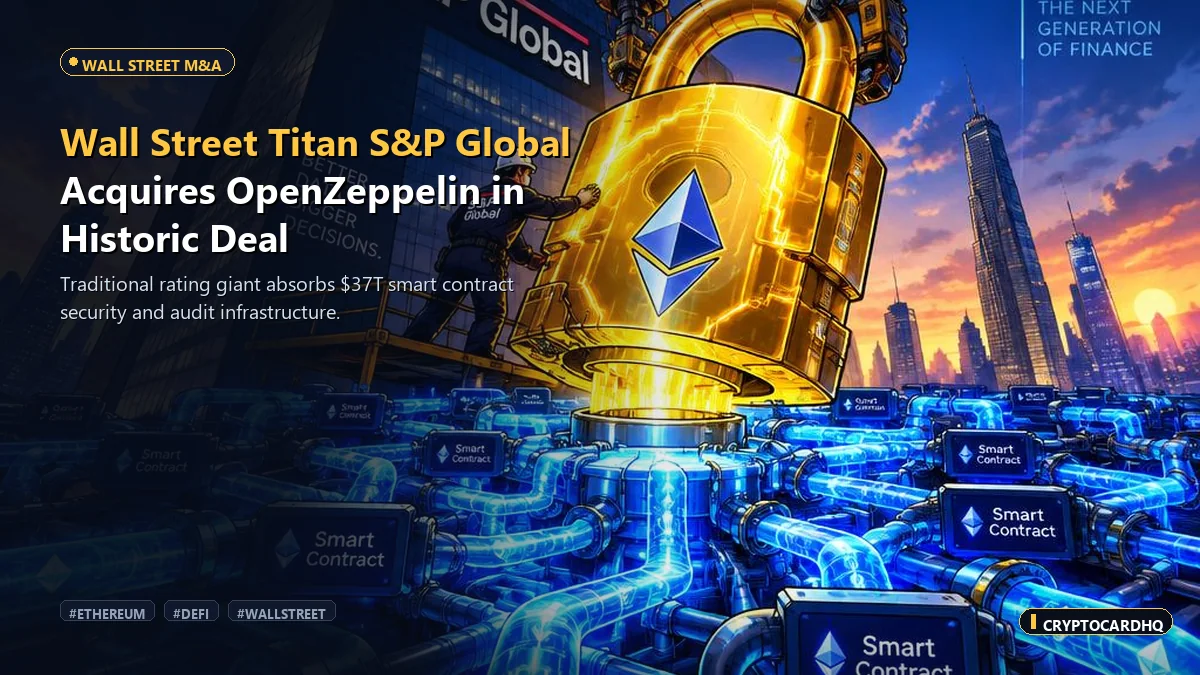
Wall Street powerhouse S&P Global has struck a definitive deal to acquire OpenZeppelin, the smart contract security and auditing firm whose code libraries form the backbone of decentralized finance. The acquisition brings Ethereum's foundational security layer directly under the umbrella of a century-old credit rating agency.
OpenZeppelin is far from an ordinary software consultancy. Its open-source repositories provide the canonical smart contract implementations—spanning ERC-20, ERC-721, and upgradeable proxy architectures—that power thousands of Web3 protocols. To date, OpenZeppelin's frameworks have facilitated more than $37 trillion in cumulative on-chain value transfers. By acquiring the shop outright, S&P Global shifts from issuing external crypto indices to controlling the core technical scaffolding of programmatic finance.
Key Takeaways
- Historic Wall Street Entry: Credit rating provider S&P Global has entered into an agreement to acquire smart contract auditing firm OpenZeppelin.
- $37 Trillion Track Record: OpenZeppelin's open-source contract libraries and runtime security monitoring have protected over $37 trillion in total on-chain transactions.
- Institutional EVM Scaffolding: S&P Global absorbs developer standards for token issuance, governance modules, and enterprise blockchain deployments.
- Calm Market Response: Digital asset prices held ground following the announcement, treating the transaction as institutional validation despite community debates over open-source neutrality.
Market Snapshot at Time of Reporting: At the time of reporting, BTC was trading at $76,719.17 (+1.28% 24h | Range: $75,064.82 - $77,179.47), while ETH hovered at $2,458.15 (+2.42% 24h | Range: $2,369.11 - $2,479.99).
Breaking Shock: Wall Street Absorbs Web3's Security Core
The acquisition agreement, first reported by Cointelegraph, puts S&P Global directly in charge of code hygiene for the Ethereum Virtual Machine (EVM). Since Ethereum's early days, OpenZeppelin has operated as an independent reference lab. Protocol teams lean on its battle-tested templates to sidestep catastrophic reentrancy exploits, integer logic bugs, and access-control vulnerabilities.
Practically every major decentralized application incorporates OpenZeppelin contracts as baseline inheritance classes. By bringing OpenZeppelin's researchers, audit desk, and automated security products in-house, S&P Global can create standardized code-risk ratings for investment banks, corporate treasuries, and asset managers preparing to tokenize private credit, treasuries, and money market funds.
Market & Structural Context: From Bond Ratings to Code Auditing
For generations, rating agencies scrutinized balance sheets, debt covenants, and legal filings. In smart-contract ecosystems, balance-sheet safety means nothing if the underlying code contains an exploit vector. Protocol solvency is determined by deterministic software execution.
As institutional investors prepare to deploy billions into tokenized real-world assets (RWAs), risk teams need institutional-grade assessments of code risks and composability hazards. Instead of hiring external consultants to read audit reports, S&P Global decided to acquire the firm that writes the code standards.
This shift fits into a broader pattern across digital assets. As covered in DeFi Sector Navigates Regulatory Crosscurrents as Total..., institutional liquidity is demanding rigorous, standardized technical compliance. The structural evolution is also visible in base-layer initiatives; as detailed in our analysis of the Ethereum Foundation Publishes CROPS Mandate: A 38-Page..., institutional requirements and smart contract security standards are converging quickly.
Key Figures & Operational Breakdown
| Operational Dimension | OpenZeppelin Baseline | S&P Global Post-Acquisition | Practical Market Impact |
|---|---|---|---|
| Transaction Footprint | $37+ trillion in facilitated transfers | Integrated into global corporate data services | Institutional validation of EVM standard security standards |
| Core Service Model | Independent code reviews and open repositories | Enterprise smart contract ratings and certifications | Institutional risk assessments for tokenized funds |
| Licensing Structure | Permissive open-source licenses (MIT) | Corporate-supported toolkits with commercial SLAs | Intense community scrutiny over repository neutrality |
| Target Audience | Web3 startups, decentralized protocols, DAOs | Investment banks, asset managers, corporate treasuries | Faster rollout of institutional asset tokenization (RWAs) |
Strategic Implications & Risks: The Neutrality Dilemma
While corporate boardrooms see the buyout as a natural bridge between Wall Street and decentralized ledgers, Web3 developers have raised three immediate questions:
- 1Licensing and Code Access: OpenZeppelin's public libraries are widely used because they are free, open-source, and permissive. Developers will watch whether S&P Global keeps future library releases open or pushes newer modules behind proprietary enterprise paywalls.
- 2Conflicts of Interest in Ratings: S&P Global makes its living rating corporate debt and structured products. If its own subsidiary audits the smart contracts behind a tokenized bond, assessing that product's risk profile could create an uncomfortable conflict of interest.
- 3Compliance Filtering: Developers worry that traditional corporate governance could pressure the OpenZeppelin team into inserting compliance filters, blacklists, or address-screening hooks into default contract templates.
Everyday Utility & Practical Takeaways for Crypto Holders
Institutional acquisitions can feel abstract, but they ripple down to everyday wallet operations and personal finance strategies.
- Stronger Protocol Baselines: More funding and enterprise focus behind standard libraries means fewer smart contract vulnerabilities in the protocols retail investors interact with every day.
- Real-World Spending Infrastructure: Cleaner, institutional-grade smart contract standards make it easier to tie on-chain liquidity to everyday payment rails. If you spend crypto yields through debit cards, check our breakdown in the Best Crypto Cards guide to see how modern card providers handle smart contract collateral.
- Tracking EVM Governance: Protocol upgrades and code standards shift quickly. Keep up with network changes and institutional adoption through our dedicated Ethereum News hub.
Catalysts & What to Watch Next
Over the coming weeks, market participants should watch for several concrete developments:
- Antitrust and Closing Disclosures: Filings outlining financial terms, closing timelines, and potential regulatory conditions.
- GitHub Commit Flow: Public commit history on OpenZeppelin's code repositories to confirm maintainer autonomy and open licensing remain intact.
- Competitor Reactions: Whether competing rating agencies like Moody's or Fitch seek their own acquisitions across the blockchain security sector.