
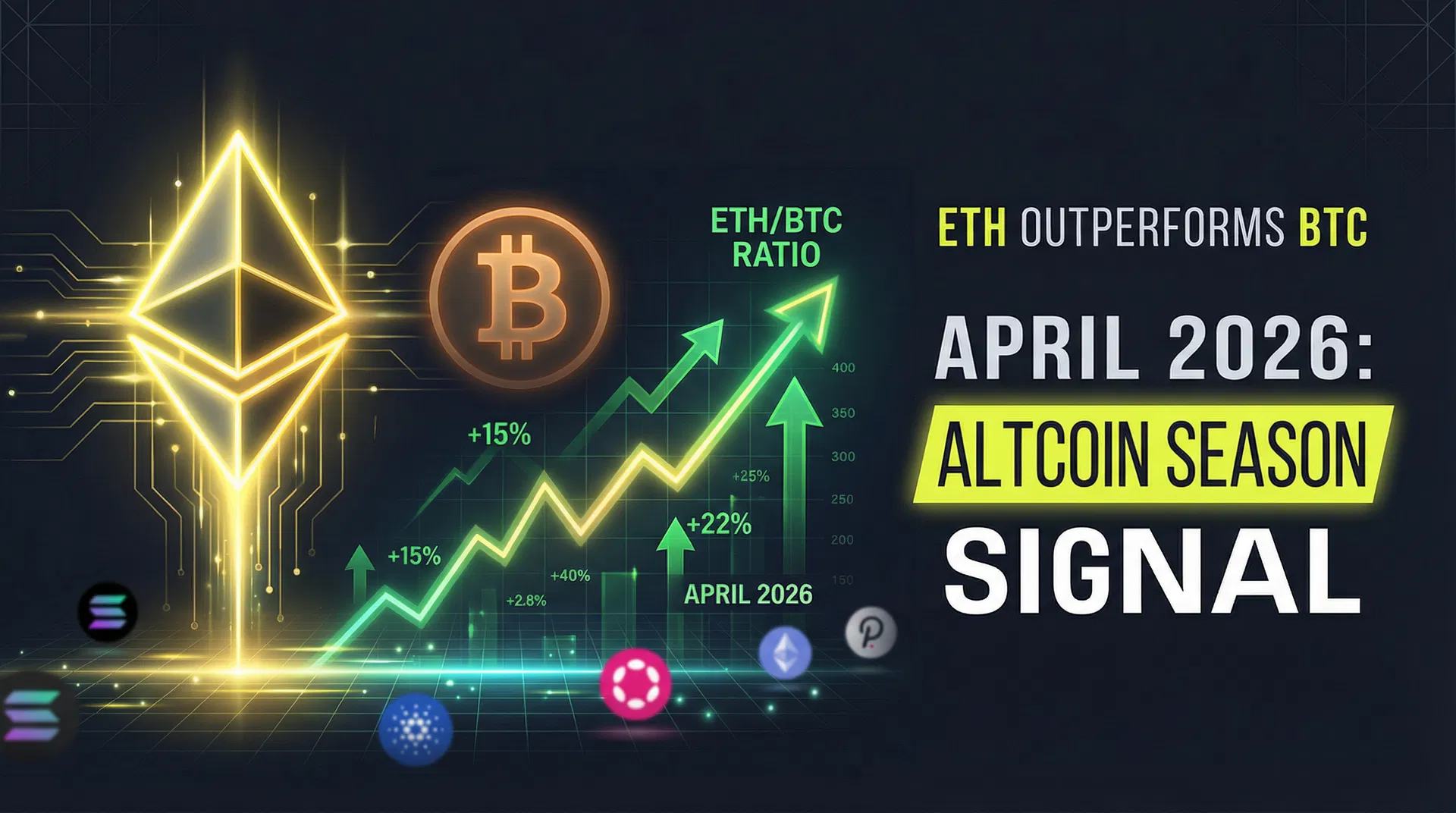
Something significant is happening beneath the surface of the crypto market in April 2026, and most investors are missing it. While Bitcoin's climb back above $70,000 has dominated the headlines, Ethereum has been quietly outperforming its larger rival — and the ETH/BTC ratio, one of the most closely watched metrics in the industry, is starting to move in a direction that historically precedes major altcoin rallies.
As of April 6, 2026, Ethereum posted a 24-hour gain of 5.42%, compared to Bitcoin's 4.23%. More significantly, the ETH/BTC ratio ticked upward for the first time in weeks, moving off multi-year lows near 0.028. Ethereum's market dominance, which had been sitting at a depressed 10.4%, also showed its first signs of recovery. For experienced market participants, these are not coincidences — they are signals.
Understanding the ETH/BTC Ratio
The ETH/BTC ratio measures how many Bitcoin one Ethereum is worth. When the ratio rises, it means Ethereum is gaining value relative to Bitcoin — a sign that capital is rotating from the market's safe haven into higher-risk, higher-reward assets. When the ratio falls, it typically indicates a risk-off environment where investors are consolidating into Bitcoin.
Historically, sustained moves upward in the ETH/BTC ratio have preceded broader altcoin seasons. The logic is straightforward: Ethereum is the gateway to the DeFi ecosystem, NFT markets, and the broader smart contract economy. When investors start buying Ethereum over Bitcoin, it often signals growing appetite for the riskier, higher-upside assets that are built on top of Ethereum.
The ratio's current position near 0.028 represents one of the lowest valuations for Ethereum relative to Bitcoin in years. From a mean-reversion perspective, this creates a compelling setup — either Ethereum is genuinely undervalued and due for a correction upward, or the market is pricing in a structural decline in Ethereum's relevance. The evidence, on balance, points toward the former.
What Changed in April 2026
Several catalysts have converged to shift sentiment toward Ethereum in the early weeks of April. The first is macro: the Iran ceasefire reports that triggered Bitcoin's short squeeze on April 6 also lifted the broader crypto market, but Ethereum's percentage gain exceeded Bitcoin's — a pattern consistent with early-stage risk-on rotation.
The second catalyst is structural. Ethereum's network activity has been quietly recovering after a difficult first quarter. Layer 2 transaction volumes on Arbitrum, Optimism, and Base have been growing steadily, and the total value locked in Ethereum-based DeFi protocols has stabilized after months of outflows. These on-chain metrics suggest that the underlying demand for Ethereum block space — and by extension, for ETH itself — is recovering.
The third factor is institutional. BlackRock's Ethereum ETF, which launched in March 2026, has been accumulating inflows at a pace that surprised many analysts. While the flows have been modest compared to the Bitcoin ETF, they represent a new and persistent source of demand that did not exist a year ago. Institutional buyers, unlike retail traders, tend to accumulate on weakness — and Ethereum's multi-year low against Bitcoin has created exactly the kind of weakness that long-term institutional buyers look for.
The Altcoin Season Question
The question on every trader's mind is whether Ethereum's outperformance signals the beginning of a broader altcoin season. Historical precedent is instructive but not definitive. In 2021, the ETH/BTC ratio began recovering in January before the broader altcoin market exploded in March and April. In 2023, Solana's recovery preceded a major altcoin rally by approximately six weeks.
The current setup shares characteristics with both of those periods. The ETH/BTC ratio is at historically low levels, providing significant room for recovery. Bitcoin dominance, while still elevated, has been showing signs of topping out. And the macro environment — with Iran ceasefire hopes reducing geopolitical risk and the Federal Reserve signaling a potential pause in rate hikes — is becoming more favorable for risk assets.
That said, altcoin seasons are not guaranteed, and timing them is notoriously difficult. The most reliable approach is to identify quality projects with genuine utility and accumulate them during periods of Bitcoin dominance, rather than trying to time the exact inflection point.
Ethereum's Competitive Position in 2026
Beyond the short-term price dynamics, it is worth examining Ethereum's competitive position in the broader blockchain landscape. Solana has emerged as a genuine competitor for DeFi and consumer applications, offering faster transaction speeds and lower fees. However, Ethereum's Layer 2 ecosystem has responded effectively, with networks like Base and Arbitrum offering comparable performance while inheriting Ethereum's security guarantees.
The Ethereum Foundation's CROPS mandate, published earlier in 2026, outlined a clear roadmap for continued protocol development focused on scalability, privacy, and developer experience. This institutional clarity — combined with the growing adoption of Ethereum-based stablecoins and real-world asset tokenization — provides a strong fundamental case for Ethereum's long-term value.
Practical Implications for Investors
For investors considering exposure to Ethereum, the current ETH/BTC ratio provides a useful reference point. Buying Ethereum when the ratio is at historically low levels and selling when it reaches historically high levels has been one of the more reliable strategies in crypto — not because the ratio is a perfect predictor, but because it captures the cyclical nature of capital rotation in the market.
For those who want to use their crypto holdings in everyday life, crypto debit cards that support Ethereum and ERC-20 tokens provide a practical way to access your holdings without selling. Several of the best crypto cards of 2026 now support direct spending from Ethereum wallets, making it easier than ever to use your ETH for everyday purchases.
If you are looking to trade Ethereum or accumulate during this potential rotation, our best crypto cards guide covers the platforms with the deepest ETH liquidity, lowest fees, and strongest security track records.