
As the Federal Open Market Committee (FOMC) convenes for its monumental September 16, 2026 interest rate decision, global financial markets have been violently rocked by an unexpected macroeconomic whiplash. Just weeks ago, institutional consensus and speculative commentary projected the continuation of monetary easing and anticipated a potential 25 basis point rate cut. Today, that narrative has dissolved into thin air.
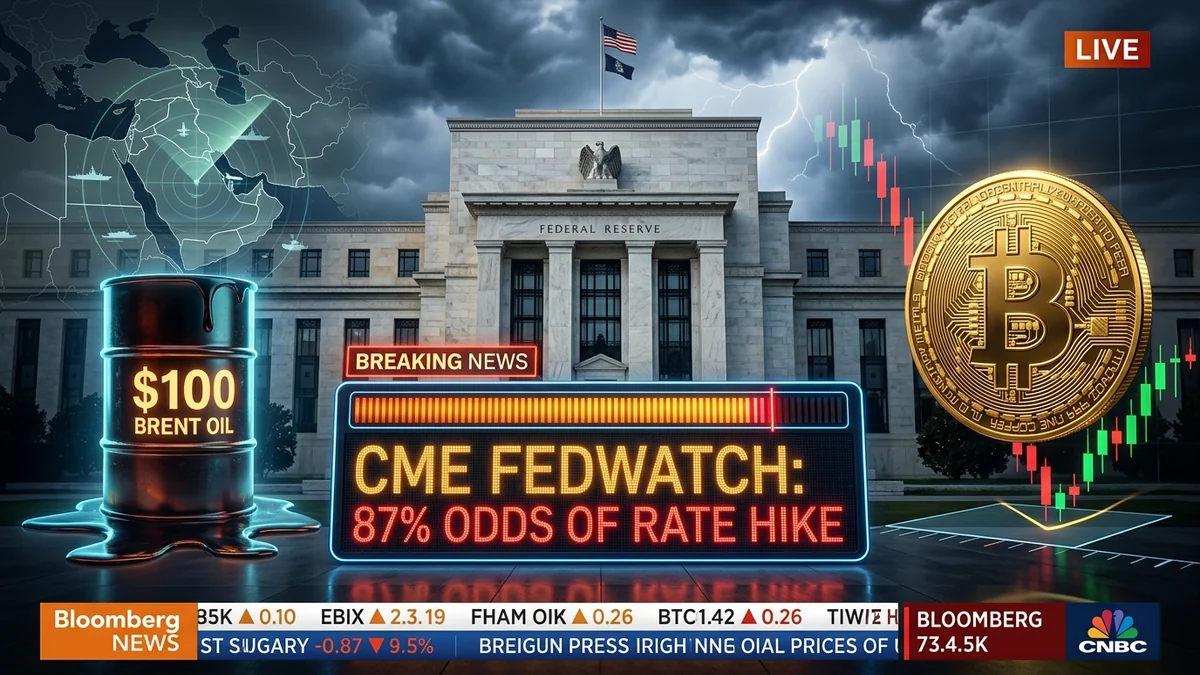
According to real-time interest rate futures on the CME FedWatch Tool, market participants have priced in an overwhelming 87% to 93% probability that the Federal Reserve will raise the federal funds target rate by 25 basis points, lifting the benchmark corridor from 3.50%–3.75% to 3.75%–4.00%. If realized, this decision marks the Federal Reserve's first interest rate hike since 2023, effectively ending the easing interlude and reigniting intense fears of stagflation across global equities, digital assets, and commodities.
The sudden hawkish pivot has triggered a ferocious liquidity drain. Bitcoin ($BTC) has slid aggressively from its summer highs, breaching intermediate psychological supports to trade between $75,800 and $77,500 as over $420 million in leveraged long positions were vaporized across derivatives exchanges within a single 24-hour trading window. Compounding the monetary shock is an escalating geopolitical crisis in the Persian Gulf between the United States and Iran, which has driven Brent crude oil soaring above $102 per barrel, reignited domestic inflation to a stubborn 3.4% CPI print, and paralyzed legislative progress on Capitol Hill following the Senate's sudden failure to pass the landmark Digital Asset Market Clarity Act.
In this exhaustive macro briefing, CryptoCardHQ breaks down the critical mechanics driving tomorrow's Fed decision, models the 24-hour volatility scenarios for Bitcoin and traditional stocks, investigates the geopolitical oil-to-crypto contagion line, and outlines the essential defensive playbook for cardholders seeking to shield their capital with stablecoins.
Executive Snapshot: The September 16 Fed Decision & Market Impact
| Key Metric / Macro Catalyst | Current Market State | Expected FOMC Shift | Primary Impact on Bitcoin & Crypto |
|---|---|---|---|
| Federal Funds Target Rate | 3.50% – 3.75% | 3.75% – 4.00% (+25 bps) | Cost of speculative capital rises; short-term liquidity contraction |
| CME FedWatch Probability | 87.2% Hike / 12.8% Pause | 100% Final Determination | Binary volatility event; "sell the rumor, buy the news" potential |
| US Headline CPI Inflation | 3.4% Annualized | Target remains 2.00% | Eliminates hopes of near-term rate cuts; forces restrictive stance |
| Global Brent Crude Oil | $102.40 / Barrel | Supply risk premium ongoing | Energy inflation feeds directly into shipping, electricity, and living costs |
| Bitcoin Price & Technical Zone | $76,400 (-4.2% in 24h) | Support: $74,200 / Res: $79,800 | Liquidated $420M+ longs; heavy spot accumulation at $74K-$75K |
| US 10-Year Treasury Yield | 4.98% (Testing 5.05%) | Multi-month high | High sovereign yields compete directly against risk assets and tech |
| Capitol Hill Regulatory Status | Senate Clarity Act Stalled | Cloture vote failed (48-51) | Industry structural clarity delayed; SEC enforcement remains hostile |
| Crypto Card Defense Strategy | USDT / USDC Yield Spending | 0% Conversion Spreads | Users convert volatile holdings to stablecoins on RedotPay & Kast |
1. The 87% Probability Shock: Inside Tomorrow's FOMC Crucible
To understand why markets are reacting with such violent turbulence, one must appreciate how violently the interest rate trajectory has inverted over the past thirty days. Following the Jackson Hole Economic Symposium in late August, where Federal Reserve leadership signaled an unyielding commitment to stamping out second-wave inflation, institutional trading desks began aggressively unwinding their dovish bets.
The Federal Reserve's dilemma boils down to a classic central banking nightmare: supply-side inflation driven by geopolitical warfare colliding with resilient consumer demand.
When the August Consumer Price Index (CPI) printed at 3.4% year-over-year—significantly above the Federal Reserve's long-term 2.0% mandate—the bond market sounded an immediate alarm. Treasury yields across the curve spiked, with the benchmark 10-Year yield aggressively challenging the pivotal 5.0% threshold.
According to CME Group's FedWatch Tool, which calculates implied probabilities derived from 30-day Fed Funds futures pricing: - 87.2% of traders are pricing in an immediate 25 basis point hike to 3.75%–4.00%. - 12.8% price in a reluctant "hawkish pause" at 3.50%–3.75%. - 0.0% of participants expect a rate cut.
The psychological consequence of this shift cannot be overstated. Throughout 2024 and 2025, Wall Street equity strategists and cryptocurrency bulls built their models on the assumption that global liquidity would expand steadily into late 2026. A rate hike completely upends those DCF (Discounted Cash Flow) calculations, elevating the discount rate applied to risk assets, depressing price-to-earnings multiples across the Nasdaq, and tightening margin lending facilities across major prime brokers.
2. The Geopolitical Crucible: USA-Iran Conflict, $100 Oil, and Strait of Hormuz Risks
Central banks do not raise rates in a vacuum. The primary catalyst forcing the Federal Reserve's hand is not an overheating domestic manufacturing boom, but rather a violent geopolitical escalation in the Middle East that has ruptured global energy supply chains.
The conflict between the United States, its regional allies, and Iran has intensified sharply in mid-September 2026. Military strikes targeting ballistic missile sites and retaliatory maritime harassment in both the Strait of Hormuz (through which roughly 20% of the world's petroleum passes) and the Bab el-Mandeb Strait have driven commercial shipping insurance rates to all-time highs.
Key Geopolitical Developments Impacting the Economy:
- 1Crude Oil Price Explosion: Brent crude has breached $102.40 per barrel, while West Texas Intermediate (WTI) trades firmly above $97.80. Energy analysts at Goldman Sachs and Morgan Stanley estimate that as long as tanker passage through Hormuz remains under naval escort and subject to drone interception, global oil flows will carry an embedded $15-to-$20 geopolitical risk premium.
- 2The Inflation Feedback Loop: Energy prices are an unyielding regressive tax on production. Higher diesel and jet fuel prices instantly transmit into higher freight costs, grocery prices, and airline tickets. This ensures that headline CPI will remain elevated well into the fourth quarter, depriving the Federal Reserve of any justification to cut rates.
- 3Department of Justice Crypto Crackdown: Underscoring the intersection of geopolitics and digital assets, the U.S. Department of Justice on September 14 unsealed a historic civil forfeiture complaint seeking over $61 million in cryptocurrency. The DOJ alleged that illicit trading networks utilized cryptocurrency protocols and offshore accounts on Binance to launder proceeds from sanctioned Iranian oil shipments directly into funding conduits for the Islamic Revolutionary Guard Corps (IRGC). This enforcement action has cast an immediate regulatory cloud over sovereign compliance and cross-border OTC crypto desks.
3. Regulatory Whiplash: The Senate Stalls the Clarity Act
As if central bank monetary tightening and Middle Eastern warfare were not enough, the cryptocurrency industry absorbed another severe blow from Washington D.C. on September 15.
The Digital Asset Market Clarity Act—widely hailed as the most comprehensive legislative framework for US digital assets since the inception of Bitcoin—unexpectedly failed to advance in the United States Senate. A crucial procedural cloture vote fell short of the required 60-vote threshold, ending at 48 in favor and 51 opposed, after bipartisan negotiations fractured over jurisdiction between the CFTC and SEC, stablecoin yield provisions, and anti-money laundering (AML) mandates tied to geopolitical sanctions.
The stalling of the Clarity Act has immediate operational consequences:
- SEC Enforcement Authority Reaffirmed: Without statutory boundaries codified by Congress, the SEC's regulatory posture under existing securities law remains intact, leaving altcoins and DeFi liquidity pools exposed to continued litigation.
- Institutional Hesitancy: Corporate treasuries and conservative pension allocations that were preparing to deploy capital under the Clarity Act's explicit safe-harbor rules have suspended execution until after the upcoming mid-term legislative cycle.
- Stablecoin Yield Scrutiny: Traditional banking lobbyists successfully argued that allowing yield-bearing stablecoins without reserve FDIC compliance would cannibalize regional bank deposits, leaving stablecoin providers to operate primarily under state trust and European MiCA frameworks.
4. Bitcoin Price Action: Liquidations, Technical Support, and the Dual Thesis
How has Bitcoin responded to this storm of macro headwinds? Predictably, the initial reaction has been characterized by sharp, volatile deleveraging.
Over the past 48 hours, Bitcoin tumbled from $79,400 to tap an intraday low of $75,820 before consolidating around $76,400. According to on-chain liquidation data from CoinGlass and Binance order book heatmaps:
- Total 24h Liquidations: Exceeded $425 million across all crypto derivatives, with long traders accounting for 84% of total liquidations.
- Open Interest Contraction: Aggregate Bitcoin futures open interest dropped by 6.8%, signaling that speculative leverage was aggressively flushed from the system rather than spot investors panic-selling.
- The $74,200 Support Wall: Massive institutional bid clusters are stacked between $74,000 and $75,200, representing the average cost-basis of spot Bitcoin ETF inflows recorded during the spring accumulation wave.
The Dual Thesis: Short-Term Pain vs. Long-Term Supremacy
To navigate this volatility, seasoned investors distinguish between Bitcoin's short-term market beta and its structural macro destiny:
1. The Short-Term Reality (Risk-Off Liquidity Drag): In the immediate aftermath of an unexpected central bank rate hike or war panic, Bitcoin trades as a high-beta liquidity asset. Hedge funds and multi-asset trading desks face margin calls in their traditional bond and equity portfolios; to meet liquidity demands, they sell whatever is liquid 24 hours a day, 7 days a week. Because crypto never closes, Bitcoin acts as the market's global liquidity release valve.
2. The Medium-to-Long-Term Thesis (Non-Sovereign Hard Money): Historically, geopolitical conflicts and runaway energy crises inevitably culminate in sovereign debt expansion and currency debasement. Wars cannot be funded through tax revenue alone; they are financed through monetization of debt. As central banks eventually discover that rate hikes cannot drill for more oil or manufacture more shipping containers, stagflation will set in. When governments are forced to return to quantitative easing to prevent sovereign bond yields from collapsing the banking system, Bitcoin's mathematically capped 21-million supply becomes the premier global hedge against fiat decay.
5. The Fed vs. AI & Big Tech: Wall Street Valuations Under Fire
The ripple effect of tomorrow's anticipated rate hike extends directly into the artificial intelligence boom that has anchored the S&P 500 and Nasdaq throughout 2026.
Over the past eighteen months, tech titans like Nvidia (NVDA), Microsoft, and Alphabet have commanded historically elevated valuation multiples, driven by trillions of dollars in projected capital expenditures on GPU compute clusters and AI infrastructure. However, high interest rates fundamentally alter the cost of that capital.
The AI Tech Equity vs. AI Crypto Token Divergence:
- Tech Stock Multiple Compression: When the risk-free rate sits at 4.00% and 10-year Treasuries yield near 5.0%, institutional fund managers demand a much higher equity risk premium. High-multiple growth equities that do not produce immediate quarterly cash flow become prime candidates for profit-taking.
- Decentralized AI Crypto Resiliency: Conversely, decentralized compute and intelligence protocols such as Bittensor ($TAO), Render Network ($RENDER), and Near Protocol ($NEAR) operate on decentralized token incentive models rather than multi-billion-dollar corporate debt facilities. While traditional cloud providers face escalating interest expenses on debt-financed data center builds, decentralized protocols crowd-source compute from global nodes, providing a cost-effective alternative that thrives in tight monetary regimes.
6. Financial Self-Defense: Protecting Purchasing Power with Crypto Cards
When central banks hike interest rates to combat 3.4% CPI inflation while geopolitical conflict sends energy costs through the roof, everyday consumers face a silent wealth confiscation: fiat currency loses domestic purchasing power faster than traditional savings accounts can compensate.
In response, savvy cryptocurrency investors are pivoting away from holding depreciating local bank balances, instead deploying high-yield stablecoin architectures paired with institutional crypto payment cards. By locking value into dollar-pegged stablecoins (USDT and USDC) and spending directly via Visa and Mastercard networks, users enjoy sovereign borderless liquidity with zero conversion friction.
Top Crypto Cards for Navigating the Macro Crunch:
1. **RedotPay Crypto Card (Editor's Top Pick): - Why It Excels Now: Available in over 180 countries, RedotPay allows direct deposits of USDT, USDC, BTC, and ETH with 0% top-up fees. Users can instantly provision virtual Visa cards to their Apple Pay or Google Pay wallets, enabling immediate everyday spending at grocery stores, gas pumps, and online retailers worldwide without paying predatory foreign exchange spreads. - Deep Dive**: Read our full RedotPay Card Review.
2. **Kast Card (Best for High-Volume Users): - Why It Excels Now: Kast delivers institutional-grade virtual and physical cards backed by automated zero-spread conversions on stablecoins. For freelancers and global investors earning in crypto, Kast completely bypasses traditional cross-border wire delays. - Direct Comparison**: Explore our head-to-head RedotPay vs. Kast Card Comparison.
3. **Bitget Card: - Why It Excels Now**: Seamlessly connects to Bitget Wallet and exchange accounts, providing high daily ATM withdrawal limits and up to 8% cashback tiers for active traders hedging market swings.
4. **Rizon Card: - Why It Excels Now**: Tailored for cross-border digital nomads seeking zero foreign exchange fees and high monthly spending caps across Europe and Asia.
7. The FOMC Playbook: Three Volatility Scenarios for Tomorrow
As the clock ticks down toward the Federal Reserve's official 2:00 PM EST policy announcement and Chair Powell's subsequent 2:30 PM press conference on September 16, market participants should prepare for three distinct volatility paths:
Scenario A: The 25bps Hike with Hawkish Dot Plot (87% Probability)
- The Action: The Fed increases the benchmark rate to 3.75%–4.00%, citing sticky 3.4% CPI and energy uncertainty. The updated "dot plot" signals rates will stay restrictive through mid-2027.
- The Market Reaction: Because this move is almost entirely priced into derivatives, expect an initial knee-jerk flush down to test the $74,500 – $75,200 support cluster, followed by a classic "sell the rumor, buy the news" relief bid as macro uncertainty is temporarily eliminated.
Scenario B: The Tactical Hawkish Pause (10% Probability)
- The Action: The Fed holds rates steady at 3.50%–3.75%, but issues an aggressively stern statement warning that an October hike remains firmly on the table if Brent oil remains above $100.
- The Market Reaction: A violent short squeeze across digital assets. Bitcoin aggressively rips back through $78,500 and tests $80,000 as overleveraged macro shorts are caught off-guard.
Scenario C: The Shock 50bps Escalation (3% Tail Risk)
- The Action: In an emergency maneuver reminiscent of the 1970s Volcker Fed, the FOMC delivers a 50 basis point rate shock to quash oil-driven inflation expectations immediately.
- The Market Reaction: Extreme risk-off panic. Bitcoin briefly loses $74,000 to hunt liquidity in the $70,500 – $72,000 zone, while traditional equities experience a circuit-breaker test.
1. Why is the Federal Reserve considering an interest rate hike instead of a rate cut?
The Federal Reserve's primary statutory mandate is price stability (maintaining 2.0% inflation). While economic growth had been moderating, the sudden resurgence of headline CPI to 3.4% in August, combined with a violent geopolitical escalation in the Middle East pushing Brent crude oil above $102 per barrel, has created a severe stagflation risk. Lowering rates would pour monetary fuel on an already burning inflation fire; raising rates by 25 basis points allows the Fed to defend its credibility and cool speculative demand.
2. What are the CME FedWatch odds, and how reliable are they?
The CME FedWatch Tool calculates the conditional probabilities of future Federal Open Market Committee (FOMC) target rates based on the actual traded prices of 30-day Federal Funds futures contracts traded on the Chicago Mercantile Exchange. With over 87% of market open interest pricing in a 25 basis point hike, the probability reflects billions of dollars in real institutional hedging capital rather than opinion polls.
3. How does a Fed rate hike directly impact Bitcoin's price?
In the short term, higher interest rates make the "risk-free" yield on sovereign Treasury bills and cash deposits more attractive, raising the opportunity cost of holding non-yielding speculative assets like Bitcoin. Institutional investors often reduce leverage and sell high-beta assets to cover margin requirements. However, in the medium to long term, rate hikes caused by war and energy inflation highlight the fundamental fragility of fiat monetary systems, reinforcing Bitcoin's value proposition as decentralized digital gold with an immutable supply.
4. Why did the Senate Clarity Act fail, and what does it mean for crypto?
On September 15, the Digital Asset Market Clarity Act failed to pass a procedural cloture vote in the U.S. Senate (ending 48-51). The legislation stalled over disagreements regarding CFTC vs. SEC jurisdictional boundaries, regulatory requirements for yield-bearing stablecoins, and national security provisions following the DOJ's seizure of $61 million in crypto tied to Iranian oil laundering. The failure means comprehensive legislative clarity is delayed, leaving the industry under existing SEC oversight.
5. How can crypto cardholders protect their funds during this volatility?
During periods of violent market swings and currency debasement, cardholders can mitigate volatility by converting a portion of their holdings into dollar-backed stablecoins like USDT or USDC. By using global crypto payment cards such as **RedotPay (offering 0% top-up fees and instant Apple/Google Pay in 180+ countries) or Kast** (with zero conversion spreads), users preserve their purchasing power while retaining the ability to spend their capital seamlessly in the real economy.
*Disclaimer: This article is for informational and educational purposes only and does not constitute financial, investment, legal, or tax advice. Macroeconomic indicators, central bank policies, and cryptocurrency markets are subject to high volatility. Always conduct independent research and consult a licensed financial professional before making investment decisions.*