

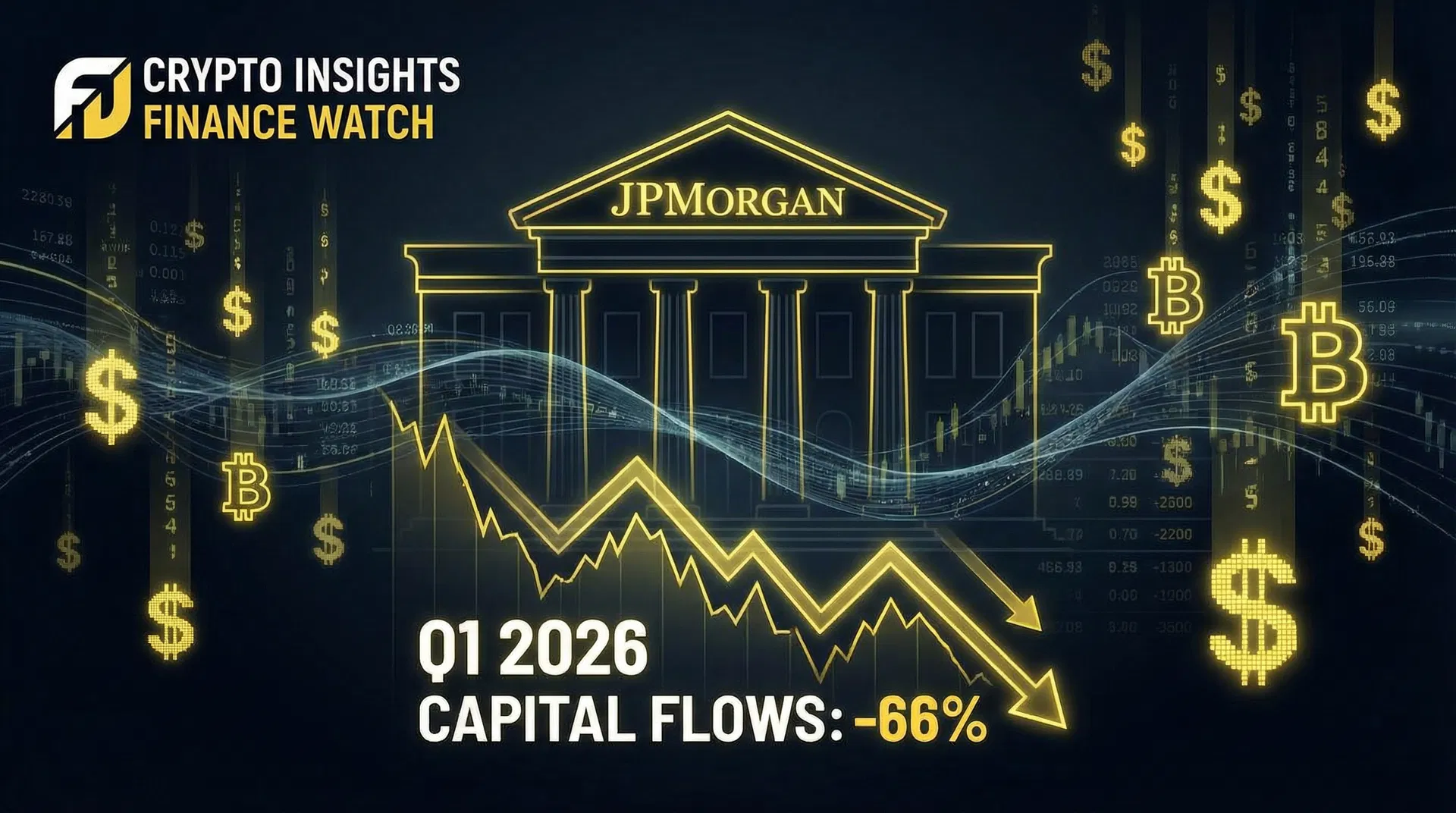
JPMorgan, the world's largest bank by assets, has published a sobering assessment of the cryptocurrency market's first quarter of 2026. According to the bank's research team, capital flows into the crypto sector fell to approximately $11 billion in Q1 2026 — roughly one-third of the $33 billion that flowed into the space during the same period in 2025. The 66% decline represents the sharpest quarterly drop in institutional crypto interest since the bear market of 2022.
The report, which circulated widely among institutional investors on April 6, 2026, has prompted a range of interpretations. Bears point to it as evidence that the crypto bull cycle is exhausted and that institutional enthusiasm is waning. Bulls counter that reduced inflows during a period of geopolitical uncertainty and Federal Reserve hawkishness are entirely expected, and that the underlying infrastructure of institutional crypto adoption — ETFs, custody solutions, regulatory frameworks — continues to strengthen.
The truth, as is often the case in financial markets, is more nuanced than either camp acknowledges.
Breaking Down the $11 Billion Figure
To understand what JPMorgan's $11 billion figure actually represents, it is important to understand what it measures. The bank's analysts track capital flows into crypto-related investment products — primarily Bitcoin and Ethereum ETFs, crypto-focused funds, and publicly traded crypto companies — rather than direct on-chain activity. This means the figure captures institutional and retail investment through traditional financial channels, not the full picture of crypto market activity.
By this measure, Q1 2025 was an exceptional period. The approval and launch of spot Bitcoin ETFs in the United States in early 2024 had created a wave of pent-up institutional demand that continued to flow into the market through the first half of 2025. The $33 billion figure from Q1 2025 was, in retrospect, an anomaly driven by a one-time structural change in market access rather than a sustainable run rate.
Comparing Q1 2026 to Q1 2025 without this context creates a misleading picture. A more useful comparison is to Q1 2023 or Q1 2022, when the institutional infrastructure was less developed. By that measure, $11 billion in a single quarter still represents a historically significant level of institutional engagement with the crypto asset class.
What Drove the Decline
Several factors contributed to the reduced inflows in Q1 2026. The most significant was the macroeconomic environment. The Federal Reserve maintained its hawkish stance on interest rates throughout the quarter, keeping the cost of capital high and reducing appetite for risk assets across the board. Crypto, despite its growing institutional legitimacy, is still classified as a risk asset by most portfolio managers, and it tends to underperform during periods of tight monetary policy.
Geopolitical uncertainty also played a role. The escalation of tensions in the Middle East, which culminated in the Iran war that began in late 2025, created a risk-off environment that drove capital toward traditional safe havens — gold, US Treasuries, and the Swiss franc — rather than digital assets. Bitcoin's reputation as "digital gold" has grown, but it has not yet fully displaced traditional safe-haven assets in institutional portfolios during acute geopolitical crises.
Finally, the regulatory environment in several key markets remained uncertain. While the United States made significant progress with the Crypto Clarity Act and the SEC's new framework for digital asset classification, implementation has been slow, and many institutional investors are waiting for clearer rules before committing additional capital.
The Bullish Interpretation
Despite the headline decline, several elements of JPMorgan's report support a more optimistic reading. The bank noted that the composition of inflows has shifted meaningfully toward longer-duration, strategic allocations rather than short-term speculative positions. Family offices and sovereign wealth funds, which typically have multi-year investment horizons, accounted for a larger share of Q1 2026 inflows than in previous quarters.
This shift in investor composition is significant. Short-term speculative capital is volatile and tends to exit quickly when prices fall. Long-term strategic capital is stickier and provides a more stable foundation for price recovery. The fact that the remaining inflows are increasingly coming from patient, long-term investors is a structural positive for the market.
Additionally, the report noted that outflows from crypto investment products were minimal during Q1 2026, despite the challenging environment. Investors who had previously entered the market largely held their positions, suggesting conviction in the long-term thesis even as new inflows slowed.
Implications for the Rest of 2026
JPMorgan's analysts offered a cautiously optimistic outlook for the remainder of 2026. The bank's base case assumes that a combination of Federal Reserve rate cuts in the second half of the year, continued regulatory clarity, and the next Bitcoin halving cycle will drive a recovery in capital flows. The bank's crypto strategists maintained their year-end Bitcoin price target of $120,000, though they acknowledged significant uncertainty around the timing and magnitude of any recovery.
For the broader crypto market, the JPMorgan report serves as a useful reality check. The market is not in freefall — $11 billion in quarterly inflows is still a substantial number — but the extraordinary pace of institutional adoption seen in 2024 and early 2025 has normalized. Going forward, growth in institutional crypto investment will likely be more gradual and more dependent on fundamental developments in regulation, technology, and macroeconomic conditions.
What This Means for Everyday Crypto Users
While institutional capital flows are important for price discovery and market stability, they are not the only measure of crypto's progress. On-chain activity, developer activity, and the growth of crypto's practical use cases — payments, DeFi, tokenization — continue to expand regardless of institutional investment cycles.
For individuals looking to participate in the crypto economy, the current environment offers an opportunity to build positions at prices that reflect institutional caution rather than institutional enthusiasm. Crypto cards with strong security and competitive fees remain the most accessible entry point for new investors.
For those who want to integrate crypto into their daily financial lives, crypto debit cards have continued to expand their features and geographic availability regardless of institutional flow cycles. The best cards of 2026 offer competitive cashback rewards, stablecoin support, and seamless integration with major payment networks — making them a practical tool for anyone who holds digital assets.