
If you’ve been watching the charts this week, you know something felt distinctly off. While the rest of the altcoin graveyard was busy doing its usual impression of a melting glacier, Bittensor (TAO) decided to strap a couple of afterburners to its back and launch straight into the stratosphere.
Let's be completely candid. Crypto markets love a good regulatory plot twist, but the sudden vaporization of nearly $50 million in bearish bets wasn't just blind luck. It was the result of a textbook short squeeze, a macro environment gasping for fiscal relief, and Washington suddenly remembering that decentralized artificial intelligence exists outside the comfortable, rubber-stamped echo chambers of Silicon Valley venture capital firms.
Here is what the mainstream financial press completely missed while they were busy hyperventilating over traditional banking earnings reports.
What Happened
Treating decentralized AI like a standard Software-as-a-Service startup is like strapping a rocket booster to a horse cart—it’s exhilarating right up until the structural reality collapses under you. For months, protocols building open-source machine learning networks operated under a suffocating cloud of regulatory anxiety. The SEC used to view anything involving distributed token rewards and unpermissioned node validators with the warmth of a cornered rattlesnake.
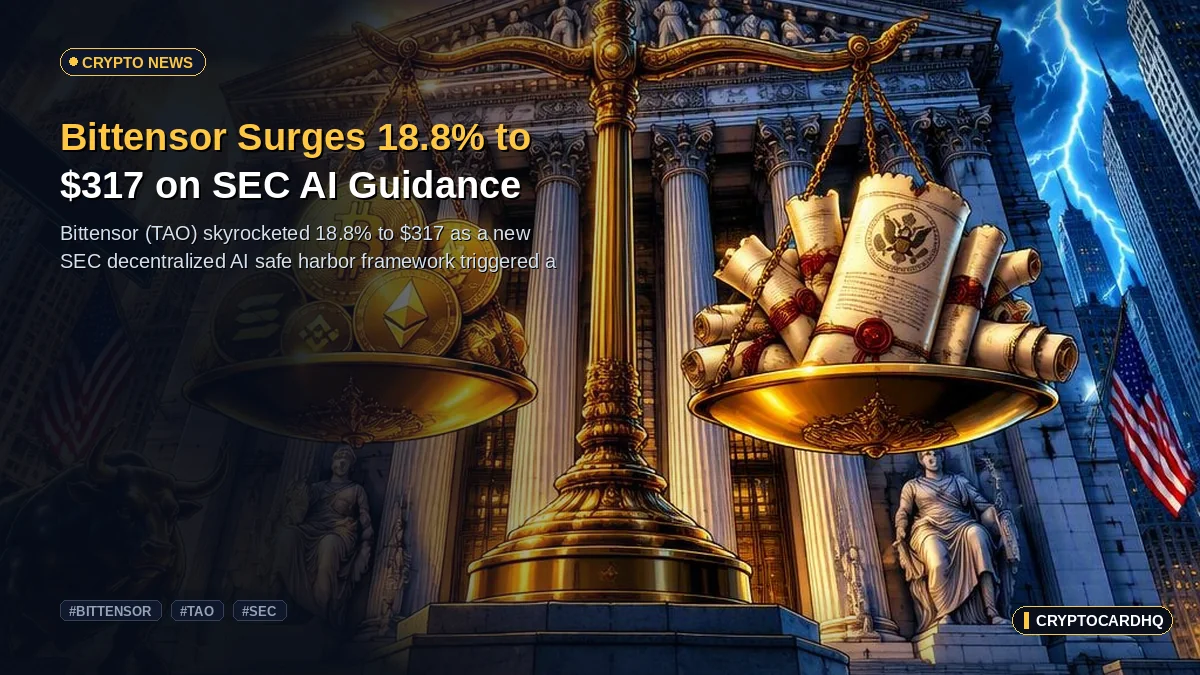
Then came the policy pivot. SEC Chair Paul Atkins dropped a tailored regulatory safe harbor framework specifically built for decentralized AI protocols. Just like that, the immediate compliance friction vaporized for networks like Bittensor. For months, institutional desks and hedge fund quants had loaded up on short positions, pricing in regulatory doom, heavy-handed enforcement actions, and a perpetual winter for compute-sharing tokens.
Add a splash of macro sugar to the regulatory cocktail. U.S. 10-Year Treasury yields stabilized at 4.25% ahead of tomorrow's anticipated 25-basis-point FOMC rate cut. When the risk-free rate stops looking quite so appetizing, capital invariably cascades down the risk curve. Risk-on flows slammed directly into high-beta altcoins, and Bittensor was sitting right at the front of the line with its bags packed.
| Market Variable | Previous Status | Current Catalyst | Market Impact |
|---|---|---|---|
| SEC Policy | Hostile Ambiguity | Safe Harbor Framework | Massive Short Coverage |
| 10-Yr Treasury | Climbing / Volatile | Stabilized at 4.25% | Risk-On Altcoin Rotation |
| FOMC Expectations | Hawkish Pause | 25-bps Cut Priced In | Liquidity Expansion |
Market Reaction and On-Chain Data
Markets don't move linearly; they move by violently liquidating the most arrogant people in the room. TAO printed a scorching 18.86% 24-hour gain to reach $317.00, but the price tag tells only half the story.
The real fireworks happened in the derivatives ledger. According to Coinglass-tracked exchanges like Binance and Bybit, a cascading short squeeze wiped out $48.2 million in derivative liquidations in a matter of hours. Bears who had been aggressively shorting every minor bounce suddenly found themselves trapped in a burning theater with the exit doors locked from the outside. Margin calls triggered automatic buy-orders, which pushed the price higher, which triggered *more* margin calls. It is the oldest, most beautiful feedback loop in modern finance.
Order books on major spot exchanges thinned out dramatically as liquidity providers pulled their asks to reprice risk. When institutional algorithms realized the regulatory rug wasn't going to be pulled, they had to chase the market higher. Funding rates swung wildly into negative territory before flipping positive as late retail FOMO flooded the order books.
The CryptoCardHQ Takeaway: Volatility isn't a bug in crypto; it's the entire business model. When regulatory clarity collides with leveraged short positions, the resulting price velocity can rewrite portfolio balances overnight—making real-time asset management more critical than ever.
What It Means for Crypto Cards & Everyday Spending
Most market commentary treats price action as an abstract scoreboard for wealthy speculators sitting in glass towers. But what happens on the charts eventually hits the real world—specifically, the plastic in your wallet.
If you are funding your daily expenses using a digital asset debit card, violent 18% swings are a mixed blessing. On one hand, sudden token appreciation instantly fattens your available purchasing power. On the other hand, high-beta assets like TAO can whipsaw just as fast as they pump. Spending volatile collateral without dynamic conversion protocols is a great way to accidentally buy a cup of coffee for the equivalent of a second mortgage when the local trend reverses.
This is precisely why smart digital asset holders rely on specialized tools to navigate sudden market expansions. Rather than guessing the local top, users are increasingly utilizing our best crypto cards to lock in gains or automatically route spending through stablecoin layers during high-volatility events. If you want to see how different issuers handle real-time asset conversion, slippage protection, and reward yields, our crypto card comparison tool breaks down the exact mechanics without the marketing fluff.
If you prefer to keep a macro eye on the broader digital economy while managing your daily card portfolio, keeping tabs on bitcoin news today and our broader editorial stream at /news gives you the baseline baseline before altcoin liquidity starts playing catch-up.
Where the Risk Hides
Let’s pump the brakes before we all start shopping for superyachts denominated in decentralized compute tokens.
Skeptics will rightly point out that regulatory safe harbors from agency chairs are not acts of statutory legislation. Chair Atkins' guidance provides breathing room, but it doesn't offer permanent immunity from future congressional overhauls or aggressive judicial challenges. Also, a $48 million liquidation event is a drop in the ocean compared to the billions sloshing through TradFi derivative markets.
There is also the underlying tokenomics of incentivized AI subnets to consider. Bittensor relies on continuous token emission to reward miners and validators. If token price surges outpace actual enterprise utility or real-world compute demand, you are simply looking at a high-speed reflexive loop driven entirely by momentum traders and regulatory relief euphoria. When the short squeeze exhausts its momentum, gravity has a funny way of reasserting itself.
A Practical Checklist for Users
- ✓Review Your Auto-Conversion Rules: Ensure your card profile is set to automatically liquidate volatile holdings into stablecoins if intraday price swings exceed predetermined volatility thresholds.
- ✓Monitor Order Book Depth: Check major exchange liquidity metrics before executing large asset top-ups or spending cycles during high-beta rallies.
- ✓Utilize Comparison Metrics: Use our crypto card comparison tool to evaluate which card issuers offer the best slippage protection during sudden market expansions.
- ✓Secure Profit Margins: Consider locking in staking rewards or capital gains into stable yield layers rather than leaving daily spending balances exposed to sharp structural pullbacks.
Our takeaway
The explosive rally in Bittensor proves once again that regulatory clarity acts as the ultimate liquidity unlock for nascent tech sectors. However, treating a leveraged short squeeze as a fundamental green light for reckless spending is a fast track to portfolio destruction. As crypto cardholders, the smartest approach is to tap into these macro tailwinds to optimize your purchasing power, utilize dynamic stablecoin routing, and always respect the gravity of high-beta markets.
What caused the sudden surge in Bittensor (TAO)?
TAO surged nearly 19% to hit $317 due to a combination of SEC Chair Paul Atkins announcing a tailored regulatory safe harbor framework for decentralized AI protocols, macro stabilization ahead of the FOMC rate cut, and a massive cascading short squeeze that liquidated over $48 million in bearish derivative positions.
How does a short squeeze affect crypto cardholders?
Sudden price spikes cause extreme market volatility. For crypto cardholders, rapid token appreciation increases spending power, but it also heightens the risk of slippage and unfavorable conversion rates if assets aren't managed or converted to stablecoins in real time.
Are regulatory safe harbors legally binding laws?
No. Regulatory safe harbors and guidance frameworks issued by agency chairs like the SEC provide enforcement discretion and compliance clarity, but they do not replace acts of Congress or permanent statutory legislation.
Where can I compare crypto cards that handle volatile assets?
You can evaluate different spending options, real-time conversion features, and reward structures by utilizing our dedicated crypto card comparison tool.