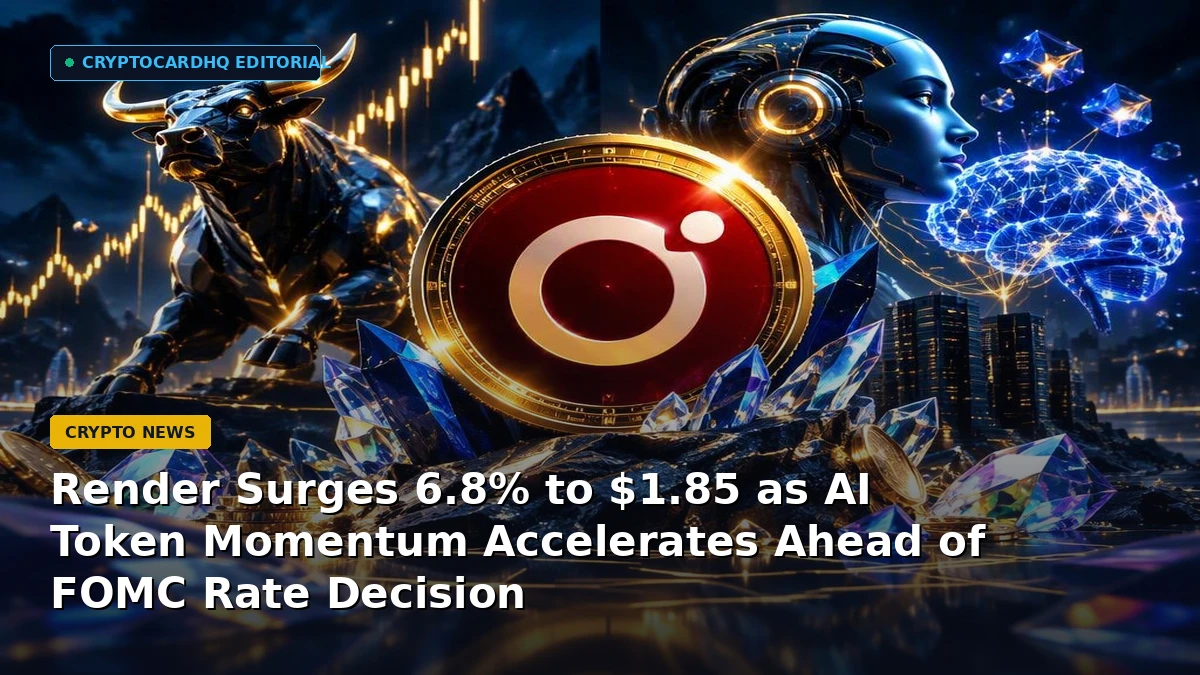

If you checked your portfolio this morning and blinked twice, you aren't hallucinating. Render just decided to grow some wings, climbing 9.29% to sit right at $1.87, testing the psychological brick wall near $1.90 while the rest of the market hums a nervous tune waiting for the Federal Reserve to make its move. Let’s be candid: when utility tokens pump while TradFi suits sweat over interest rate projections, something unusual is happening beneath the hood. This wasn't just a random green candle painted by bored day traders on leverage. It's a messy collision of Washington regulatory theater, macro positioning, and derivatives market mechanics. If you've been funding your life through crypto rewards, these sudden swings matter more than you think, altering the immediate calculus of how digital assets translate into everyday purchasing power.
Why This Matters to Markets
Why now? Why is Render—a network renting out decentralized GPU power—suddenly catching a major bid while broader market liquidity remains constricted? First, look toward Capitol Hill. The U.S. Senate quietly advanced critical procedural motions regarding the Clarity Act. Washington finally seems to realize that pretending utility and AI tokens don't exist isn't a viable long-term strategy. For months, developers building decentralized physical infrastructure networks (DePIN) have been operating in a legal fog thicker than London soup. The recent Senate momentum provides a genuine tailwind, signaling to institutional capital that AI compute tokens aren't immediately walking into an enforcement crosshair from regulators.
Second, timing is everything in modern token economies. The latest FOMC rate decision looms large, with Wall Street biting its fingernails down to the quick, trying to guess whether Jerome Powell and company will cut, hold, or signal a pivot that saves over-leveraged balance sheets. Surprisingly, the U.S. 10-Year Treasury yield held remarkably stable through the noise. Stable yields in the face of a looming Fed meeting usually mean one thing: smart money is reallocating risk rather than running for the bunker. When risk appetite creeps back into tech-adjacent sectors, decentralized AI tokens act like high-beta lightning rods. Treat buying an AI rendering token right before a major macro decision like strapping a jet engine to a bicycle—it's exhilarating until you hit a pothole, but the ride up is glorious.
Market Reaction and On-Chain Data
Let’s look at the underlying plumbing. Markets don't move on vibes alone; they move because someone's position just got forcefully liquidated. As RENDER vaulted toward $1.90, it caught an aggressive cluster of bearish bets sleeping at the wheel. Across major derivatives exchanges, over $140 million in short liquidations vaporized in a matter of hours. Bears tried to front-run the FOMC hesitation by shorting utility tokens, and the market squeezed them out with maximum prejudice.
| Metric | Old Rail / Data Point | New Rail / Status |
|---|---|---|
| RENDER Price | $1.71 (Yesterday) | $1.87 (+9.29%) |
| Key Resistance | $1.75 | $1.90 (Active Test) |
| Short Liquidations | Baseline Average | >$140M (Market-wide flush) |
| Funding Rates | Neutral-Negative | Aggressively Rebalancing |
Data from platforms like CoinGlass highlights how heavily skewed bearish sentiment had become over the prior two weeks. When everyone leans over the edge of the ship to look at the water, even a minor wave knocks them overboard. The short squeeze provided the initial velocity, but spot buyers chasing the momentum kept the candle green. On-chain metrics confirm that exchange inflows slowed down drastically during the breakout, signaling that holders are moving tokens into cold storage rather than preparing to dump into the rally.
What It Means for Crypto Cards & Everyday Spending
You might be asking yourself: *I just want to buy groceries with my crypto rewards, why do I care if Render squeezes shorts?* Here is the connection. Sudden green candles across mid-cap utility assets change the localized liquidity profile of your crypto balance sheet. If you're utilizing the best crypto cards to fund daily expenses, a sharp 9% to 10% pop in your altcoin holdings temporarily supercharges your purchasing power.
Suddenly, that bag of Render you accumulated during the boring consolidation phase can cover your utility bill or your weekend dinner without forcing you to touch your core Bitcoin stack. But don't let the euphoria cloud your judgment. Volatility cuts both ways. The exact mechanism that pumps your portfolio by 9% today can shave it down by 12% tomorrow morning if the macro statements sound slightly more hawkish than expected.
"Volatility is the tax we pay for liquidity in decentralized markets; if you want double-digit daily gains, you have to accept that your spending token might double as a roller coaster."
When evaluating your everyday financial setup, it pays to use a crypto card comparison tool to see which providers offer flexible asset liquidation. You want platforms that let you lock in stablecoin values instantly rather than exposing your daily spending wallet to the raw, unadulterated madness of an altcoin short squeeze.
Where the Risk Hides
Let's pump the brakes for a second. Before you mortgage your house to buy GPU rendering tokens, let's look at the glass half empty. Critics will rightly point out that Senate procedural motions are a far cry from an enacted law. The Clarity Act still has to navigate committees, amendments, floor votes, and potential presidential signatures. Washington moves at the speed of a glacier with a broken leg, and betting your financial future on immediate regulatory clarity in an election cycle is a dangerous game.
Upcoming central bank decisions are perennial wild cards, too. If the Federal Reserve surprises the market by keeping rates restrictive longer than anticipated, macro liquidity will tighten instantly. Tokens that rely on speculative AI narratives and leveraged short squeezes are historically the first to bleed out when the macro tide goes out. Render is testing a formidable resistance ceiling at $1.90. If it fails to break through cleanly on high volume, we could easily see a mean reversion back toward support levels closer to $1.65. Don't mistake a tactical short squeeze for a secular bull market breakout.
A Practical Checklist for Users
Navigating this level of volatility requires discipline rather than emotional trading. Follow these steps to protect your capital while utilizing crypto payment rails:
- ✓Audit Your Card Holdings: Check if your spending wallet is overexposed to high-beta altcoins. Shift a portion of recent gains into stablecoins if you need guaranteed purchasing power for upcoming bills.
- ✓Monitor Resistance Levels: Keep an eye on RENDER's battle at $1.90. Do not treat temporary wick spikes as permanent structural support until confirmed by daily candle closes.
- ✓Review Card Liquidation Settings: Use your platform settings to dictate whether auto-sell features trigger automatically during price spikes to lock in fiat values.
- ✓Track Macro Data Releases: Keep tabs on interest rate announcements and Treasury yields to gauge whether broader market liquidity is expanding or contracting.
Our takeaway
The recent price action in Render demonstrates the incredible, high-velocity reflexivity of crypto markets when regulatory optimism collides with trapped bearish leverage. While it provides a welcome portfolio boost and temporarily expands the purchasing power of active spenders, it remains a high-risk, high-beta asset class. Treat these surges as tactical opportunities rather than a green light for reckless over-leveraging. By staying disciplined, leveraging the right tools for asset conversion, and maintaining exposure to stable liquidity rails, you can tap into market volatility without letting it burn a hole in your pocket.
What caused Render (RENDER) to surge 9.29% today?
The pump was driven by a combination of positive legislative momentum in the U.S. Senate regarding the Clarity Act, stable macroeconomic yields ahead of the FOMC meeting, and a localized short squeeze that liquidated over $140 million in bearish derivatives positions.
How do token price spikes affect crypto-linked debit cards?
When altcoins like Render rally sharply, they temporarily increase the fiat equivalent spending power of your crypto wallet. However, it also increases volatility risk, making it essential to use flexible cards that let you convert holdings into stablecoins to lock in gains before a market reversal.
Is the Senate Clarity Act officially signed into law?
No. The U.S. Senate recently advanced essential procedural motions regarding the framework. It remains a work in progress through legislative committees, meaning full enactment is still a ways off.
What is the next major resistance level for Render?
Render is currently testing overhead resistance near $1.90. A definitive daily close above this threshold could open the path toward $2.20, while failure to hold momentum risks a pullback toward $1.65 support.