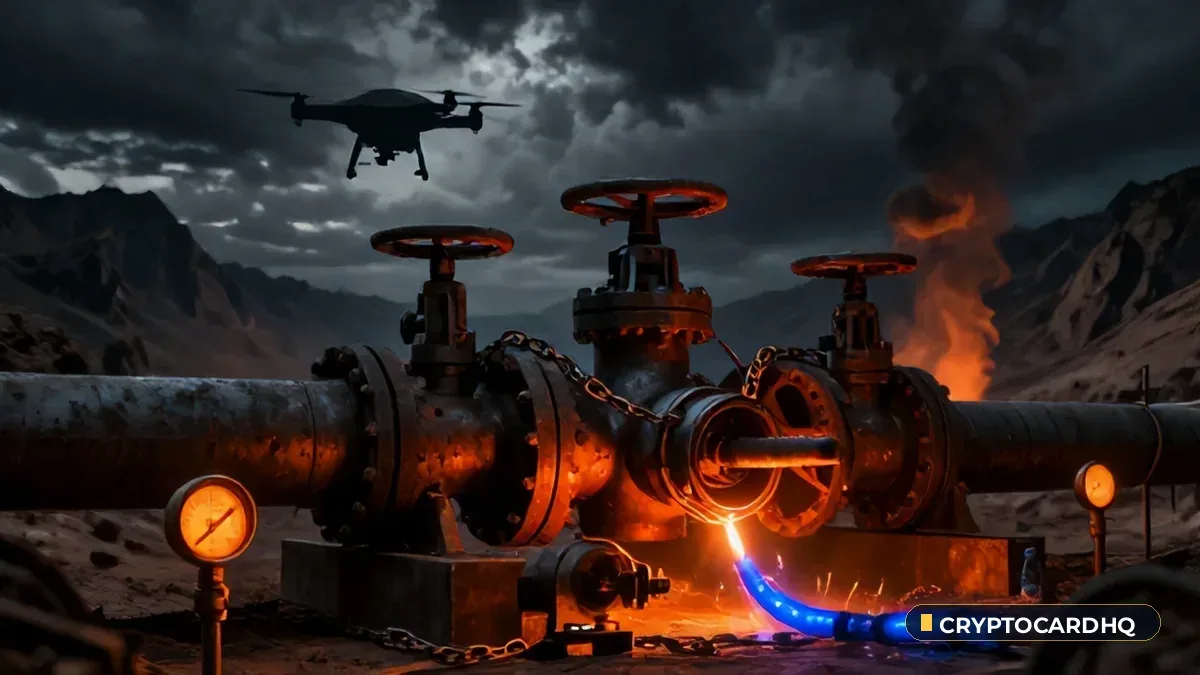
A hostile drone strike slammed into the Khor Mor gas field in northern Iraq's Sulaimaniyah province early today, forcing an immediate full-field shutdown and plunging major population centers across Iraqi Kurdistan into widespread blackouts. Facility operators executed emergency depressurization procedures, venting volatile gas and sealing production manifolds to prevent secondary explosions after the unmanned aircraft breached defensive perimeters.
The installation serves as the primary fuel conduit for the Kurdistan Regional Government's (KRG) electrical grid. With incoming feed-gas choked off at the wellhead within minutes of impact, regional power stations dropped offline one after another. Metropolitan feeders throughout Erbil, Sulaimaniyah, and Duhok went dark before dawn, leaving utility managers scrambling to secure diesel reserves for baseline emergency services.
Commodity desks and global crypto traders reacted with immediate defensive positioning. Coming amid an already tense geopolitical environment across Middle Eastern export corridors, the kinetic attack on strategic energy infrastructure sparked instant de-risking across cross-asset derivatives books. Digital asset markets absorbed the initial wave of macro anxiety as capital shifted into defensive cash equivalents, forcing Bitcoin lower and applying heavy pressure to leveraged derivatives positions.
The 30-Second Executive Brief:
• The Catalyst: A hostile drone strike targeted northern Iraq's Khor Mor gas field, forcing an immediate full production shutdown and triggering widespread power outages across Iraqi Kurdistan. > • The Money Flow: Flight-to-safety defensive positioning across macro trading desks, reallocating marginal liquidity into dollar cash equivalents while regional energy risk premia surge.
• The Market Reaction: Broad risk-off sentiment hitting cryptocurrency markets, with Bitcoin slipping towards local support and Ethereum underperforming amidst heightened fear. > • The Invalidation Trigger: Rapid operational restoration of gas throughput at Khor Mor without sustained infrastructure damage or retaliatory military escalation in northern Iraqi airspace.
Market Snapshot at Time of Reporting: At the time of reporting, BTC ($74,992.01, -1.22% 24h | Range: $73,510.00 - $76,200.00), while ETH ($2,144.03, -4.16% 24h | Range: $2,060.00 - $2,246.00) with broader market sentiment registering 29 (Fear).
Immediate Market and Liquidation Timeline
News of explosions near Chamchamal district hit automated terminal feeds before dawn, triggering instant algorithmic selling across international risk assets. Energy risk models immediately flagged supply frictions, and market makers on round-the-clock crypto exchanges widened spreads within seconds.
Digital assets carry price discovery 24 hours a day, meaning they act as the initial shock absorbers whenever geopolitical surprises break outside standard equity trading hours. Bitcoin faced steady sell orders that pulled spot prices down through the psychological $75,000 level to touch an intraday low of $73,510.00. Ethereum suffered steeper downward momentum, falling 4.16% over the 24-hour cycle to bottom out near $2,060.00 as market participants moved liquidity into short-term cash shelters.
Overnight leveraged longs felt the pressure almost immediately. Systematic stop-loss runs swept through perpetual futures markets as funding rates cooled. Thinned bid depth across centralized venues exacerbated intraday slippage, demonstrating how quickly liquidity evaporates when regional hostilities threaten global supply lines. As analyzed in our previous coverage of Middle East oil tensions, geopolitical energy disruptions consistently trigger short-term risk contractions across crypto liquidity reserves before sovereign asset characteristics can reassert themselves.
Core Event Breakdown: Drone Assault Freezes Khor Mor
The targeted strike on Khor Mor strikes directly at Iraqi Kurdistan's economic foundation. Developed and operated by the Pearl Petroleum consortium—spearheaded by Dana Gas and Crescent Petroleum—the sprawling complex taps one of Iraq's most productive non-associated gas basins. Piped throughput feeds high-output combined-cycle power facilities in Chemchemal, Bazian, and Erbil.
According to on-the-ground reports published by Al Jazeera Middle East, the incoming drone evaded local perimeter radar, detonating near key compression and processing trains. Field engineers initiated emergency shut-in sequences within seconds of detonation, cutting pipeline intake and isolating major storage vessels to avert widespread fires.
The immediate fallout was severe: regional generation capacity cratered by roughly 2,500 to 3,000 megawatts. Electricity authorities had no choice but to isolate regional grid segments, shedding commercial and residential load to protect high-voltage transmission lines from catastrophic collapse. Municipal hospitals, water treatment plants, and telecom switching hubs were quickly switched over to stand-alone diesel generators.
Peshmerga forces and local security units cordoned off surrounding access roads while specialized engineering teams began inspecting processing equipment, valve racks, and separation units. While investigators work to confirm the launch trajectory, the incident fits an established pattern of recurring asymmetric strikes against Kurdish autonomous energy sites, often timed to disrupt delicate administrative negotiations between Erbil and federal authorities in Baghdad.
Market & Structural Context: Energy Fragility and Macro Spillover
The sudden risk premium injected into global markets highlights the acute vulnerability of northern Iraq's industrial network. Sulaimaniyah and neighboring provinces form a vital transit corridor where regional gas extraction, crude processing, and cross-border transit intersect. Taking a primary processing hub like Khor Mor offline forces regional industry to scramble for expensive liquid fuels, tightening Middle Eastern fuel supplies right when global transport corridors are already stretched.
Institutional commodity desks view events like Khor Mor through a wide lens. When low-cost unmanned aerial systems breach defensive perimeters around fortified industrial infrastructure, maritime and overland insurance rates climb across the entire corridor. That added operating expense bleeds into regional transport costs, feeds broader inflation gauges, and firms up the US Dollar index against risk-sensitive asset classes.
For digital asset traders, this dynamic creates immediate headwinds. The broader Crypto Fear & Greed index sitting at 29 (Fear) highlights how hesitant institutional players are to carry high-beta exposure through heightened military tension. In placid macro environments, crypto attracts expansionary capital seeking yield and asymmetric upside; when kinetic events threaten critical energy lifelines, institutions routinely pull back to cash, leaving crypto to absorb early portfolio de-risking.
Operational Breakdown: The Khor Mor Energy Disruption
To grasp the real-world scale of this disruption, the operational parameters below compare normal output against the current shutdown state:
| Operational Parameter | Baseline Operations | Current Strike Status | Structural & Market Impact |
|---|---|---|---|
| Daily Gas Output | ~500 Million Standard Cubic Feet/Day (MMscf/d) | 0 MMscf/d (Full Emergency Shut-in) | Total fuel cutoff for regional combined-cycle power plants. |
| Grid Capacity Loss | ~3,500–4,200 MW normal regional supply | Generation deficit topping 2,500 MW | Rolling municipal blackouts in Erbil, Sulaimaniyah, and Duhok. |
| Alternative Fuel Costs | Inexpensive piped domestic gas | Expensive commercial diesel generation | Massive run on local diesel reserves and surging small-business expenses. |
| Node & Mining Uptime | Steady commercial power grid | Intermittent generator fuel / full outages | Local telecom latency spikes and hash rate disruption across private clusters. |
| Macro Risk Premium | Standard operational friction | Elevated military & regional premium | Widening credit and CDS spreads, rotating capital into defensive USD holdings. |
Strategic Implications, Governance Friction, and Escalation Hazards
The broader consequences of this strike ripple far beyond localized grid stability. Khor Mor represents the financial and operational bedrock of the Kurdistan Regional Government's energy autonomy. Knocking its production offline disrupts civil administration, strains regional finances, and tests the limits of local public services.
On the tactical front, the event shows just how difficult it remains to defend sprawling civilian energy facilities against low-altitude, small-footprint aerial drones. Traditional radar installations calibrated for fast jets or ballistic trajectories often struggle to track slow-moving, low-radar-cross-section drones hugging rolling terrain. Without dedicated point-defense interceptors and localized electronic countermeasure systems, vital energy assets remain exposed to affordable asymmetric disruption.
The strike also lands squarely in the middle of fragile talks between Erbil and Baghdad over oil exports, federal budget disbursements, and unified hydrocarbon laws. Persistent security risks chill foreign direct investment, threatening multi-year expansion projects intended to pipe Kurdish gas into central Iraqi power stations. A prolonged outage forces Iraq to lean harder on imported electricity and gas, shifting regional diplomatic balances and complicating bilateral agreements.
Strategic Scenarios for the Next 24 to 48 Hours
Market participants should watch several key variables over the next one to two days to determine whether this incident marks a temporary shock or a deeper trend:
- 1Hardware Integrity and Repair Timelines: The most pressing unknown is whether the drone blast inflicted direct structural damage on primary fractionators, compressors, or storage infrastructure. If safety systems tripped purely as a precaution and pipes remained intact, technicians could restore throughput within 24 to 48 hours. If core machinery requires replacement parts, outages could stretch into weeks.
- 2Military and Diplomatic Retaliation: Keep close tabs on statements from Kurdish and Iraqi security commands. Retaliatory actions against suspected launch sites could broaden the conflict zone and inject fresh volatility into international energy contracts.
- 3Derivatives Liquidity and Leverage Flushes: With sentiment pinned at 29 (Fear), market depth remains shallow. Traders should manage leverage carefully to avoid sudden liquidation wicks. As demonstrated during the systemic market liquidations sub-$88K, sudden shifts in macro sentiment can rapidly punish overextended perpetual futures positions.
- 4Counter-Drone Deployment: Watch for updates from Pearl Petroleum regarding point-defense reinforcements. Field engineers will only resume full operations once they receive credible security guarantees from regional defense ministries.
Crypto Cards, Everyday Spending, and Holder Liquidity
While institutional desks reshuffle macro books, geopolitical shocks filter quickly down to everyday consumers, travelers, and crypto cardholders. In regions facing sudden utility failures or political friction, maintaining flexible, self-custodied liquidity is a practical necessity.
When electrical grids fail, conventional banking networks, regional ATM fleets, and local payment terminals frequently stall. Cardholders relying exclusively on centralized regional banks can run into unexpected delays if local bank servers lose grid power. Using self-custodial debit cards tied to global payment networks helps individuals maintain functional purchasing power even when localized banking rails stutter.
For active crypto cardholders managing everyday outlays, sudden dips in Bitcoin ($74,992.01) and Ethereum ($2,144.03) require active account oversight:
- Managing Collateralized Borrowing: Cardholders using crypto-backed debit cards with automated credit lines against deposited BTC or ETH need to keep a close eye on their Loan-to-Value (LTV) ratios. Sudden price drops can trigger collateral liquidation warnings or unexpected spending limits if buffers run thin.
- Stablecoin Balance Migration: During volatile macro trading sessions, experienced spenders often move volatile balances into dollar-backed stablecoins like USDC or USDT. Pre-funding debit cards with stablecoins insulates your daily grocery and travel spending from sudden market sell-offs while preserving cash-back rewards. To see which cards provide seamless stablecoin settlements, minimal foreign exchange markups, and reliable point-of-sale execution, consult our Best Crypto Cards guide.
- Foreign Exchange and Travel Reserves: Geopolitical events frequently spark rapid moves in regional foreign exchange markets. Using crypto payment cards that apply direct interbank FX rates allows consumers to bypass inflated currency conversion spreads at local exchange counters.
To stay updated on how international trade disruptions and regional energy developments influence digital asset liquidity, explore the Crude Oil & Middle East Macro News category.
Catalysts & What to Watch Next
Keep track of these operational indicators to gauge whether markets are stabilizing or preparing for further downside volatility:
- Pearl Petroleum Damage Assessment: Official technical updates from Dana Gas outlining the exact physical condition of Khor Mor's processing units and gathering lines.
- KRG Power Restoration Schedule: Updates from the Ministry of Electricity detailing the return of generation units to the regional grid.
- Regional Oil Transit Stability: Flow metrics along northern pipeline interconnects and storage terminals.
- Perpetual Funding Rate Equilibrium: Normalization of crypto derivatives funding rates, pointing toward reduced short positioning and steady spot accumulation.
- Air Defense Deployments: The positioning of localized mobile defense and electronic jamming equipment around key energy facilities in the Chemchemal basin.