

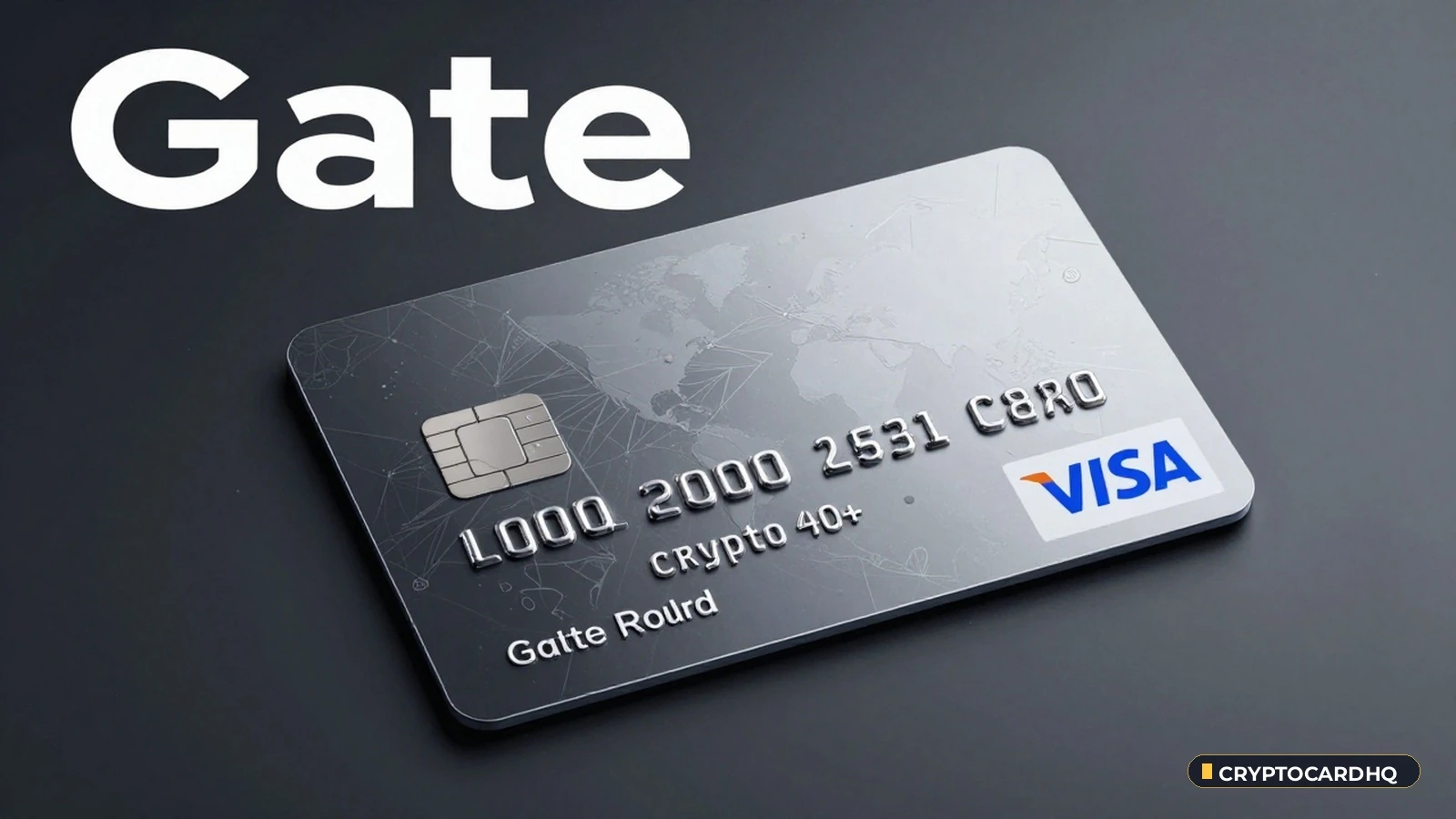
Cryptocurrency exchange Gate has started rolling out a Visa-linked debit card program across more than 40 international markets. The payment vehicle hooks exchange accounts directly to traditional point-of-sale systems, executing automated, real-time conversion from digital assets into local fiat currencies at checkout for both physical stores and online merchants.
This broad rollout tackles one of the oldest pain points in centralized crypto custody: friction during off-ramping. Instead of routing users through multi-day withdrawal queues, traditional wire windows, or peer-to-peer desks to extract liquid spending power, Gate is routing liquidations directly through the checkout terminal. By plugging into Visa's clearing network across dozens of territories at once, the program takes aim at traditional retail banking setups and turns up the competitive heat on trading platforms fighting to keep user balances on their books.
The 30-Second Executive Brief:
• The Catalyst: Gate is launching a Visa-linked debit card across more than 40 international jurisdictions, providing real-time point-of-sale digital-asset-to-fiat conversion for retail and online transactions. > • The Money Flow: Retail trading deposits are integrated directly into Visa merchant rails, enabling instantaneous micro-conversions from exchange custody accounts into merchant settlement currencies.
• The Market Reaction: Major digital assets trade in tight consolidation ranges, with Bitcoin hovering around $81,844 and Ether at $2,481 as broader market sentiment holds in Greed territory. > • The Invalidation Trigger: Heightened cross-border regulatory scrutiny surrounding localized issuing bank licenses, anti-money-laundering (AML) enforcement, or restrictive regional interchange caps.
Market Snapshot at Time of Reporting: At the time of reporting, BTC ($81,844.01, -1.76% 24h | Range: $80,393.56 - $83,521.15), while ETH ($2,481.23, -3.60% 24h | Range: $2,406.11 - $2,587.28) with broader market sentiment registering 59 (Greed).
The Architecture of Gate's 40-Market Visa Rollout
As reported by crypto.news, Gate's new payment product relies on direct integration with the Visa network to secure global merchant coverage. Running on standard Visa payment rails means the card is accepted right out of the box across millions of retail cash registers, tap-to-pay card readers, and online checkouts across the globe.
The mechanics boil down to automated point-of-sale liquidation. Early crypto debit cards were clunky. Cardholders had to manually sell tokens on an exchange interface hours or days before shopping, preloading a separate fiat wallet inside the app. That clunky setup forced shoppers to forfeit market exposure early and sit on idle cash balances that were vulnerable to monthly account fees and banking delays.
Gate shifts that liquidation trigger to the exact millisecond an authorization ping hits Visa's network. When a shopper taps a terminal or types card details into a browser, the merchant gateway asks for local currency. Gate's backend immediately queries the user's selected crypto balances, liquidates the necessary amount at current spot prices, and greenlights the payment. The merchant gets paid in their usual fiat currency over standard domestic card networks. There is no special hardware, no manual wallet address entry, and zero exposure to crypto volatility on the retailer's end.
Pushing a rollout of this scale across 40+ countries requires a complex web of regulated partners. No single banking charter spans multiple continents without friction. International programs like this depend on localized electronic money institutions (EMIs) and regional sponsor banks that can issue co-branded Visa credentials under local legal frameworks.
Payments Infrastructure and the Institutional Race for Everyday Spend
Gate's expansion comes as card networks accelerate efforts to capture consumer volume originating in digital asset ecosystems. Payment giants have spent years experimenting with settlement mechanisms to connect on-chain capital with day-to-day shopping. In our earlier reporting on how Visa reached 160 stablecoin card programs and rapid transaction growth, card networks demonstrated that retail appetite for instant crypto liquidity remains massive across established economies and emerging markets alike.
For card networks, these partnerships generate reliable interchange and processing revenue. For exchanges, debit cards are primarily a tool for deposit retention. When traders can pay for morning coffee, fuel, and online shopping straight from their trading wallets, they keep their capital on the exchange. They have less incentive to wire money back to a local bank branch. That stickiness keeps platform liquidity deep, cuts down on bank off-ramp outflows, and opens an extra revenue stream via conversion spreads at checkout.
The competitive landscape among top-tier exchanges is intense. Rivals like Binance, Bybit, and Kraken have launched region-specific cards to defend their capital bases. Yet pulling off a coordinated rollout across 40+ jurisdictions simultaneously is a massive operational hurdle. Differing legal environments—like the European Union's Markets in Crypto-Assets (MiCA) regulation compared to fragmented guidelines across Southeast Asia or Latin America—create compliance headaches that have routinely tripped up competitors and led to sudden card pauses.
Operational Breakdown: Legacy Cards vs. Gate's Multi-Market Deployment
To see how Gate's card compares to earlier crypto card designs and traditional bank cards, the table below maps out the payment mechanics across every layer of the transaction cycle:
| Operational Parameter | First-Generation Crypto Cards | Standard Retail Bank Cards | Gate Visa Card Program | Practical Industry Impact |
|---|---|---|---|---|
| Funding Source | Pre-funded fiat balances | Checking or savings bank account | Exchange-held digital asset balances | Keeps capital invested until the exact second of purchase |
| Liquidation Timing | Manual sale hours or days ahead | None (direct fiat deduction) | Real-time millisecond conversion at checkout | Removes manual trading steps and premature market exits |
| Merchant Acceptance | Niche merchant lists or bespoke terminals | Global Visa and Mastercard networks | Standard global Visa merchant network | Zero merchant friction; standard card payment flow |
| Jurisdictional Coverage | Single-country pilot programs | Single-country domestic banking rails | 40+ international markets at launch | Scales cross-border retail payment coverage |
| Merchant Settlement | Pre-converted local fiat reserves | Domestic legal tender | Real-time local fiat merchant settlement | Protects merchants from digital asset price volatility |
Strategic Realities, Regulatory Roadblocks, and Financial Trade-Offs
Covering 40+ jurisdictions gives Gate serious geographic reach, but operating an international card program also brings serious regulatory and financial challenges. Compliance sits at the top of that list. Card programs demand stringent Customer Due Diligence (CDD) and continuous Anti-Money-Laundering (AML) monitoring under Financial Action Task Force (FATF) standards.
In Europe, complying with MiCA and the Transfer of Funds Rule requires strict sender and receiver identification for every transaction. In other regions, central banks monitor retail card outflows closely to guard against domestic capital flight. If a user funds their daily living costs by tapping overseas exchange balances with a Visa card, local tax authorities may classify every small purchase as a taxable capital disposal. In countries with strict rules, users must track cost bases and fair market value for every retail swipe, turning simple budgeting into an accounting nightmare.
Exchange counterparty risk is another factor cardholders must weigh. Traditional bank accounts are backed by government-backed deposit insurance, such as the FDIC in the US or the FSCS in the UK. Custodial balances sitting on Gate have no such protections. Users who leave significant capital on the platform to fund daily card spending take on full exchange insolvency risk. If the platform experiences sudden outages, regulatory restrictions, or liquidity freezes, cardholders could find their primary payment method cut off without warning.
Interchange caps also pinch card economics. In markets like the European Union and the UK, caps restrict interchange fees to 0.2% on debit transactions and 0.3% on credit transactions. Running real-time conversion engines, paying card network fees, and compensating local issuing partners under tight interchange caps leaves paper-thin margins. To stay profitable, programs often lean on secondary conversion spreads applied when converting assets at the register.
Crypto Cards and Consumer Spending Realities
For readers keeping up with payment developments in our Crypto Cards News category, Gate's rollout shows how fast retail payment habits are diverging from traditional bank branches. The clear appeal for active market participants is capital velocity: profits from spot trading, on-chain yields, or freelance crypto earnings can be put to work immediately without waiting on bank business days.
To see how Gate's instant-conversion model compares with other exchange cards, non-custodial options, and tiered reward programs, take a look at our Best Crypto Cards guide. Picking the right card requires reading past headline promotions and inspecting real fee schedules. Even when platforms advertise fee-free spending, they often pad their conversion spreads or tack on foreign exchange margins for purchases made in non-base currencies.
Travelers need to be especially cautious about compounding FX costs. When using a card in another country, transactions can trigger two back-to-back conversions: first from the digital asset into the card's base fiat currency, and then via Visa's exchange rate into the local currency at the terminal. Those double conversions can quickly eat away at cardholder funds unless the card provides competitive FX rates, like the options analyzed in our breakdown of the Best Crypto Cards for Travel in 2026.
Account security is another practical concern. Because debit cards pull funds from an exchange account, cardholders should set up isolated sub-wallets. Keeping day-to-day spending money separated from long-term holdings and trading capital helps prevent a stolen card number or online leak from putting your entire exchange balance at risk.
What to Watch Next
Traders and industry analysts tracking Gate's 40-market rollout should watch these upcoming developments:
- 1Regional Rollout Timelines: Watch which countries go live first, particularly within tightly regulated areas like the European Economic Area, the UK, and financial hubs in the Asia-Pacific region.
- 2Spread and Fee Disclosures: Check the platform's official documentation for exact details on conversion spreads, ATM cash limits, and foreign exchange markups.
- 3Bank Partnership Details: Look out for official filings revealing the regulated sponsor banks and EMIs handling card issuance in each region.
- 4Competitor Responses: Keep an eye on whether rival exchanges like Bybit, KuCoin, or Bitfinex upgrade their card rewards or broaden their own geographic reach.
- 5Tax Export Capabilities: Check if Gate releases dedicated accounting tools to help users track capital gains and losses across hundreds of retail micro-transactions.