
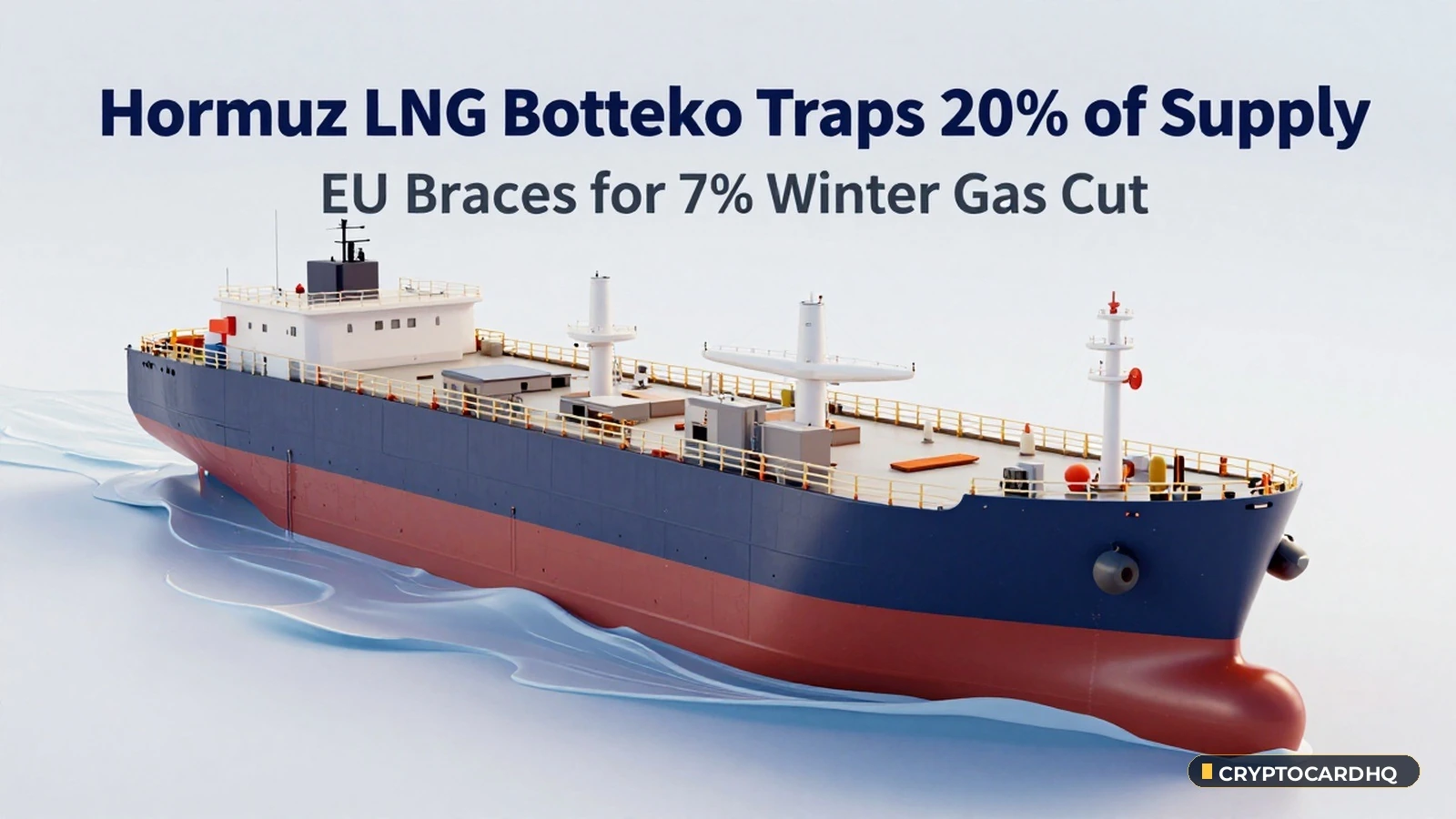
A critical choke point in global energy logistics has fractured, sending shockwaves through international capital markets and directly challenging European macro stability ahead of the winter heating season. With escalating military conflict surrounding Iran trapping roughly 20% of global liquefied natural gas (LNG) supplies behind the Strait of Hormuz, European natural gas inventories sit at critically vulnerable seasonal benchmarks. Projections from energy analysts indicate the bloc faces an unavoidable structural deficit, raising the prospect of mandatory rationing that threatens industrial output and rekindles aggressive inflationary pressures across fiat currencies.
For digital asset markets, this supply disruption represents an immediate macro stress test. Cryptocurrency assets, which had traded with steady risk appetite throughout early autumn, now confront an abrupt repricing of global inflation expectations, sovereign bond yields, and energy input costs. As physical tankers remain stalled in the Persian Gulf, institutional desks are rapidly assessing whether digital capital will act as a liquidity sponge under broader market crosscurrents or maintain its standing as an unencumbered alternative store of value.
The 30-Second Executive Brief:
• The Catalyst: Escalating conflict in Iran has trapped 20% of global liquefied natural gas (LNG) supply behind the Strait of Hormuz, leaving European gas storage dangerously depleted heading into winter and threatening a mandatory 7% demand cut according to the Institute for Energy Economics and Financial Analysis (IEEFA). > • The Money Flow: Physical energy markets saw dramatic price surges across European natural gas benchmarks, prompting defensive capital rotation into crude, domestic energy derivatives, and cash equivalents while global risk assets absorb severe supply-chain friction.
• The Market Reaction: Bitcoin traded in a tight intraday range between $80,393.56 and $82,776.01, showing cautious resilience despite the macro energy shock, while broader digital asset sentiment registered Greed at 59. > • The Invalidation Trigger: Diplomatic de-escalation ensuring free tanker transit through the Strait of Hormuz, or alternative pipeline capacity mitigating Europe's projected 7% deficit before sustained cold weather begins.
Market Snapshot at Time of Reporting: At the time of reporting, BTC ($82,579.34, -0.16% 24h | Range: $80,393.56 - $82,776.01) with broader market sentiment registering 59 (Greed).
Immediate Market Reaction and Liquidation Timeline
The onset of the transit freeze triggered an immediate, synchronized reaction across commodities and cross-asset financial desks. As reports confirmed that commercial maritime carriers suspended voyages through the Persian Gulf choke point, benchmark European gas futures spiked sharply, reflecting the sudden removal of one-fifth of global sea-borne LNG volume from forward availability. Energy trading hubs across Northwest Europe adjusted spot valuations higher in minutes, forcing utilities to scramble for alternative floating storage and pipeline capacity.
Global equities and sovereign debt responded with immediate defensive posturing. European government bond yields ticked higher as traders priced in persistent headline consumer inflation and deferred monetary easing cycles. The threat of forced industrial curtailment across major manufacturing hubs quickly hit euro-denominated assets, driving foreign exchange volatility against the US dollar.
In the cryptocurrency space, order books reflected sudden caution rather than panic selling. Bitcoin absorbed the initial headline volatility by holding firmly within its established daily bracket of $80,393.56 to $82,776.01. Despite the immediate risk-off reaction seen across European equities, spot market participants prevented an aggressive breakdown below the key $80,000 threshold. The Crypto Fear & Greed Index hovered at 59, reflecting an underlying greed posture that refused to succumb instantly to the geopolitical headlines. However, depth on perpetual contracts thinned noticeably, with market makers widening bid-ask spreads across major exchanges to guard against abrupt macro gap risk.
Core Event Breakdown: The Hormuz Choke Point and Europe's Gas Deficit
The strategic bottleneck at the center of this supply shock is the Strait of Hormuz, a maritime corridor through which roughly one-fifth of the world's liquefied natural gas cargo flows. As military tensions involving Iran flared into direct conflict, commercial insurers canceled war-risk coverage, and international shipping conglomerates halted container and tanker transits. This effectively locked Persian Gulf LNG export terminals behind a logistical barrier, severing vital supply chains to both European and Asian import terminals.
According to analysis from the Institute for Energy Economics and Financial Analysis (reported by OilPrice.com), the timing of this outage could not be more precarious for the European Union. Unlike typical pre-winter cycles where underground storage caverns approach maximum operational capacity, European inventories were already lagging behind optimal seasonal trajectory following unseasonal maintenance and prior supply disruptions. The sudden closure of the Hormuz corridor removes the marginal seaborne imports that European energy ministers relied upon to bridge the late-autumn injection window.
The IEEFA warns that these historically depressed storage levels leave member states exposed to an acute winter supply deficit. If the transit freeze persists through the onset of sub-zero temperatures, the European Union may be forced to implement an emergency 7% mandatory reduction in natural gas consumption across industry and public utilities. A forced 7% demand curtailment is not an abstract bureaucratic metric; it necessitates heavy rationing across energy-intensive industrial sectors, including chemicals, glass, steel, and fertilizer production, threatening direct factory shutdowns and widespread supply-chain paralysis.
Macro & Structural Context: Energy Inflation Meets Digital Capital
This breaking crisis highlights how vulnerable traditional fiat economies remain to physical logistics corridors. When real-world energy infrastructure fractures, central banks face an impossible dilemma: tighten interest rates to suppress cost-push inflation and risk deepening an industrial recession, or loosen liquidity to protect banking systems and accept sustained purchasing power debasement. As examined during the Iran Strait Crisis triggers crypto market volatility analysis, physical supply shocks quickly spill over into digital asset liquidity profiles.
Historically, sudden spikes in primary energy commodities produce a multi-stage reaction across the cryptocurrency sector:
- 1First-Stage Liquidity Drain: Immediate institutional risk reduction leads trading desks to raise cash equivalents, creating temporary downward pressure on liquid high-beta assets.
- 2Inflationary Repricing: As headline inflation numbers reflect surging electricity, transport, and heating costs, capital begins re-evaluating hard assets and decentralized networks free from counterparty risk.
- 3Network Hashrate Realignment: Prolonged surges in global energy benchmarks compress profit margins for commercial proof-of-work mining operators relying on grid power, accelerating the migration of hashpower toward stranded, off-grid, and renewable energy resources.
Unlike traditional industrial enterprises that cannot quickly adjust their operational inputs, the Bitcoin network is structurally indifferent to geopolitical borders. While European factories face mandatory curtailment orders, the decentralized monetary network continues producing blocks every ten minutes. Institutional investors are watching whether capital allocations will mirror the dynamics documented when Bitcoin whales absorbed the 86k wall amid Strait of Hormuz tensions, demonstrating how large-scale participants use structural macro dips to build long-term positions.
Key Figures & Operational Breakdown
The scale of this disruption carries direct consequences across physical logistics, macro indicators, and digital asset operations. The table below outlines the core parameters defining this emerging energy bottleneck:
| Operational Metric / Factor | Pre-Disruption Baseline | New Crisis Development | Strategic Market Impact |
|---|---|---|---|
| Hormuz Global LNG Flow | ~20% of global seaborne LNG transiting uninterrupted | Commercial tanker transits frozen due to military hostilities | Immediate supply deficit in seaborne spot energy markets |
| EU Gas Storage Status | Injections targeting standard pre-winter reserve capacity | Storage levels critically below historical seasonal targets | High vulnerability to early-season cold snaps |
| Projected EU Demand Cut | 0% (Standard discretionary commercial consumption) | 7% mandatory demand curtailment projected by IEEFA | Heavy industrial rationing, plant idlings, and reduced economic growth |
| European Gas Valuations | Stabilized autumn baseline pricing | Significant price surge across regional benchmarks | Reignites headline inflation and delays central bank easing |
| Bitcoin Spot Pricing | Consolidated range above psychological round figures | $82,579.34 (Intraday range: $80,393.56 – $82,776.01) | Demonstrates immediate structural absorption above $80,000 |
| Market Sentiment Index | Balanced neutral-to-bullish positioning | 59 (Greed) | Market participants maintain positive bias despite macro shock |
Strategic Implications and Risk Vectors for the Next 24–48 Hours
As this breaking event unfolds, investors, market participants, and treasury desks must monitor several critical risk vectors over the next 24 to 48 hours:
1. Diplomatic and Maritime Escalation
The immediate priority is determining whether naval escorts or multilateral negotiations can restore safe commercial passage through the Strait of Hormuz. If commercial tankers remain unwilling to enter the Persian Gulf due to uninsurable maritime risk, spot energy prices will continue to incorporate an aggressive geopolitical risk premium. Any widening of military engagements to include direct strikes on coastal export infrastructure would transform a transit bottleneck into a lasting physical capacity destruction event.
2. Central Bank Policy Expectations
The prospect of an energy-induced inflation spike disrupts the prevailing monetary policy narrative in Europe and North America. Fixed-income markets must recalculate whether central banks will pause anticipated rate reductions to combat secondary price effects. If bond yields surge in response to inflation fears, broader risk assets will face headwinds from a strengthening US dollar and tighter financial conditions.
3. Holder Hazard Warnings: Derivatives Liquidity Gaps
Digital asset traders holding leveraged positions face acute volatility risks over the coming sessions. In fast-moving geopolitical crises, sudden weekend or after-hours developments often create significant price gaps across traditional futures markets that cascade directly into crypto perpetuals. Spot holders should remain cautious of sudden wick volatility that sweeps liquidity pools around the $80,000 support zone. Managing margin buffers and avoiding aggressive leverage are essential defensive practices during high-velocity macro shocks.
4. European Industrial Competitiveness
Should the European Union be forced to implement the 7% demand reduction outlined by the IEEFA, energy-intensive European industries will experience reduced productivity. This dynamic increases sovereign debt burdens as governments step in with emergency consumer subsidies, reinforcing long-term capital flight toward borderless assets and international jurisdictions.
Crypto Cards & Everyday Spending Analysis
Beyond institutional macro considerations, energy supply shocks and geopolitical crises carry practical, real-world consequences for individuals who use digital assets for daily payments, cross-border remittances, and card spending.
When macro shocks hit regional economies, fiat currencies often experience sudden purchasing power volatility. European cardholders using conventional bank cards to travel or settle international bills may face wider foreign exchange spreads and deteriorating purchasing power as regional currencies react to domestic economic strain. In contrast, users who spend fiat-pegged stablecoins or top up their payment instruments via non-custodial wallets bypass domestic currency fluctuations entirely.
For consumers exploring our Best Crypto Cards guide, several critical operational considerations emerge during periods of heightened geopolitical stress:
- Stablecoin Settlement Reliability: In times of high fiat inflation, holding liquid spending balances in major dollar-pegged stablecoins (such as USDC or USDT) provides an effective hedge for non-US cardholders. Crypto debit cards that convert stablecoins directly at the point of sale protect everyday purchasing power against local currency devaluation.
- Network Gas Fee Spikes: In moments of sharp market volatility, decentralized blockchain settlement layers can experience brief surges in transfer fees. Card users should ensure their spending accounts are funded during calm market windows to avoid elevated transaction fees when interacting with on-chain top-up addresses.
- Card Limits and Liquidity Preservation: Users maintaining active debit cards connected directly to volatile crypto assets should review automated conversion limits. If market volatility touches stop-loss boundaries, cards with automatic liquidation settings could execute transactions at unfavorable price levels. Storing daily spending funds in separate stablecoin reserves while keeping long-term holdings offline prevents unintended conversions.
- Cashback Reward Realignment: Many premier crypto card platforms disburse cashback rewards in platform tokens or major digital assets. During market consolidation periods where Bitcoin holds steady—such as the current $82,579.34 zone—accumulating rewards in blue-chip assets offers an efficient way to dollar-cost-average without paying manual exchange fees.
To stay informed on how broader market volatility impacts digital payment systems and regulatory frameworks, explore our dedicated coverage in the Bitcoin News category.
Catalysts & What to Watch Next
To navigate the coming trading sessions effectively, market participants should track these upcoming milestones:
- Maritime Insurance Advisories: Watch for official updates from the Joint War Committee (JWC) regarding risk ratings in the Persian Gulf and Strait of Hormuz. Any downward revision in risk premiums will signal early tanker movements.
- European Council Emergency Energy Sessions: Track potential emergency meetings of European energy ministers discussing gas allocation protocols, strategic petroleum reserves, or cross-border pipeline reallocations.
- Weekly Natural Gas Storage Injection Reports: Monitor Gas Infrastructure Europe (GIE) data releases to measure the exact pace of storage accumulation relative to seasonal five-year averages.
- Cryptocurrency Spot Volume and ETF Inflow Data: Track whether institutional spot ETF vehicles record net inflows during this geopolitical flight to liquidity, confirming whether long-term asset allocators view Bitcoin as an effective macro diversifier.