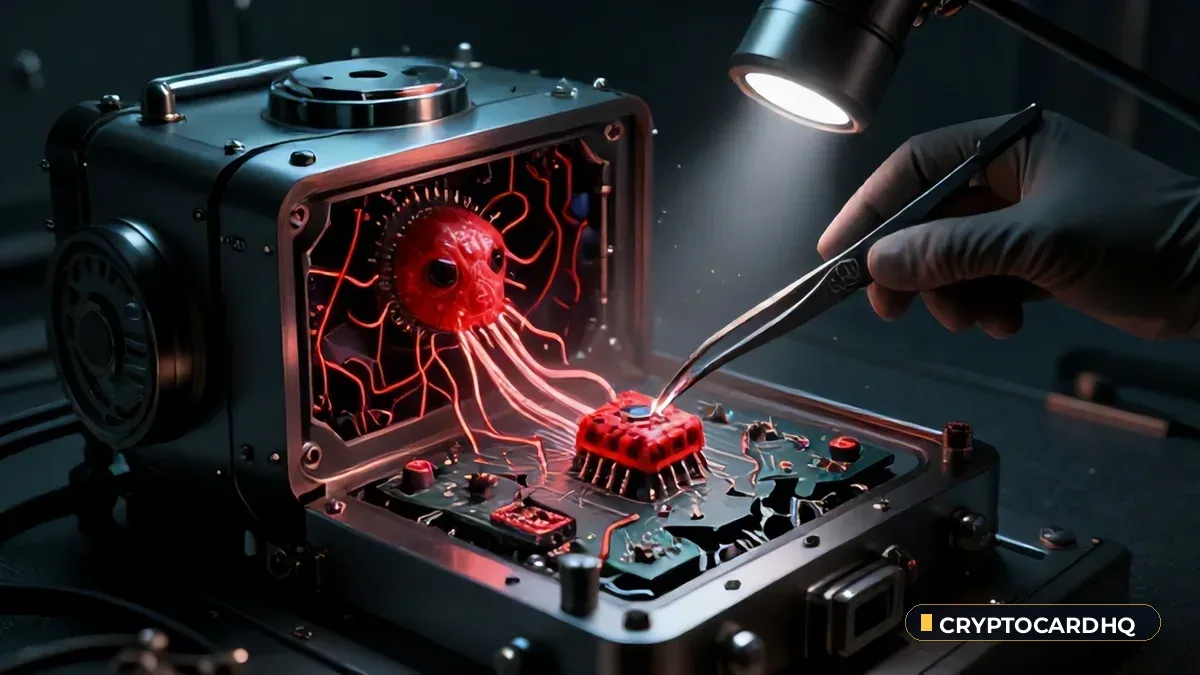
A physical supply-chain crisis has struck the self-custody ecosystem. MediaMarkt Saturn, Europe's largest consumer electronics retailer, pulled all Ledger hardware wallets from its store shelves and online storefronts. The emergency move landed after security disclosures confirmed rogue actors modified retail units with physical spy implants designed to siphon secret recovery seed phrases straight out of user devices.
This finding blows a hole in an article of faith among self-custody practitioners: that grabbing a shrink-wrapped box off a display at an authorized electronics superstore guarantees hardware authenticity. When malicious silicon piggybacks directly onto internal printed circuit boards, software guarantees crumble. The attack bypasses operating system defenses by capturing private keys the precise second a user generates their wallet.
The 30-Second Executive Brief:
• The Catalyst: MediaMarkt Saturn enacted an emergency sales halt on all Ledger hardware wallets following verified reports of physical spy implants embedded within retail inventory to harvest recovery phrases. > • The Money Flow: Retail distribution channels froze consumer sales across hundreds of European superstores, locking down millions of dollars in planned inventory turnover pending hardware audits.
• The Market Reaction: Broader crypto markets absorbed the shock with measured composure, though hardware wallet holder communities witnessed sharp spikes in off-chain operational panic and verification audits. > • The Invalidation Trigger: Formal forensic confirmation that rogue hardware implants were isolated to an unauthorized retail return fraud loop, rather than upstream factory manufacturing or firmware compromise.
Market Snapshot at Time of Reporting: At the time of reporting, BTC traded at $83,170.01 (+0.49% 24h | Range: $81,033.66 - $84,168.00) with broader market sentiment registering 57 (Greed).
Timeline of the Attack and Immediate Retail Reaction
The crisis accelerated when security audits revealed that physical counterfeit implants had slipped right past routine warehouse receiving and shelf stocking. Unlike common web phishing campaigns or deceptive smart contract approvals—attack vectors explored thoroughly in CryptoCardHQ's Bitcoin security guide on revoking permissions—this attack relies entirely on physical silicon and microscopic solder work.
According to investigative findings reported by Bitcoin.com, attackers acquired authentic Ledger retail inventory, cracked the packaging seals with heat guns, altered the printed circuit board (PCB) architecture, and restored the original shrink-wrap. They soldered tiny microcontrollers directly onto peripheral traces inside the casing. These microchips act as hardware sniffers. They capture PIN entries and 24-word seed generation sequences as they travel across internal board traces, storing or relaying the secret data so attackers can drain incoming collateral the moment a user deposits funds.
MediaMarkt Saturn moved quickly once security teams provided technical proof of the modified units. Store managers across Germany, Austria, and broader European retail networks received orders to yank Ledger Nano and Stax devices off display hooks, isolate backroom stock, and deactivate online product pages. Retail executives realized that letting even a handful of altered devices reach consumers could saddle the retail giant with immense legal exposure.
Anatomy of the Hardware Implant Exploit
Understanding why MediaMarkt Saturn slammed the brakes requires looking at how secure element hardware actually works—and where its physical boundaries end. Ledger builds its architecture around Secure Element (SE) microchips. These chips guard against side-channel analysis, voltage glitching, and physical micro-probing. But an attacker holding the device before the buyer even opens the box does not need to crack the Secure Element itself. They simply hijack the wires running between the secure chip and the screen.
The intercepted retail implants exploit three distinct physical attack surfaces:
- 1Display & Ribbon Interception: An auxiliary microprocessor bridges the display ribbon cable. As the Secure Element spits words across the screen during the initial 24-word recovery setup, the parasitic chip records the raw display buffer data.
- 2Rogue Pre-Configuration Fraud: Criminals initialize a known seed phrase, modify secondary controller firmware to skip setup steps, and place counterfeit scratch-off cards in the box instructing the victim to use a pre-determined wallet address.
- 3Power-Rail Data Sniffing: Microscopic surface-mount chips tap power rails and bus lines to capture entropy signals and exfiltrate data to nearby receivers during device initialization.
Hardware wallet enclosures usually feature sonic-welded plastic or tight metal sleeves. Skilled attackers use razor-thin blades, low-temperature heating plates, and specialized adhesives to pop open the cases, solder surface-mount hardware, and glue the shells back together. To an everyday buyer opening a shrink-wrapped box at home, the device looks factory-fresh.
Market Context and the Collapse of the Retail Trust Model
For nearly a decade, cryptocurrency manufacturers repeated a consistent rule of thumb: buy only from the official website or verified retail partners. MediaMarkt Saturn held pride of place as one of the most visible authorized partners in Europe. Millions of retail investors viewed the chain as a safe, simple on-ramp to escape centralized exchange custody.
When that retail chain breaks, the shock waves hit market trust hard. Institutional allocators and treasury managers track physical custodial risks with sharp focus. During intense market movements—similar to capital rotations documented in our coverage of institutional ETF flows—uncompromised cold storage forms the foundation of balance sheet confidence. You cannot patch a soldered circuit board with a firmware download. When silicon gets modified in a rogue workshop, the hardware stays tainted forever.
| Assessment Factor | Traditional Self-Custody Baseline | Compromised Retail Channel | Systemic Consequence |
|---|---|---|---|
| Supply Chain Integrity | Direct manufacturer courier delivery | Multi-tier third-party distribution | Interception, shelf-swapping, and illicit returns |
| Verification Vector | Ledger Live cryptographic attestation | Cryptographic attestation bypassed via physical I/O tap | False sense of security despite compromised display |
| Primary Attack Vector | Blind-signing malicious smart contracts | Hardware keylogging of 24-word seed phrase | Total, instant drainage of deposited assets |
| Remediation Path | Firmware update or seed revocation | Complete physical device destruction | Total loss of capital if seed phrase was imported |
| Retail Availability | Unrestricted consumer checkout | Indefinite operational sales freeze | Reputational damage and channel liability |
Strategic Implications for Institutional and Retail Custody
The retail freeze exposes a glaring operational loophole: the retail return loop. Criminal syndicates buy legitimate devices with cash or prepaid cards, take them back to specialized workshops, solder in spy implants, and return them within standard return windows for cash refunds. Retail customer service clerks lack microscopic inspection tools and cryptographic test benches. They inspect the plastic box, spot no obvious damage, slap new shrink-wrap on the packaging, and put the unit right back on the sales floor.
This attack shatters conventional assumptions about tamper-evident stickers and plastic wrap. A genuine cryptographic handshake between a PC and a device confirms that the Secure Element runs authentic firmware. It does not—and cannot—detect a hidden microcontroller soldered to display traces outside the Secure Element's physical boundary.
Hardware manufacturers must adapt their engineering and distribution playbooks:
- Monolithic Resin Potting: Encapsulating entire internal circuit boards inside tough, transparent resin so any soldering attempt leaves obvious physical fractures.
- Direct-to-Consumer Distribution: Eliminating loose third-party retail return setups that allow returned hardware to cycle back into consumer inventory.
- Optical Display Attestation: Implementing hardware-level visual authentication schemes that independently prove the display output has not been mirrored or tapped.
Crypto Cards and Everyday Spending Analysis
Hardware wallets act as deep cold-storage vaults, but everyday crypto users rely on fast, liquid balances to fund prepaid debit cards for travel, software subscriptions, and routine point-of-sale spending. This retail supply-chain breach carries clear operational warnings for anyone who balances long-term savings with daily card utility.
Users frequently link cold storage vaults to intermediate hot wallets to top up spending cards. If an attacker plants a spy chip inside a hardware wallet and grabs the master seed phrase, they seize total control over both cold holdings and pending card top-ups. An exploit at the vault level instantly empties card replenishment pools.
Cardholders should set up strict security boundaries between their wallets:
- Air-Gapped Top-Up Pipelines: Never link primary cold vault seed phrases to apps or browser extensions used for daily debit card top-ups. Route card funding through separate multi-signature setups or isolated hardware devices ordered straight from the manufacturer.
- Prepaid Balance Isolation: Move only the funds you plan to spend in the immediate term onto card platforms. When picking card products with solid cash back, clear limits, and clean account controls, read our comprehensive Best Crypto Cards guide to review platforms offering sub-account segregation.
- Tracking Protocol Security: Keep tabs on shifting network trends and custodial alerts through our dedicated Bitcoin News category before pushing large capital transfers between cold storage and payment rails.
Immediate 24-48 Hour Action Plan for Device Holders
If you purchased a Ledger device from MediaMarkt, Saturn, or any third-party retail store over the last 90 days, treat that unit as compromised until you verify its history. Take these protective steps right away:
- 1Stop Device Initialization: Do not plug in, power up, or enter recovery phrases into any unopened or recently unboxed retail unit.
- 2Evacuate Vulnerable Wallets: If you generated a seed phrase on a retail device and funded it, spin up a fresh wallet on a verified, secure device and transfer all assets out immediately.
- 3Examine Shell Seams: Look closely along the casing seams for prying tool marks, uneven glue lines, misaligned plastic joints, or odd variations in weight.
- 4Discard Pre-Printed Seed Cards: Genuine Ledger hardware never ships with pre-printed recovery words. Any card asking you to scratch off foil or use printed words is an outright scam.
- 5Watch Blockchain Activity: Monitor wallet addresses via public block explorers for unauthorized transactions or suspicious token approval requests.
Catalysts and What to Watch Next
The retail sales freeze is the opening chapter of a wider security audit across consumer electronics distributors. Market observers and security researchers should watch several key benchmarks:
- Hardware Teardown Releases: Detailed engineering teardowns from Ledger's Donjon security team outlining the specific microchips, schematics, and component IDs used in the modified retail units.
- Retail Inventory Audits: Findings from MediaMarkt Saturn's internal supply-chain audit detailing whether the modified devices stayed confined to specific city branches or spread through central logistics hubs.
- Regulatory Scrutiny: Formal notices from European consumer safety bodies regarding packaging standards and verification rules for self-custody electronics.
- Retail Channel Consolidation: Shifts by major hardware wallet builders toward closed-loop direct shipping models, cutting out third-party retail return desks entirely.