

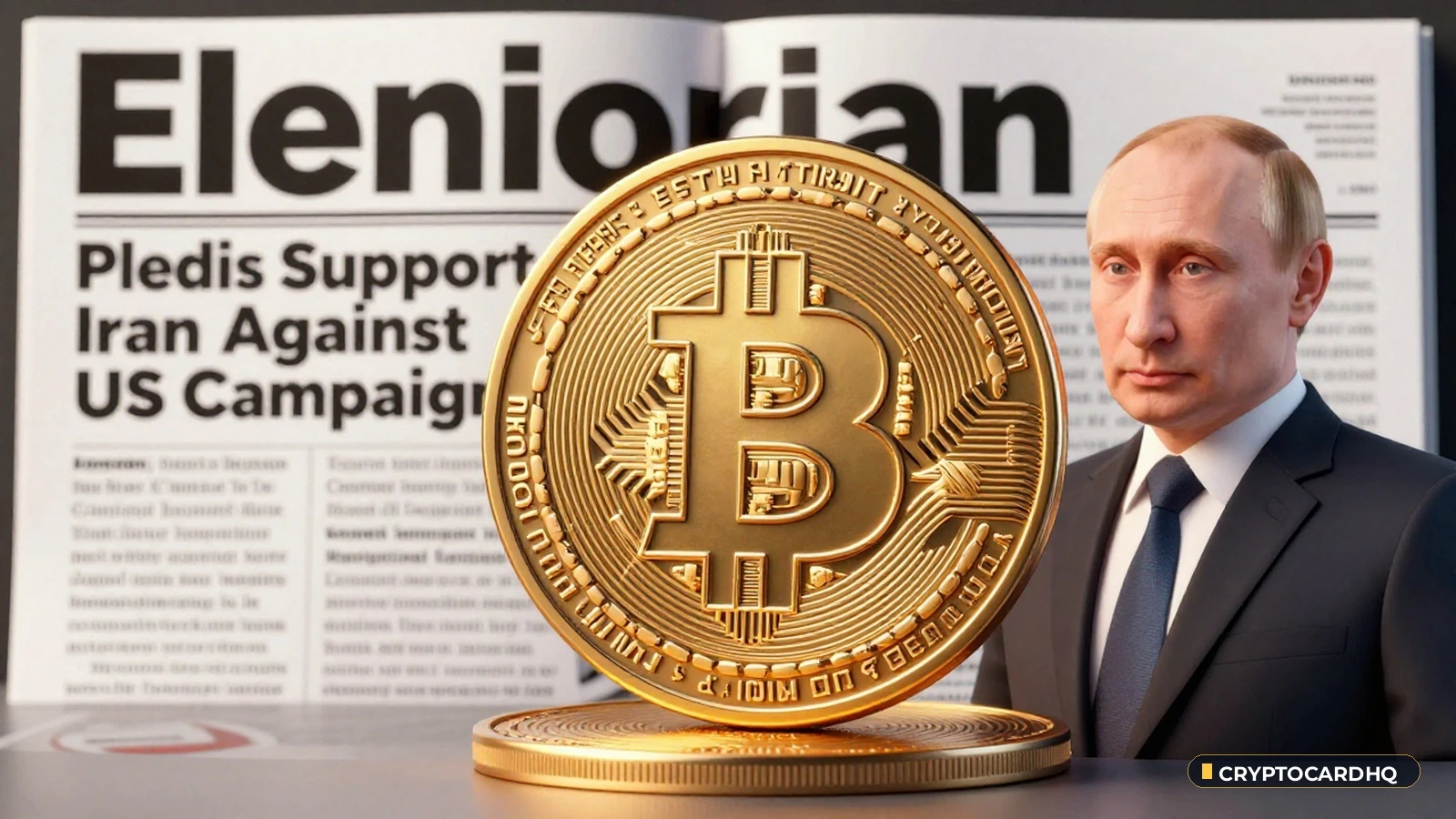
Russian President Vladimir Putin stepped directly into the crosshairs of the Middle Eastern crisis on October 8, 2026, pledging Moscow's direct diplomatic and geopolitical backing to Iran in an explicit bid to halt US-led military operations against the Islamic Republic. The bilateral pronouncement unfolded inside Ashgabat, Turkmenistan, where Putin held high-level discussions with his Iranian counterpart. The declaration sent instantaneous shockwaves ripping through global commodities desks, sovereign bond desks, and digital asset markets. As news alerts flashed across institutional trading terminals, risk assets retreated into defensive posture, with traders rapidly pricing in the acute risks of energy infrastructure strikes, naval blockades in the Persian Gulf, and widespread macro contagion across sovereign liquidity.
The 30-Second Executive Brief:
• The Catalyst: Russian President Vladimir Putin formally pledged Russian backing to Iran against US military actions during high-stakes diplomatic talks in Turkmenistan on October 8, 2026. > • The Money Flow: Global capital fled toward traditional defensive havens while digital asset desks rotated into defensive cash reserves, pressuring primary liquidity pairs.
• The Market Reaction: Bitcoin slipped 1.67% on the session to trade at $81,841.20 within an intraday range of $80,393.56 to $83,521.15, while broader sentiment stood at 64 on the Fear & Greed Index. > • The Invalidation Trigger: Direct de-escalatory diplomatic channels between Washington and Tehran or coordinated multilateral cease-fire negotiations.
Market Snapshot at Time of Reporting: At the time of reporting, BTC ($81,841.20, -1.67% 24h | Range: $80,393.56 - $83,521.15) with broader market sentiment registering 64 (Greed).
Immediate Market Liquidation Timeline and Asset Reaction
The moment Vladimir Putin's statements were reported by Al Jazeera Middle East, automated market makers and quantitative execution models across crypto derivatives exchanges hit the sell button. Order book liquidity dried up in seconds. Within twenty minutes of the wire release, spot bids across major centralized exchanges dissolved, dragging Bitcoin from session highs near $83,521.15 straight down to an intraday low of $80,393.56 before finding tentative support around $81,841.20.
That rapid three-thousand-dollar wick revealed familiar vulnerabilities across crypto derivatives. Leveraged longs, accumulated during days of range-bound calm, were caught flat-footed. Margin liquidation engines fired across perpetual swap venues, dumping collateral directly into falling order books. This downward thrust was not an isolated crypto event caused by protocol bugs or DeFi exploits. It was pure macro panic, closely matching historical flight patterns seen when Bitcoin plunged below $69K as geopolitical tensions escalated during prior confrontations in the Persian Gulf.
Market sentiment held on to a reading of 64 on the Crypto Fear & Greed Index. The metric showed traders had not completely thrown in the towel, but risk appetites shrank fast. High-frequency market makers widened bid-ask spreads across major altcoins, pulling depth from the books and preparing for volatile overnight trading sessions.
The Turkmenistan Summit: Moscow Formalizes Tehran Alliance
The strategic alignment solidified inside Ashgabat, Turkmenistan, where Vladimir Putin held bilateral discussions with his Iranian counterpart. According to official diplomatic briefings, Putin stated that Moscow stands ready to lend comprehensive diplomatic and geopolitical weight to confront and end the US military operations targeting Iranian assets and territorial integrity.
This overt security commitment formalizes an alliance that had previously operated largely through diplomatic shielding, trade mechanisms, and defense technology transfers. By taking a public stance during active US operations, Moscow has signaled that it views the survival and stabilization of the Iranian state as an indispensable pillar of its foreign policy agenda.
Defense analysts emphasize that direct Russian involvement—whether manifested through intelligence sharing, advanced air-defense systems, or electronic warfare deployment—dramatically alters the cost-benefit calculus for Western military planners. An expanded proxy theatre in the Middle East increases the risk of miscalculation, raising the prospect of kinetic friction that could spill beyond regional borders and directly interrupt maritime traffic through the Strait of Hormuz.
Regional specialists note that Turkmenistan was intentionally selected as the venue. Ashgabat has long maintained a policy of permanent international neutrality recognized by the United Nations, offering a convenient platform where non-Western leaders can convene outside European and North American diplomatic reach. For Tehran, securing a public security guarantee from a permanent member of the UN Security Council is a vital diplomatic victory. For Washington and NATO allies, it adds a hazardous layer of friction to regional operations, forcing the Pentagon to balance military targets against the real risk of striking Russian assets or personnel embedded within Iranian installations.
Energy Shockwaves and Macroeconomic Transmission Lines
Financial markets view geopolitical conflict through the prism of global supply chains and inflation. The Middle East remains the world's most critical crude production and export corridor. Any direct clash drawing in nuclear-armed superpowers immediately threatens vital sea lanes, driving crude futures higher and reviving fears of an energy-led inflation spike, similar to previous episodes when oil surged past $110 as Middle East tensions escalated.
When global energy prices jump unexpectedly, bond yields face upward pressure as fixed-income traders price in persistent core inflation. For central banks, rising energy benchmarks constrain the flexibility to cut benchmark policy rates. For Bitcoin and broader risk assets, higher-for-longer interest rate projections restrict global liquidity growth, dampening institutional inflows into speculative and non-yielding instruments.
While Bitcoin has often been hailed by advocates as a non-sovereign safe haven, its short-term trading behavior during acute military flashpoints remains predominantly tethered to high-beta liquidity. When capital preservation becomes paramount, institutions initially dump liquid digital assets to meet margin calls in sovereign bond and commodities markets, delaying any digital gold store-of-value bids until broader financial markets stabilize.
In crude oil futures, Brent and West Texas Intermediate contracts reacted with prompt-month backwardation, signaling acute anxiety over immediate physical supply disruptions rather than distant paper barrels. If maritime transit across the Strait of Hormuz is obstructed—even through sporadic drone harassment or naval boarding attempts—global crude transport costs will surge overnight. Insurance underwriters operating out of Lloyd's of London would reprice war-risk premiums for commercial tankers, creating an immediate drag on European and Asian manufacturing economies heavily reliant on imported hydrocarbon supplies.
Key Figures & Geopolitical Risk Breakdown
To contextualize how this summit shifts global market dynamics compared to previous regional standoffs, the structural factors break down across several operational dimensions:
| Metric / Factor | Previous Diplomatic Baseline | New Ashgabat Development | Strategic Market Impact |
|---|---|---|---|
| Russian Geopolitical Posture | Indirect rhetorical support, bilateral economic trade | Formal pledge to support Iran against US military campaign | Raises stakes of direct great-power confrontation in Middle East |
| Crude Transit Vulnerability | Standard tanker traffic through Persian Gulf corridors | Elevated threat of asymmetric disruption in Strait of Hormuz | Spikes supply-chain risk premium and headline energy inflation |
| Bitcoin Market Behavior | Rallies during localized cease-fires and diplomatic easing | Volatility within wide $80,393.56 to $83,521.15 band | Initial risk-off liquidation before long-term hedge narrative tests |
| Market Sentiment Index | Elevated optimism near 70-75 Greed threshold | Compressed to 64 Greed, reflecting caution | Fragile order books vulnerable to further headline-driven pullbacks |
| Treasury Yield Expectations | Pricing consistent central bank easing cycles | Risk of inflation resurgence slowing rate reductions | Tighter global monetary conditions capping speculative expansion |
Strategic Implications for Institutional and Retail Capital
Institutional capital allocators managing spot digital asset positions face a complex landscape over the coming days. The primary danger stems from secondary headline volatility. If retaliatory strikes, cyber warfare, or naval interceptions occur in the Persian Gulf, global financial markets will price in worst-case scenarios regarding global trade disruption.
During previous geopolitical cycles, speculative rallies emerged whenever diplomatic breakthroughs appeared viable, as observed when Trump's Iran ceasefire signals triggered a Bitcoin rally toward $71K. Conversely, when major powers dig into entrenched military positions, risk premia remain elevated, forcing hedge funds and multi-asset desks to reduce gross exposure.
For digital asset traders, holding unhedged leverage in perpetual futures contracts represents an acute hazard over the next 24 to 48 hours. Weekend trading gaps and illiquid overnight sessions leave order books prone to sudden whipsaws on unverified military claims. Market participants must monitor key technical support zones around the lower boundary of the current range near $80,393.56, where failure to hold could invite deeper tests of structural liquidity pools.
Portfolio risk officers at institutional crypto funds are instructing trading desks to trim directional exposure and shift capital into short-dated Treasury bills or delta-neutral basis trades. When geopolitical lines harden, liquidity tends to vanish when it is needed most. Traders trying to buy fast dips on leverage often end up liquidated before any relief rally can materialize. Keeping spot exposure unencumbered by leverage remains the primary defense against volatile headline whipsaws.
Readers tracking macroeconomic catalysts, central bank responses, and structural crypto market shifts can find regular updates and breaking analysis through our dedicated Bitcoin News category.
Crypto Cards & Everyday Spending Analysis
For everyday cryptocurrency users relying on digital asset debit cards for daily transactions, geopolitical volatility introduces practical operational friction that requires defensive portfolio management.
When holding volatile assets like Bitcoin to back consumer debit balances, sudden market contractions directly degrade local purchasing power. A holder backing their card account with volatile assets sees their available fiat limit contract during sharp price swings. During heightened macro instability, cardholders should consider keeping a larger portion of their spendable collateral in fully backed USD or EUR stablecoins (such as USDC or USDT).
Using stablecoin balances shields card users from market volatility while preserving instant liquidity for retail spending, bill payments, and international transactions. Additionally, high market volatility frequently leads centralized crypto exchanges to widen internal automated conversion spreads. When an exchange automatically liquidates spot Bitcoin at the point of sale to settle a Visa or Mastercard fiat authorization, a wider spread translates to a less favorable conversion rate for the cardholder.
Evaluating platform fee schedules, foreign exchange margins, and cashback tiers becomes essential when navigation conditions turn turbulent. Cardholders seeking competitive fee structures and robust cashback rewards can consult our Best Crypto Cards guide to benchmark which providers offer zero-spread stablecoin conversions and high daily limits.
Beyond conversion spreads, cardholders traveling internationally during geopolitical tensions must monitor transaction processing routes. When sovereign tensions rise, card issuers connected to cross-border settlement rails occasionally tighten fraud and compliance filters on international merchant authorizations. Having a multi-currency card that lets you toggle between fiat balances and dollar-pegged stablecoins ensures you are not stranded at payment terminals when markets swing wildly.
Catalysts & What to Watch Next
Market participants should watch several definitive operational and diplomatic markers over the next 24 to 72 hours:
- 1Official Washington Response: Statements from the White House, the Pentagon, or the State Department regarding Moscow's commitment will signal whether the US intends to recalibrate its military campaign or expand economic sanctions.
- 2Strait of Hormuz Shipping Security: Maritime tracking feeds and naval advisories along Persian Gulf shipping channels will provide immediate verification of whether physical oil flows face imminent risk.
- 3Centralized Exchange Reserves: On-chain movements of Bitcoin and stablecoins moving into or out of primary exchanges will reveal whether institutional market makers are accumulating the dip or preparing for broader distribution.
- 4Derivatives Open Interest Fluctuations: Tracking open interest adjustments across major options and futures venues will indicate whether leverage has been adequately flushed or remains vulnerable to secondary liquidation spikes.