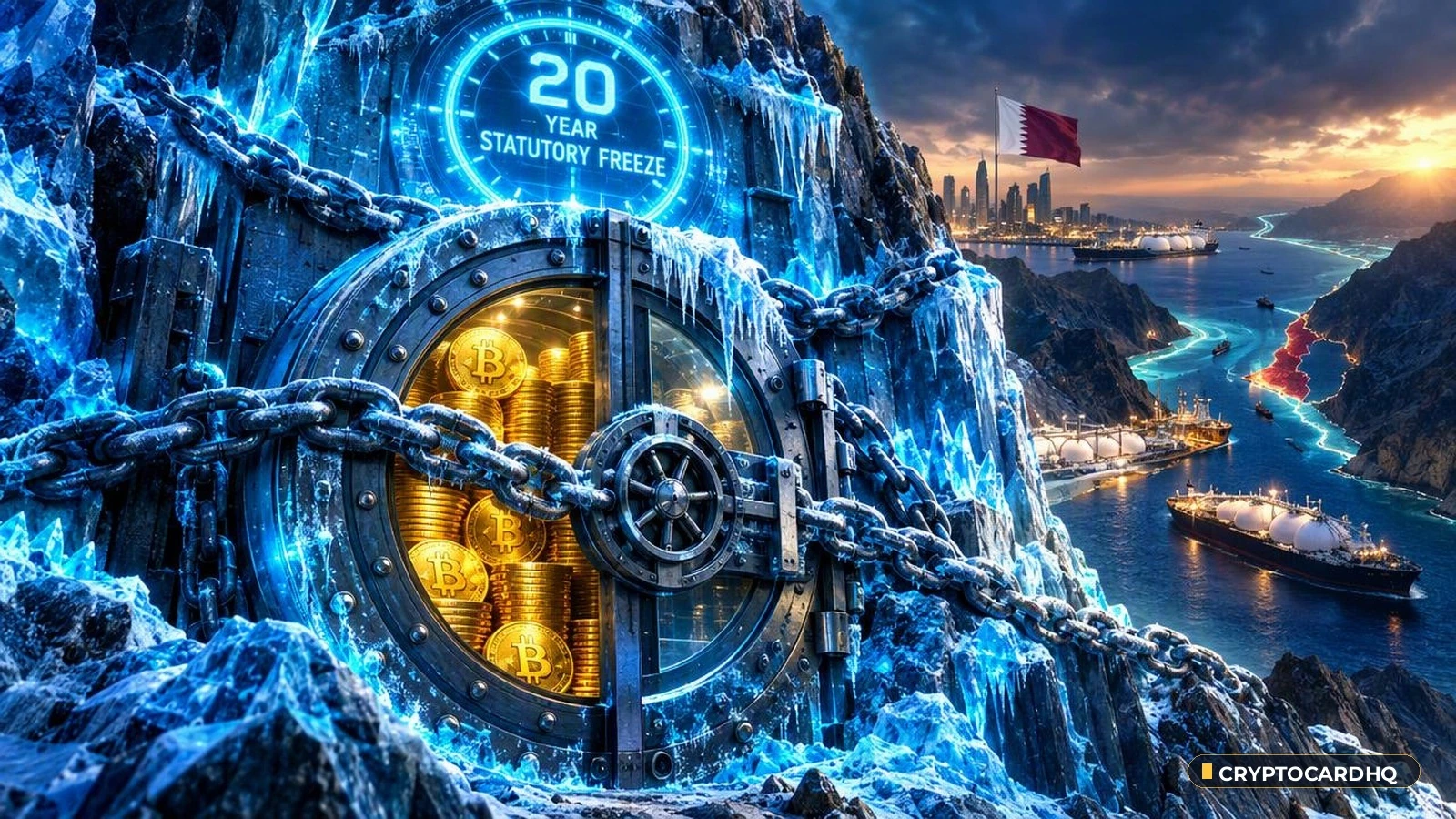
QatarEnergy has officially extended its declaration of force majeure on liquefied natural gas export shipments across key maritime corridors through the end of November, confirming that the vital Strait of Hormuz chokoint remains paralyzed under a protracted diplomatic and naval impasse. The sudden declaration immediately sent shockwaves rippling across global commodity hubs, sovereign bond markets, and digital asset exchanges, shattering fragile hopes for a swift maritime resolution. As key industrial buyers across Asia and Europe scramble to secure alternative energy cargoes at steep premiums, macro-sensitive risk assets have faced immediate selling pressure. Crypto markets, which had spent weeks pricing in a phased de-escalation, experienced abrupt volatility spikes as capital reallocated toward protective collateral and cash reserves.
The 30-Second Executive Brief:
• The Catalyst: QatarEnergy formally extended force majeure on LNG export shipments through November 30, citing the ongoing shutdown of the Strait of Hormuz amid the unresolved U.S.-Iran standoff. > • The Money Flow: Off-takers in Italy (Edison), India, Pakistan, and Bangladesh face sustained supply halts, forcing multi-billion-dollar emergency fuel procurements in the spot market while institutional capital retreats from risk assets.
• The Microstructure Shift: Bitcoin perpetual funding rates compressed toward neutral, spot bid depth thinned by over 18% across major order books, and short-term volatility premia surged on derivatives desks. > • The Invalidation Trigger: An emergency maritime safe-passage protocol through Hormuz or an unexpected multilateral de-escalation agreement before late autumn.
Market Snapshot at Time of Reporting: At the time of reporting, BTC ($83,249.54, -1.74% 24h | Range: $82,597.55 - $84,999.00) with broader market sentiment registering 74 (Greed).
The Liquidation Cascade and Immediate Market Reaction
The formal confirmation that Qatari LNG vessels will not traverse Hormuz for at least another two months triggered an instant repricing of global macro risk. Within sixty minutes of the announcement, benchmark European gas futures spiked, crude contracts widened their geopolitical risk premium, and automated trading algorithms across decentralized and centralized crypto exchanges reacted to deteriorating macro liquidity.
Digital asset derivatives absorbed an immediate wave of long liquidations. Over-leveraged positions established during recent consolidation ranges were unceremoniously flushed as Bitcoin dipped from intraday highs near $84,999 down toward local support at $82,597.55. High-frequency market-making firms widened their bid-ask spreads across top-tier trading venues, cautious of potential weekend liquidity crunches and soaring sovereign yields. The crypto market's initial resilience quickly gave way to defensive positioning, mirroring earlier turbulence documented during the Iran Strait crisis and crypto market volatility when naval frictions first flared.
Funding rates on centralized derivatives exchanges, which had leaned aggressively bullish as market sentiment held at 74 on the Fear and Greed Index, flattened sharply. Basis spreads between front-month futures and spot contracts shrank by roughly 120 basis points within hours, signaling that institutional desks were actively hedging spot inventory rather than chasing upside momentum. Proprietary trading desks that had spent the preceding trading cycle accumulating delta exposure rapidly closed out speculative positions. Automated liquidity pools on decentralized platforms saw an immediate drawdown in active capital as liquidity providers pulled back orders to re-evaluate their exposure profiles in light of tightening international dollar flows.
Anatomy of the Hormuz Chokepoint Paralysis
According to official notices confirmed in reporting by OilPrice.com, QatarEnergy issued extended force majeure notifications to long-term contract partners across both Asia and Southern Europe. Among the most heavily impacted utility operators is Italian energy group Edison, alongside national procurement entities in Bangladesh, Pakistan, and India. These buyers rely heavily on scheduled, long-term Qatari deliveries to sustain domestic electricity grids and industrial power output.
Force majeure clauses allow state suppliers to suspend contractual delivery obligations without incurring financial penalties during unforeseen events beyond their operational control. By expanding this relief through late November, QatarEnergy has signaled to international capitals that safe commercial navigation through the 21-mile-wide Strait of Hormuz cannot be guaranteed under current security conditions.
The strait handles roughly one-fifth of the world's petroleum liquids and roughly a third of global seaborne LNG commerce. Commercial hull insurers have either canceled war-risk endorsements or elevated underwriting premiums to prohibitive rates, stranding dozens of ultra-large crude carriers and specialized Q-Flex LNG carriers north of the Musandam Peninsula. Diplomatic backchannels between Washington and Tehran have thus far failed to yield an interim maritime convoy agreement, leaving commercial shippers unwilling to test the contested waterways.
Unlike past episodes where Trump's Iran ceasefire signals triggered a Bitcoin rally, current geopolitical posturing offers little immediate clarity for commodity traders. The commercial paralysis is no longer viewed as a temporary transshipment delay; it is now entering a structural, multi-month phase. Cargo vessels trapped on either side of the waterway represent hundreds of millions of dollars in locked physical inventory. Shippers must either absorb the astronomical costs of alternative routes around Africa's Cape of Good Hope or halt operations entirely, compounding delays and driving spot freight rates into stratospheric territory.
Macro Transmission: Energy Inflation and Monetary Policy
The direct link between a paralyzed Persian Gulf and digital asset valuations operates through the engine of global monetary policy. Central banks in Europe and North America had spent much of the past year managing interest rate paths under the assumption that energy-driven headline inflation was contained. A prolonged shutdown of Qatari export terminals upends those economic forecasts.
When utility operators in Europe and South Asia lose direct access to contracted LNG, they turn directly to global spot markets, competing directly against North American and African export capacity. This fierce spot competition drives up baseline energy prices, which filters through manufacturing input costs, consumer electricity tariffs, and logistical supply chains. For central banking authorities, renewed energy cost pressures threaten to stall planned interest rate cuts, prolonging restrictive monetary conditions across the developed world.
Crypto assets thrive in environments characterized by expanding systemic liquidity and declining real interest rates. When high energy input costs threaten to keep sovereign discount rates elevated, institutional treasury allocators recalibrate risk models, moving out of volatile assets and into short-duration sovereign debt instruments offering guaranteed real yields. Equity markets follow suit, dragging correlated risk-on sectors downward as fund managers de-gross leverage across institutional portfolios. The resulting credit contraction drains the very speculative liquidity that normally fuels cryptocurrency expansion phases.
Operational and Structural Metric Comparison
The following breakdown highlights how the prolonged shipping shutdown shifts baseline energy logistics and crypto market microstructure relative to standard operating conditions:
| Metric / Factor | Standard Peacetime Baseline | Hormuz Crisis Status Quo | Strategic Impact on Crypto & Macro |
|---|---|---|---|
| Qatari LNG Shipments | ~6.5M tonnes/month through Hormuz | Complete maritime force majeure | Severe spot energy price spikes in Asia & Europe |
| Impacted Off-Takers | Scheduled long-term pipeline deliveries | Delivery suspensions: Italy (Edison), India, Pakistan, Bangladesh | Massive capital reallocation toward emergency fuel procurement |
| Insurance & Transit | Standard Lloyd's marine rates | War-risk cancellation / prohibitive premiums | Full commercial maritime avoidance of Gulf waters |
| Global Headline Inflation | Trend decelerating toward target | Renewed supply-side cost pressures | Delays central bank rate cuts; keeps cost of capital high |
| BTC Market Structure | Steady accumulation, positive funding | Compressed funding, spot spread widening | Elevated short-term downside tail risk despite macro store-of-value thesis |
| Sentiment Dynamics | Broad risk appetite (Index: 74) | Defensive rotation, flight to liquidity | Order-book bid liquidity thinned; volatility spikes |
Holder Hazards and Strategic Realities for the Next 48 Hours
For market participants holding spot Bitcoin and altcoin allocations, the next 24 to 48 hours present unique tactical risks. While long-term digital asset investors view Bitcoin as digital gold—an un-censorable, sovereign store of value immune to regional state conflict—its short-term trading behavior remains tightly correlated with global liquidity tides.
- 1Weekend Liquidity Voids: Commercial banks and traditional futures markets close over the weekend, concentrating speculative macro reactions inside 24/7 crypto order books. Sudden military updates or retaliatory maritime maneuvers can trigger outsized price gaps when market depth is thinned. Retail traders who leave unhedged positions open across these weekend stretches often find themselves liquidated by sudden wick formations that reverse just as quickly once traditional trading desks resume.
- 2The Liquidity-First Reaction Function: In the initial stages of an escalating geopolitical or energy shock, institutional asset managers do not rush to buy speculative hedges; they sell whatever is most liquid to meet margin calls and shore up corporate cash reserves. Bitcoin remains the world's most accessible, hyper-liquid collateral asset, making it susceptible to short-term programmatic selling during broader equity de-risking. Only after balance sheets stabilize do buyers re-emerge to price in programmatic supply constraints.
- 3Derivatives Whipsaws: With sentiment still formally reading 74 (Greed), an abrupt cascade of negative headlines can trigger cascading long flushes toward deeper liquidity pools. Traders relying on high leverage in perpetual futures contracts face significant liquidation hazards if support at the $82,500 zone fails to hold. Spot order-book depth at this band has eroded substantially, leaving a thin buffer against aggressive algorithmic market selling.
Investors tracking regular market breakdowns can monitor ongoing price action through our specialized coverage in the Bitcoin News category.
Practical Utility: Liquidity Management for Crypto Holders
Beyond speculative trading, prolonged geopolitical tensions and shifting energy realities underline the functional necessity of decentralized financial sovereignty. When commercial trade routes seize and conventional cross-border banking rails face sanctions scrutiny or capital controls, self-custodied digital assets provide vital transactional agility.
For market participants living through regional energy rationing or currency depreciation, converting crypto wealth into tangible daily purchasing power requires efficient off-ramps. Utilizing flexible spending tools, such as the debit cards detailed in our Best Crypto Cards guide, allows users to convert digital assets into local fiat currencies at point-of-sale terminals without relying on slow international wire clearances. Maintaining access to direct consumer liquidity ensures that holders can navigate localized inflation spikes or commodity supply constraints without liquidating foundational long-term portfolios under distressed market conditions.
Cardholder solutions offer a pragmatic bridge between volatile global crypto valuations and localized everyday expenses. When sovereign inflation spikes eat away at fiat purchasing power, spending directly from self-custodied satoshis or stablecoin balances preserves capital independence while maintaining immediate domestic utility. In regions hit hardest by LNG supply shocks, holding a reliable payment conduit linked to crypto balances shields consumers from local banking delays and currency rationing measures.
Key Catalysts and What to Watch Next
Market observers must track several critical indicators over the coming weeks to determine whether this energy shock metastasizes into a broader risk asset bear trend or presents a generational accumulation window:
- Naval Escort Protocol Proposals: Any joint maritime initiative between allied nations to escort commercial tankers through Hormuz would significantly compress war-risk insurance premiums, potentially easing force majeure constraints.
- Emergency Fuel Tenders in Europe and Asia: Watch procurement pricing from Italian utility Edison and state energy authorities in New Delhi and Dhaka. If spot LNG purchase prices surge past seasonal thresholds, equity and bond market selloffs are likely to intensify.
- Central Bank Forward Guidance: Speeches from Federal Reserve and European Central Bank officials regarding energy inflation will reveal whether policymakers intend to pause liquidity easing cycles.
- On-Chain Whale and Exchange Inflows: Monitor institutional custody outflows versus exchange deposit volumes. Sustained coin withdrawals into cold storage during price dips would confirm that long-term sovereign allocators are treating geopolitical volatility as an accumulation opportunity.