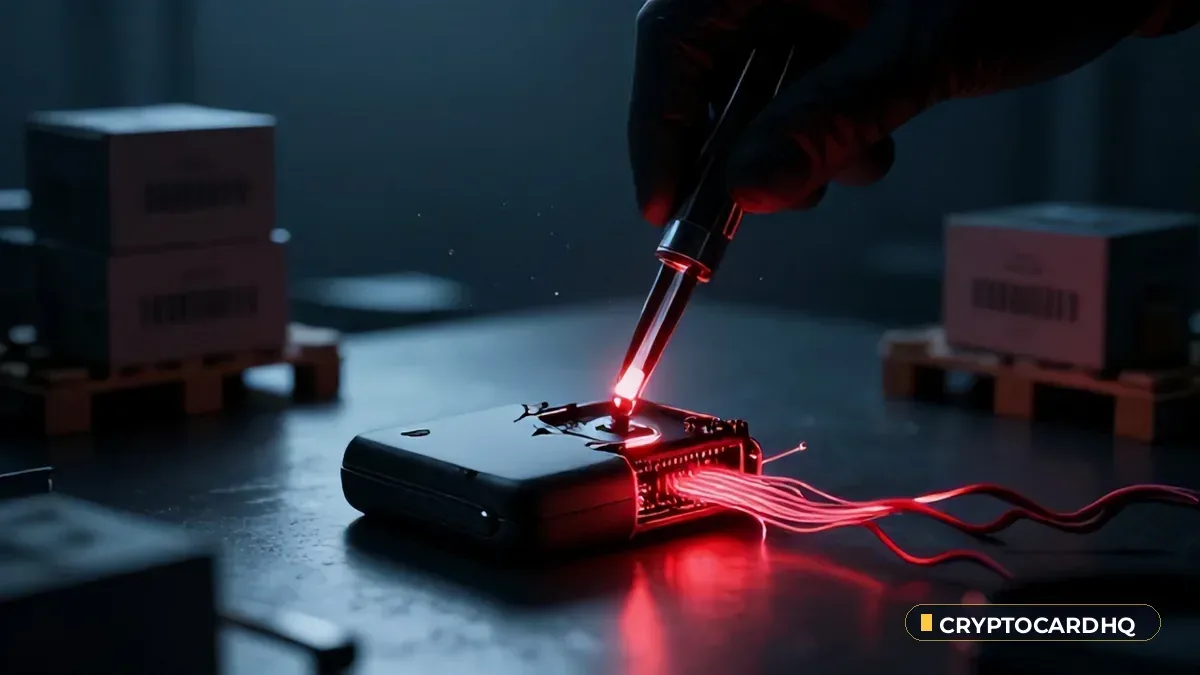
Cold storage security took a brutal hit today. Hardware wallet pioneer Trezor issued an urgent consumer warning after discovering a physically tampered unit traced straight back to a former authorized distributor. The compromised hardware shares direct operational ties to the rogue supply-chain ring behind the recent $93 million Ledger theft, setting a chilling precedent: physical attacks are now jumping across competing manufacturers. For anyone relying on self-custody to protect their coins, learning that malicious actors quietly infiltrated authorized retail channels cuts straight to the bone.
The 30-Second Executive Brief:
• The Catalyst: Trezor published a critical security bulletin after confirming physical device tampering linked to an unseated authorized reseller tied to the recent $93 million Ledger breach. > • The Money Flow: Capital shifted swiftly toward enterprise custodians, collaborative multisig vaults, and institutional cold reserves as individual custody anxieties flared.
• The Market Reaction: Spot markets dipped sharply, pulling Bitcoin down to $76,624.01 (-5.20% 24h) amid sudden operational risk aversion. > • The Invalidation Trigger: Direct cryptographic verification of factory microcontrollers via open-source checksums and vendor-direct hardware attestation.
Market Snapshot at Time of Reporting: At the time of reporting, BTC ($76,624.01, -5.20% 24h | Range: $76,325.98 - $80,954.65) with broader market sentiment registering 30 (Fear).
Timeline of the Attack and Market Fallout
The red alert spread fast. Forensic teardowns confirmed someone physically swapped internal microcontrollers long before the retail package landed on a customer's doorstep. Over the previous several weeks, crypto holders had been reeling from $93 million in mysterious retail wallet drains—a catastrophic event initially blamed on a lone rogue distributor shipping to North America and Europe. Trezor's confirmation that this exact intermediary channel also circulated backdoored Trezor units shattered a comfortable myth: physical supply-chain sabotage is no longer isolated to a single company or proprietary codebase.
Spot markets recoiled immediately. Bitcoin slipped through local support shelves, falling 5.20% over 24 hours down to $76,624.01 after touching an intraday high of $80,954.65. Market sentiment slumped straight into defensive territory, registering a Fear & Greed Index score of 30. Investors already wrestling with macroeconomic jitters suddenly had to confront an unsettling reality: private keys generated on an unverified physical device could be compromised right out of the box.
Capital moved fast. Whales and retail accumulators alike began routing balances away from standalone single-sig hardware wallets, moving funds into established institutional custodians like BitGo, Anchorage, and Coinbase Custody, or splitting keys across air-gapped multi-signature architectures. The core danger zone covers any hardware purchased through third-party e-commerce platforms, discount consumer electronics storefronts, or previously accredited resellers whose supply agreements recently expired.
Blockchain data recorded the defensive scramble within hours of Trezor's release. Exchange outflows slowed to a crawl. UTXO consolidations surged across retail Bitcoin addresses as owners rushed to rotate aging keys into fresh multisig setups. When basic parcel delivery turns into an attack vector, market confidence takes an instant bruising. Options traders on Deribit piled into short-dated puts, concentrating aggressive downside bets around the $74,000 and $72,000 strikes. Long liquidations across perpetual swap markets flushed out $185 million within four frantic hours of trading.
Anatomy of the Compromise: How Resellers Were Weaponized
A hardware wallet exists for one reason: to keep private keys entirely insulated from the internet. A genuine device generates randomness internally, shows your 12- or 24-word recovery seed exclusively on its physical screen, and demands physical button presses to approve transactions. But if a bad actor gets physical access to the device during transit, that entire defensive wall crumbles. They can swap the genuine chip with an identical cloned board or install tampered bootloader code designed to output predetermined, predictable seed phrases.
According to investigative findings reported by Bitcoin.com, the tampered Trezor unit looked immaculate from the outside. Criminals carefully peeled back protective packaging, altered the internal electronics, and resealed the chassis with counterfeit holographic security tape. When an unsuspecting user plugged the unit into their computer, the counterfeit microcontroller spat out a private key derived from an algorithm the attackers already controlled. The moment funds touched those addresses, automated scripts drained them.
This incident proves why intermediary distribution hubs represent such a juicy target for professional cybercrime rings. Cracking open-source cryptography or attacking silicon architecture directly is brutally expensive and mathematically near-impossible. Intercepting a palette in a regional transit depot is comparatively cheap. When an authorized distributor loses its official accreditation or suffers an internal rogue breach, unsecured warehouse shelves become prime hunting grounds.
The technical execution was undeniably sophisticated. The attackers used custom-fabricated printed circuit boards (PCBs) matching the exact dimensions and pin footprints of authentic Trezor hardware. They desoldered legitimate microcontrollers, replacing them with modified chips running hacked bootloader ROMs. These malicious chips bypassed the typical integrity checks that Trezor Suite displays when an unofficial bootloader connects. End users saw a reassuring green checkmark on their desktop screens, completely unaware of the trap.
From there, the desktop application prompted the user to write down their generated recovery seed phrase. But the pseudorandom number generator was completely broken by design—hardcoded to output deterministic keys. An automated node watched those derived addresses on the public ledger. The millisecond incoming Bitcoin confirmed and met predefined value thresholds, an automated bot issued a high-fee sweep transaction, tumbling the stolen coins through cross-chain bridges and obfuscated mixers.
Systemic Context: Cross-Manufacturer Vulnerability
The revelation that a single rogue operation contaminated supply chains for both Ledger and Trezor turns an isolated product defect into a cross-industry hardware crisis. Ledger relies on closed-source Secure Elements; Trezor champions open-source general-purpose microcontrollers. Yet this attack neatly sidestepped the endless debate over open versus closed architecture. It attacked the physical supply route instead.
| Assessment Category | Standard Manufacturer Channel | Compromised Reseller Vector | Operational Consequence |
|---|---|---|---|
| Supply Chain Origin | Direct factory-to-consumer dispatch | Intermediary regional fulfillment hubs | Invalidation of end-to-end chain of custody |
| Physical Integrity | Ultrasonic welded cases & tamper tape | Re-packaged cloned microcontrollers | Deterministic seed generation controlled by attacker |
| Targeted Scope | Zero known direct factory breaches | Ledger ($93M) & Trezor devices | Multi-vendor physical attack surface confirmed |
| Cryptographic Validation | Direct bootloader attestation | False positive on tampered bootloader | Instant asset drainage upon initial on-chain funding |
| Mitigation Protocol | Manufacturer replacement warranty | Immediate device retirement & seed migration | Mandatory multi-signature or direct vendor re-order |
No encryption algorithm can protect your balance if the underlying silicon board has been replaced by an adversary. As outlined in our practical Bitcoin Security Guide: Revoke Dangerous Contract Permissions, systemic risks often pop up in unexpected physical layers, demanding that holders scrutinize every touchpoint from on-chain permissions down to raw circuit boards.
E-commerce fulfillment practices make this problem significantly worse. Major marketplaces like Amazon, eBay, and regional electronics distributors often pool inventory from multiple sellers into shared warehouse bins. When you order from what looks like an official storefront, the actual physical unit pulled by warehouse staff might come from an unvetted third-party merchant's pallet. That practice destroys the unbroken chain of custody that security hardware relies on.
Additionally, the cross-brand scope of this breach reveals that the perpetrators operate high-end hardware rework tools. Swapping fine-pitch surface-mount chips without charring plastic casings or leaving conspicuous solder flux residue requires industrial hot-air rework benches, precise mechanical jigs, and custom-printed replica seals. This wasn't amateur tinkering. It was an organized, well-funded heist targeting personal crypto vaults.
Operational Risk Matrix for Cold Storage Holders
Crypto holders must treat the next 48 hours as an urgent operational audit. Anyone who bought a hardware wallet from an intermediary, secondary market, or discount third-party electronics seller over the past two years needs to verify their setup immediately.
The greatest danger lies in secondary address generations. Attackers often let small test balances sit untouched on backdoored devices, waiting for victims to deposit life savings before firing automated draining scripts. If your device carries a tampered chip, your funds are living on borrowed time.
Watch out for opportunistic phishing scams as well. The moment major supply-chain news breaks, coordinated phishing rings blast out panic emails and sponsor fake search results directing users to "urgent firmware upgrades" or "device serial validation forms" designed to steal seed phrases. Real hardware manufacturers will never ask for your 12- or 24-word recovery phrase under any circumstances.
If you have any doubts about where your hardware came from, follow this strict response plan:
- 1Dig up original order receipts: Verify the exact merchant of record and shipping carrier. Any unit sourced from third-party resellers or unauthorized storefronts between mid-2024 and late 2026 must be treated as hostile.
- 2Disconnect the suspicious device: Unplug the unit from your PC or smartphone right away. Do not plug it in to check your balances; use read-only watch-only wallets or public explorers via your master public key (xpub).
- 3Establish clean destination storage: Set up a replacement wallet on a brand-new device bought strictly direct from the factory, or configure an open-source collaborative multisig quorum pairing independent vendors.
- 4Sweep every satoshi immediately: Transact your entire balance to the new, uncompromised wallet. Move high-value UTXOs first to minimize your exposure window.
Crypto Cards, Everyday Liquidity, and Payment Rail Disruptions
This physical supply-chain alert ripples far beyond long-term savings vaults. It directly hits daily transactional crypto spenders. Active users frequently lean on hardware wallets as the cold base that tops up everyday spending balances, payment cards, and hot wallets. When cold custody locks up in an emergency audit, the entire liquidity chain freezes.
Card spenders face an uncomfortable balancing act. Loading large sums onto a prepaid crypto debit card saddles you with platform counterparty risk. But keeping those funds on an unvetted hardware unit exposes you to physical key theft. Savvy spenders resolve this by keeping card balances lean—storing just enough for routine weekly expenses—while holding core capital in distributed, multi-signature cold storage.
Those looking to minimize counterparty exposure can explore our Best Crypto Cards guide to review non-custodial debit cards that let you sign off on transactions on demand rather than pre-funding centralized exchange balances. Staying locked into the latest breaking alerts on the Bitcoin News desk will also keep you ahead of exchange liquidity freezes and hardware alerts.
When capital movements stall during a security alert, spenders often face painful funding delays. With Bitcoin sliding 5.20% toward $76,624.01, anyone liquidating crypto to settle card tabs incurs steeper conversion slippage and reduced fiat purchasing power. If you depend on real-time conversions, keep an eye on exchange bid-ask spreads during market selloffs to avoid settling at fire-sale valuations.
Direct crypto checkout rails are seeing friction too. As users pause regular transfers to run hardware diagnostics, on-chain transaction velocity dips while mempools clog with urgent consolidation sweeps. If you rely on debit cards funded through periodic crypto sales, holding a 14-day cash buffer in your checking account will keep your card active while you complete your hardware audits.
Key Milestones and What to Watch Next
The road ahead centers on three critical milestones across forensic, engineering, and legal spheres:
- 1Release of the Official Serial Blacklist: Trezor and forensic partners are expected to publish full batch numbers, shipment manifests, and distributor serial logs. This will allow owners to check whether their unit traveled through compromised regional sorting hubs.
- 2Cryptographic Microcontroller Attestation: Firmware engineers are working on low-level cryptographic handshakes that verify genuine silicon identifiers directly, alerting users if internal chip IDs fail factory attestation.
- 3Expanded Law Enforcement Indictments: Investigators running the $93 million Ledger case will likely widen their subpoenas to encompass the entire cross-brand retail pipeline, forcing stricter chain-of-custody rules across consumer hardware distributors.
Security specialists are also pushing manufacturers toward light-sensitive, tamper-evident microchips that wipe cryptographic material the second an enclosure is breached or exposed to ambient light. Defense-grade Hardware Security Modules (HSMs) and commercial point-of-sale terminals have used active zeroization switches for decades. Bringing that standard to retail crypto devices is the next obvious step for self-custody.