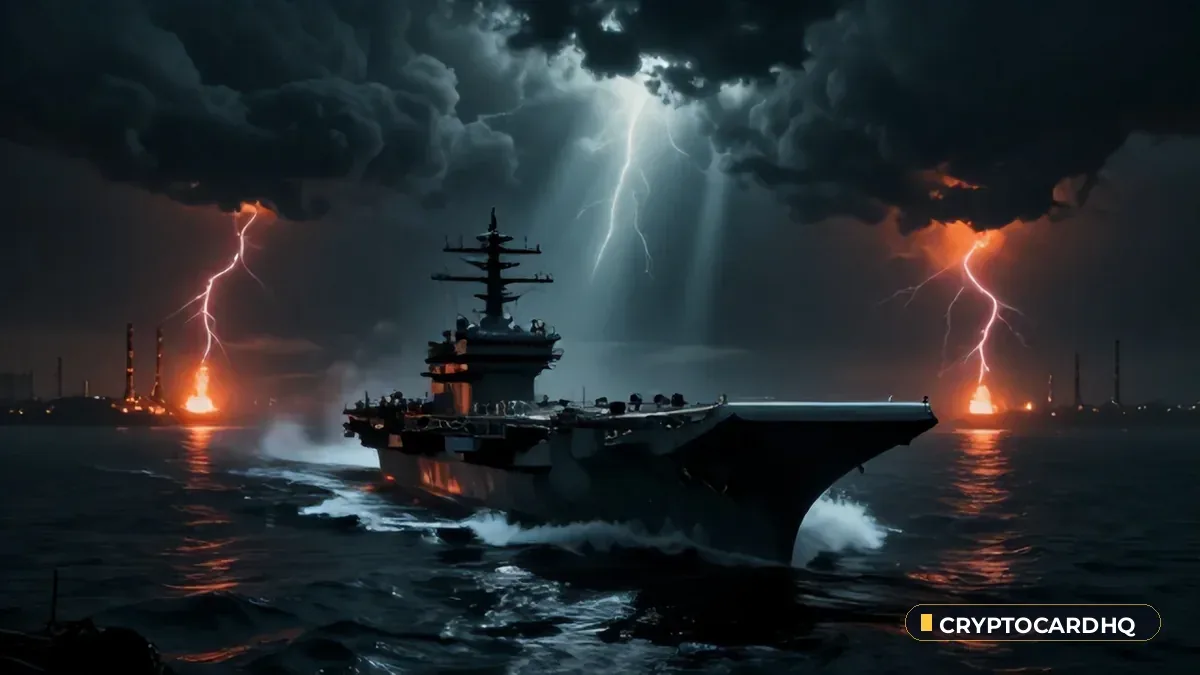
A sudden military escalation in the Persian Gulf has caught global trading desks and digital asset markets squarely in its crosshairs. In a direct operational response to Iranian targeting actions against sovereign infrastructure in the Kingdom of Bahrain, the United States Department of Defense has ordered a third aircraft carrier strike group to deploy immediately to the Middle East theater. Operating a three-carrier naval armada in regional waters represents an aggressive militarization of Persian Gulf littoral corridors. More critically, it puts commercial maritime transit through the Strait of Hormuz—the vital choke point through which roughly twenty percent of the world's petroleum supply flows daily—under imminent operational strain.
The rapid naval repositioning follows kinetic strikes by Tehran aimed at assets within Bahrain. The island kingdom permanently hosts the United States Naval Support Activity Bahrain and serves as operational headquarters for the U.S. Fifth Fleet. By striking assets located within Bahrain, Iranian forces turned localized proxy skirmishes into a direct sovereign threat against allied command nodes and international sea lines of communication. The shock waves hit energy trading pits, crude derivative books, and global spot crypto order books almost simultaneously.
The 30-Second Executive Brief:
• The Catalyst: The Pentagon has ordered a third U.S. aircraft carrier strike group to the Middle East after confirmed Iranian targeting actions against installations in Bahrain. > • The Money Flow: Capital flight surged into defensive sovereign fiat cash and crude oil futures, triggering immediate defensive positioning across major cryptocurrency order books.
• The Market Reaction: The Crypto Fear & Greed Index collapsed to 10/100 (Extreme Fear), with Bitcoin printing an intraday channel between $62,006.00 and $66,132.01, while Ethereum traded wildly between $1,711.08 and $1,845.18. > • The Invalidation Trigger: Formal diplomatic stand-downs or concrete maritime security guarantees from Gulf regional actors; conversely, any uncontained kinetic strike disabling key Persian Gulf refinery or naval installations.
Market Snapshot at Time of Reporting: At the time of reporting, BTC was trading at $64,752.28 (+4.07% 24h | Range: $62,006.00 - $66,132.01), while ETH stood at $1,807.81 (+5.08% 24h | Range: $1,711.08 - $1,845.18), with broader market sentiment pinned at 10 (Extreme Fear).
Immediate Market Shock and Liquidation Timeline
When the Pentagon confirmed the third carrier deployment, automated risk-off mechanisms fired across institutional trading venues. Algorithmic market makers immediately widened their spreads on perpetual swaps and spot order books to insulate their balance sheets from unhedged tail risk. Liquidity vanished in minutes.
Spot Bitcoin experienced severe intraday volatility. The asset carved out an aggressive four-thousand-dollar channel between $62,006.00 and $66,132.01 before consolidating around $64,752.28. Ethereum experienced an identical roller-coaster ride, whipping violently from an intraday low of $1,711.08 to a high of $1,845.18 before settling near $1,807.81.
Behind these raw numbers lies a deeply stressed market psychology. The Crypto Fear & Greed Index plummeted to 10 out of 100, firmly in Extreme Fear territory. Spot prices staged a modest counter-trend rally off their lowest intraday wicks—logging nominal 24-hour green prints of +4.07% for BTC and +5.08% for ETH—yet the underlying order book structure remains remarkably brittle. What looks like aggressive dip buying on shorter timeframes is primarily short-covering by mechanical algorithms, counterbalanced by steady, systematic spot de-risking from institutional desks managing multi-asset mandates.
Institutional capital allocators have seen this playbook unfold before. As documented in CryptoCardHQ's coverage of Middle East crude shocks and crypto markets, systemic tension near Persian Gulf transit corridors sparks an immediate retreat into sovereign fiat liquidity, short-dated Treasury bills, and physical crude futures, stripping liquidity from high-beta speculative holdings.
Core Event Breakdown: Pentagon Mobilizes Third Carrier to Counter Tehran
Concentrating three nuclear-powered aircraft carrier strike groups inside the United States Central Command (CENTCOM) area of operations represents one of the largest naval build-ups in the region in decades. Verified defense bulletins reported via Google News Iran Geopolitics coverage reveal that defense officials gave the deployment order after intelligence confirmed active Iranian targeting operations directed against assets in Bahrain.
Bahrain is not just another regional ally; it is the linchpin of American maritime command in the Middle East. Hosting the headquarters of the U.S. Fifth Fleet and the 44-nation Combined Maritime Forces, Bahrain functions as the operational nerve center coordinating international patrol vessels across the Persian Gulf, Red Sea, Gulf of Oman, and Arabian Sea. Targeting Bahrain directly threatens Western maritime deterrence and challenges long-standing regional defense agreements.
A single Carrier Strike Group (CSG) packs serious firepower. It includes a Nimitz- or Gerald R. Ford-class nuclear-powered supercarrier, an embarked carrier air wing fielding dozens of strike fighters, guided-missile cruisers, and an escort squadron of destroyers equipped with the Aegis Combat System. These surface combatants field deep arsenals of Tomahawk land-attack cruise missiles alongside advanced anti-air and anti-ballistic missile interceptors. Positioning three carrier groups in theatre gives CENTCOM continuous, 24-hour combat air patrols and overlapping air defense umbrellas spanning thousands of square miles.
Tehran's tactical pivot toward targeting assets in Bahrain sharply raises the stakes. Bahrain and Iran sit roughly one hundred miles apart across the Gulf. At that range, Iranian anti-ship cruise missiles, ballistic projectiles, and one-way loitering munitions have minimal flight times. That compressed timeline cuts decision-making windows for naval defense crews down to seconds.
Middle East Macro Framework and the Energy Transit Threat
The strategic ramifications reach far beyond naval tactical maneuvers. This escalation strikes directly at the heart of global maritime energy distribution. Persian Gulf crude exports must navigate the Strait of Hormuz, an ocean passage only twenty-one nautical miles wide at its narrowest choke point, split into inbound and outbound shipping channels barely two miles wide each. When military friction hits Bahrain and Iranian missile batteries go on high alert, commercial oil tankers face severe operational hazards.
Whenever commercial shipping lanes face live combat risks, marine insurance underwriters adjust their pricing immediately. War-risk insurance premiums for commercial tankers loading crude in the Persian Gulf climb rapidly, tacking on steep operational surcharges to every barrel moved out of regional export terminals. These logistics costs quickly feed into global Brent and West Texas Intermediate (WTI) crude benchmarks, creating cost-push inflationary pressure worldwide.
Central banks monitor these energy bottlenecks with intense scrutiny. Sudden spikes in imported fuel costs disrupt carefully planned monetary easing paths. Higher energy costs threaten to pause expected interest rate reductions or push central banks into keeping benchmark lending rates elevated for an extended period. That macro scenario bears direct consequences for crypto asset valuations. When risk-free yields on short-dated government paper stay high, capital remains locked in cash equivalents rather than venturing outward into high-beta risk assets like Bitcoin and altcoins.
History provides a clear template for how these capital flows behave. During earlier bouts of regional friction, examined in detail in CryptoCardHQ's reporting on Bitcoin's slide below $69,000 amid regional military tensions, digital assets acted not as immediate safe-haven gold substitutes, but as hyper-liquid, round-the-clock liquidity buffers. When unexpected margin calls strike traditional equity and debt portfolios, institutional funds liquidate their crypto books first simply because crypto markets never close.
Key Figures & Operational Breakdown
The intersection of direct military mobilization, maritime energy security, and cryptocurrency market structure is mapped out in the comparative breakdown below:
| Metric / Factor | Standard Peacetime Baseline | Current Crisis Deployment | Strategic Impact |
|---|---|---|---|
| U.S. Carrier Presence | Single Carrier Strike Group (CSG) or rotational gap | Three CSGs deployed concurrently in theater | Unprecedented concentration of maritime air-defense and strike assets; continuous combat air patrol capacity. |
| Targeted Territory | Isolated proxy friction or high-seas shipping interdictions | Direct Iranian targeting actions on Bahrain assets | Direct challenge to U.S. Fifth Fleet headquarters and sovereign Gulf infrastructure. |
| Crypto Market Sentiment | Neutral to Greed (45–65 index range) | 10 (Extreme Fear) | Market participants position defensively; high vulnerability to sudden liquidity withdrawals. |
| BTC Trading Dynamic | Orderly consolidation within macro bands | Wide intraday swings ($62,006.00 – $66,132.01) | Elevated intraday volatility, reflecting aggressive battle between dip buyers and macro hedgers. |
| ETH Trading Dynamic | Steady correlation with broader tech equities | Sharp multi-point range ($1,711.08 – $1,845.18) | Heightened volatility on high-beta smart contract platforms as decentralized finance yields face macro repricing. |
| Energy Transit Risk | Unimpeded maritime transit via Strait of Hormuz | Elevated war-risk surcharges and active convoy patrols | Upward cost-push inflationary risks affecting global supply chains and monetary policy paths. |
Strategic Implications and Systemic Risks
Deploying three U.S. supercarriers into regional waters forces institutional money managers to recalibrate their risk models. Three major developments stand out for the coming trading sessions.
First, littoral waterways leave very little margin for human or electronic error. Crowding three naval battle groups, allied patrol craft, and regional vessels into tight Gulf waters opposite active Iranian missile installations creates a volatile operational environment. A single misidentified radar blip, a close-quarters maritime encounter, or an errant intercepted missile striking commercial facilities could quickly spark direct retaliatory strikes and trigger a commercial maritime shutdown.
Second, the institutional capital rotation curve changes dramatically during sudden conflicts. In the opening stages of acute geopolitical crises, institutional investors prize cash and liquidity above everything else. Bitcoin offers uninterrupted 24/7 price discovery and instantaneous final settlement. As a result, it frequently absorbs the initial blow of global macro selling while traditional equity, commodity, and bond markets remain closed over weekends. Institutional trading desks that need instant fiat liquidity to cover margin shortfalls across their legacy portfolios sell their most liquid digital assets without hesitation.
Third, persistent conflict along Gulf energy routes accelerates broader structural shifts in international settlement mechanisms. Ongoing military friction and trade sanctions consistently drive non-Western nations to explore trade settlements outside the U.S. dollar payment network. Bilateral oil contracts denominated in alternative sovereign currencies or settled via experimental digital ledgers gain renewed momentum. In the heat of an active crisis, however, global market participants still stampede into physical greenbacks and short-dated sovereign cash equivalents.
To keep pace with how these shifting maritime security dynamics influence broader commodity and risk asset pricing, follow our dedicated Crude Oil & Middle East Macro News category.
Crypto Cards & Everyday Spending Analysis
While carrier strike groups maneuver across international naval corridors, the practical fallout reaches everyday Web3 payments and consumer spending. Anyone relying on crypto debit cards, self-custodial payment wallets, and Web3 merchant rails faces unique financial and operational realities during major macro disruptions.
Volatility Exposure on Crypto-Funded Cards
Cardholders funding their everyday cards with volatile crypto assets like BTC or ETH face direct purchasing power risks during sudden market dips. With Bitcoin whipping across a $4,126 band between $62,006.00 and $66,132.01 and Ethereum oscillating between $1,711.08 and $1,845.18, a regular point-of-sale card transaction that converts crypto into local fiat at the register can lock in steep losses if executed during an intraday low.
When sentiment drops to 10 (Extreme Fear), savvy card users shift their active balances into regulated dollar-pegged stablecoins like USDC or USDT. Keeping daily payment balances denominated in stable assets preserves purchasing power, sidesteps volatile intraday market dips, and ensures spending balances retain predictable value when paying for goods and services.
Merchant Category Settlement and Foreign Exchange Spreads
International travelers and digital nomads spending with crypto cards across the Gulf region need to watch foreign currency conversion spreads. During regional security alerts, interbank currency markets often see wider bid-ask spreads for local currencies against the U.S. dollar. Card programs offering direct stablecoin settlement with zero foreign transaction fees offer significant cost savings, shielding cardholders from hidden foreign exchange markups.
For a detailed evaluation of top card programs, real-time conversion rates, foreign transaction fee schedules, and self-custody features, consult our Best Crypto Cards guide.
Daily Liquidity and Card Spending Limits
During sustained market volatility, payment card issuing banks and underlying payment processors frequently dial up automated fraud detection algorithms and tighten transaction velocity rules. To prevent unexpected card declines or account holds, card users should verify that their identity credentials (KYC tier limits) are fully verified and keep secondary payment options available in case an issuer pauses instant crypto-to-fiat conversions.
Holder Hazards and Strategic Outlook (Next 24 to 48 Hours)
handling the crypto markets over the next 24 to 48 hours demands strict risk management and capital discipline. Traders and investors should keep a close eye on several key areas:
- 1Cut Back High-Leverage Exposure: With market sentiment pinned at 10 (Extreme Fear), order books are thin and vulnerable to violent stop-hunting runs in both directions. Traders using high leverage on centralized derivative exchanges risk swift liquidations on unverified headlines.
- 2Watch Official CENTCOM and Bahrain Dispatches: The critical signal determining whether this naval build-up acts as an effective military deterrent or sparks wider kinetic clashes will be official reports on the extent of damage to Bahrain assets. Any confirmed casualties or damage to Fifth Fleet naval infrastructure will trigger immediate market repricing.
- 3Monitor Tanker Traffic Through the Strait of Hormuz: Vessel-tracking data for Persian Gulf oil tankers offers real-time insight into the crisis. If major tanker operators pause voyages through Hormuz or divert ships around southern Africa, crude futures will spike, creating renewed headwinds for equities and crypto.
- 4Maintain Stablecoin Cash Buffers: Active market participants should keep a disciplined portion of their trading balances in secure, liquid stablecoins. This buffer protects portfolios against sudden downside wicks and ensures available capital to take advantage of severe market dislocations.
Catalysts & What to Watch Next
As the naval deployment takes position, market participants should track several unfolding operational catalysts:
- Positioning of the Third Carrier Strike Group: Pentagon confirmation regarding the carrier group's final operating station in the Arabian Sea or Persian Gulf, establishing the permanent tactical posture of U.S. forces.
- Emergency Diplomatic Meetings: Special sessions at the United Nations Security Council or joint statements from the Gulf Cooperation Council (GCC) addressing Iranian attacks on Bahrain.
- War-Risk Insurance Policy Updates: Formal circulars from the Lloyd's Market Association Joint War Committee revising designated high-risk maritime zones in the Persian Gulf.
- Institutional Digital Asset Fund Flows: Weekly institutional tracking data revealing whether professional asset managers accumulated spot crypto on the dip or accelerated redemptions during the height of the Gulf escalation.