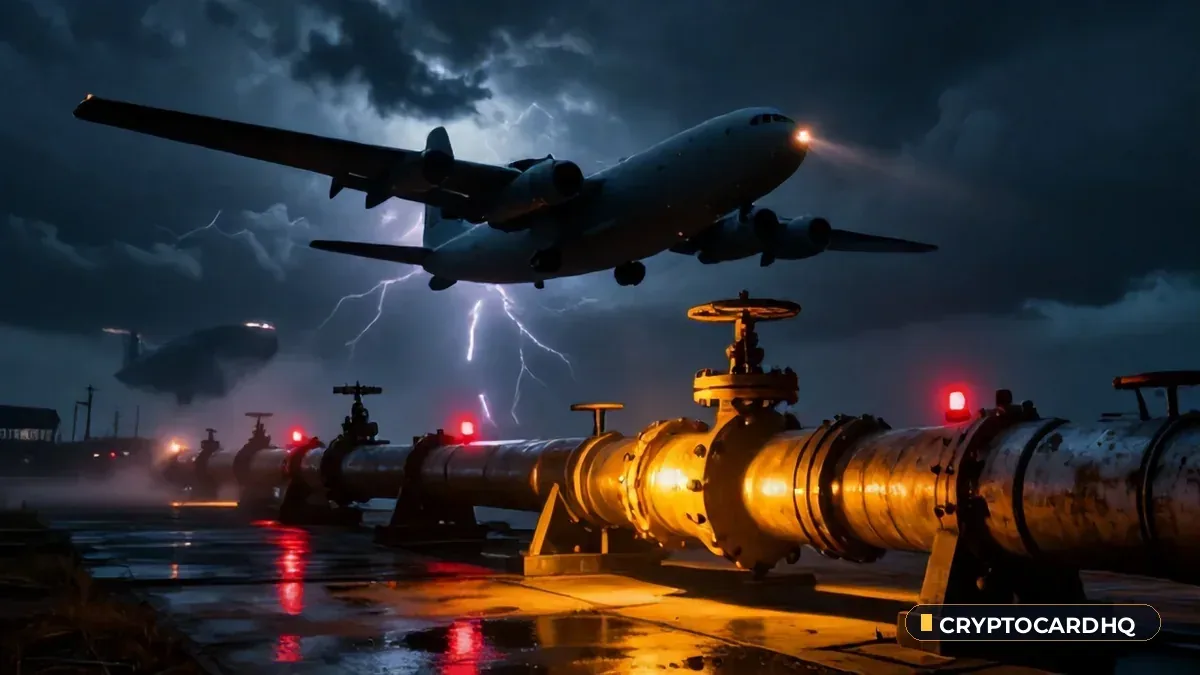
The strategic map across the European and Middle Eastern theaters shifted overnight as the United States military scrambled key aerial refueling tankers out of RAF Mildenhall. Triggered by verified intelligence warning of an imminent operational threat from Iran, the sudden clearing of the flight line in Suffolk marks an unmistakable escalation in regional military posturing. In global capital markets where geopolitical friction triggers immediate cross-asset repricing, the move registered instantly through crude oil supply logistics, sovereign defense balances, and digital asset liquidity pools.
Aerial refueling platforms operate as the silent backbone of modern expeditionary air power. Stripping these tankers from Royal Air Force Mildenhall—a foundational staging post connecting North American launchpads with operational theaters across the Mediterranean and Persian Gulf—signals that defense commanders are actively moving exposed logistics lines out of potential strike envelopes. They are securing operational readiness for an extended theater footprint. As crude oil desks reassess maritime tanker transit choke points, digital asset order books are absorbing the sudden macroeconomic chill across both spot and perpetual venues.
The 30-Second Executive Brief:
• The Catalyst: The United States military initiated an emergency redeployment of strategic aerial refueling tankers out of RAF Mildenhall following intelligence indicating an imminent threat from Iran. > • The Money Flow: Institutional capital rotated straight into defensive sovereign buffers and crude risk premia, leaving risk assets and speculative liquidity pools exposed to immediate hedging adjustments.
• The Market Reaction: Broad digital asset indices absorbed sudden volatility, with market sentiment registering elevated caution at 28 (Fear) as BTC traded within a range of $73,390.13 to $74,811.45 and ETH hovered in a tight band between $2,035.83 and $2,103.78. > • The Invalidation Trigger: Direct de-escalation statements from defense officials or the return of normal staging protocols at RAF Mildenhall alongside sustained spot bids holding Bitcoin firmly above its intraday range low of $73,390.
Market Snapshot at Time of Reporting: At the time of reporting, BTC ($73,760.64, +0.27% 24h | Range: $73,390.13 - $74,811.45), while ETH ($2,053.94, -0.31% 24h | Range: $2,035.83 - $2,103.78) with broader market sentiment registering 28 (Fear).
Emergency Redeployment: Inside the RAF Mildenhall Tanker Dispersal
RAF Mildenhall has long anchored United States Air Forces in Europe (USAFE) refueling operations, housing the 100th Air Refueling Wing and its fleet of Boeing KC-135 Stratotankers. These lumbering, mission-critical aircraft provide the airborne kerosene top-offs that keep combat air patrols, heavy strike bombers, and tactical transport corridors aloft over thousands of miles. They form the geographic bridge linking transatlantic hubs with forward operations in the Levant and the Arabian Gulf.
According to intelligence and situational dispatches reported by Google News Iran Geopolitics & Oil, the sudden departure of these assets was authorized directly in response to an identified, imminent threat attributed to Iranian state command structures or affiliated regional proxy networks. Instead of leaving high-value, slow-moving aerial targets bunched together on the tarmac in eastern England, defense planners triggered a rapid tactical dispersal.
Dispersals of this nature are not routine training sorties. Staging strategic tankers across secondary airfields or launching them into dynamic holding patterns accomplishes two immediate tactical goals: insulating critical force-multiplying airframes from precision strikes or sabotage, and repositioning refueling corridors directly along potential operational intercept routes. Strike packages and fighter escorts cannot maintain extended patrols without dedicated fuel lines in the sky. When tankers roll down the runway under threat warnings, theater timelines speed up fast.
By scattering these high-value planes across multiple secondary bases, the Pentagon removes a single point of failure. A crowded flight apron offers an irresistible target for asymmetrical drone salvos or standoff missile strikes. Dispersal changes that equation entirely. Opposing targeteers are forced to spread their reconnaissance thin and divide potential offensive salvos across multiple hardened airfields. Peacetime maintenance gives way to active combat survivability in an instant.
Energy Choke Points, Crude Risk Premia, and Middle East Theater Dynamics
The immediate consequence of military posturing involving Tehran always lands squarely on the energy desk. The Persian Gulf contains vital maritime choke points, dominated by the Strait of Hormuz, where roughly twenty percent of daily global petroleum flows through a narrow nautical channel. Any credible signal of direct military engagement between the United States and Iran injects an immediate risk surcharge into crude futures.
This behavior mirrors patterns seen in past Middle Eastern flashpoints. When maritime or air lanes come under threat, energy volatility spills across risk assets almost immediately, much like during the Iran Strait Crisis crypto market volatility. Surging oil prices operate as an unexpected tax on the global consumer base, driving up inflation metrics and boxing central bankers into tighter corners.
Commercial maritime operators monitor tanker dispersals closely. Supertankers hauling crude cannot simply pivot away from Hormuz without incurring staggering delays and financial penalties. If military command must scramble continuous combat air patrols to secure commercial corridors, maritime war-risk insurance spikes immediately. The Lloyd's Market Association Joint War Committee routinely expands high-risk territorial boundaries during these alerts, levying mandatory surcharges on hull and cargo policies. That added cost flows straight to the pump, lifting both Brent and West Texas Intermediate contracts.
At the same time, regional military friction puts renewed focus on shadow trade lanes. Illicit energy revenue and opaque capital conduits face aggressive scrutiny during military alerts, echoing the dynamic seen when the DOJ moved to seize $61M in crypto laundered from Iranian oil proceeds. When military assets reposition against state-sponsored threats, regulatory task forces and intelligence units lock down secondary financial pipelines, hunting down non-compliant settlement rails and high-risk transfer vectors operating around sanctioned actors.
Cross-Asset Contagion and Institutional Hedging Mechanics
Financial markets react to sudden military redeployments through well-worn operational channels. The initial reaction always surfaces in short-term sovereign paper and reserve currencies. Institutional risk managers activate automated hedging programs to shave down gross balance sheet exposures. When aerial tankers scatter under emergency threat alerts, fund managers do not wait around for follow-up press releases; they pull risk off the table and park liquidity in cash instruments.
This capital flight immediately hits risk assets. Equity futures soften, credit spreads widen, and decentralized digital assets face instantaneous liquidity withdrawals. Benchmark government bond yields compress as allocators rush into short-duration debt. Meanwhile, the US dollar flexes higher against emerging market currencies and oil-importing economies. Developing nations see their local buying power eroded just as energy import bills swell, compounding the macro shock.
Over in the commodity pits, prompt-month crude futures tip into backwardation, where contracts for immediate physical barrel delivery command steep premiums over future delivery dates. Commercial refiners and national strategic stockpiles rush to lock in physical inventory before potential shipping bottlenecks take hold. This backwardation proves that market panic is grounded in physical supply anxiety rather than empty speculative paper trading. For macro portfolio managers, backwardation in energy contracts signals stubborn inflationary pressure on the horizon.
Digital Asset Market Mechanics and Liquidity Compression
Digital asset markets trade around the clock, operating as the most responsive liquidity barometer available when geopolitical shocks break outside conventional Wall Street trading hours. The moment news of the Mildenhall tanker dispersal hit institutional feeds, crypto desks moved into defensive formation.
Rather than cascading into a disorderly market rout, digital assets underwent a tense period of liquidity compression and capital defense:
- 1Defense channels circulate an emergency threat notice, triggering heightened readiness.
- 2Strategic tankers relocate out of RAF Mildenhall toward diversified operational bases.
- 3Crude oil risk premia expand while capital flows into defensive sovereign paper.
- 4Institutional macro desks move capital into short-term paper and cash reserves.
- 5Crypto order books thin as liquidity providers pull resting depth; sentiment drops to 28 (Fear).
- 6Spot prices compress into a defensive range: BTC holds $73,390–$74,811 while ETH defends $2,035–$2,103.
The Crypto Fear & Greed Index captured this cautious stance, printing a defensive reading of 28 (Fear). Spot prices held their lines inside tight operational boundaries. Bitcoin oscillated between an intraday floor of $73,390.13 and resistance at $74,811.45, retaining a slight 24-hour advance of +0.27% near $73,760.64. Concurrently, Ethereum absorbed mild downward pressure, printing near $2,053.94 (-0.31%) while testing range support at $2,035.83 against overhead resistance at $2,103.78.
Automated market makers responded by widening their spreads across spot and perpetual books. Liquidity providers pulled resting bids to protect against sudden geopolitical gap risk. With market sentiment pinned down in Fear, large allocators sat on their hands, waiting to see whether the tanker dispersal was merely a precautionary safety step or the prelude to active strikes. Funding rates across perpetual futures markets flattened out, proving that leveraged participants preferred taking risk off the table rather than paying borrowing costs during an uncertain news cycle.
Key Figures & Operational Breakdown
Evaluating the scope of this deployment requires contrasting standard peacetime operations with active threat dispersal protocols:
| Strategic Dimension | Routine RAF Mildenhall Posture | Emergency Threat Dispersal | Strategic Market Impact |
|---|---|---|---|
| Tanker Fleet Deployment | Concentrated base operations (100th Air Refueling Wing) | Dispersed to alternative airfields and dynamic holding orbits | Eliminates single-point vulnerabilities; establishes active frontline mission readiness |
| Threat Level & Vector | Standard regional monitoring and scheduled readiness exercises | Direct, actionable threat intelligence linked to Iran | Pushes defense readiness conditions to elevated operational alert status |
| Crude & Energy Risk | Baseline transportation and commercial shipping logistics | Risk premia priced into crude benchmarks, refining crack spreads, and transit insurance | Direct upward pressure on global energy supply lines and macroeconomic inflation curves |
| Digital Asset Sentiment | Neutral to macro-driven liquidity flows | Fear index pinned at 28 with heavy defensive risk positioning | Order book depth thins; capital concentrates around tight spot support levels |
| Cross-Asset Volatility | Governed by traditional economic calendar prints and central bank data | Driven by breaking geopolitical alerts and tactical operational leaks | Elevated overnight and weekend volatility for 24/7 digital asset desks |
| Regulatory Surveillance | Standard compliance and anti-money laundering monitoring | Heightened sanctions monitoring on borderless settlement rails | Accelerated scrutiny of unhosted wallets and cross-border digital transactions |
Strategic Implications and Operational Hazards
The emergency redeployment of strategic air assets out of RAF Mildenhall highlights structural dynamics that will govern both macro and digital asset markets over the coming 24 to 48 hours.
First, dispersing aerial refueling assets is simultaneously a defensive safeguard and an operational springboard. Tankers sitting on an exposed apron make easy marks for modern standoff weapons or asymmetrical sabotage. Moving them to distributed airfields preserves air mobility. That dispersal ensures combat air wings can sustain around-the-clock air superiority and naval protection corridors without risking their logistics backbone on the ground.
Second, the institutional capital response reveals how digital assets behave during kinetic defense shocks. While long-term adoption frameworks emphasize decentralized assets as sovereign hedges, real-time capital flows tell a different story. In the opening hours of a military escalation, professional money managers prioritize sovereign cash reserves and short-term Treasuries. High-beta altcoins and directional leveraged longs get trimmed quickly to insulate balance sheets against sudden overnight price dislocations.
Third, regulatory surveillance across international financial channels increases sharply during military standoffs. Enforcement agencies and financial intelligence units track digital asset flows, OTC desks, and off-shore trading venues to disrupt capital flight originating from sanctioned jurisdictions. Entities facilitating unsanctioned liquidity transfers face swift regulatory enforcement actions and asset freezes.
Fourth, forward-basing agreements encounter immediate political friction. Operating American military assets out of European air bases requires continuous diplomatic alignment with host nations. Emergency dispersals indicate host officials have permitted operational postures that could draw regional retaliation or cyber campaigns. Any tension between domestic political realities in host countries and forward-deployed military missions can surface in diplomatic commentary, adding volatility to foreign exchange markets.
Critical Hazard Warnings for Market Participants (Next 24–48 Hours)
Navigating an escalating geopolitical confrontation demands rigorous risk management. Traders and portfolio managers should monitor several operational risks across the immediate trading window:
- 1Thin-Book Liquidity Cascades: With sentiment sitting at 28 (Fear), resting order book depth across major exchanges remains light. Sudden military developments or unsourced headlines can trigger aggressive price wicks through thin books, liquidating over-leveraged accounts.
- 2Weekend and Overnight Gap Risk: Traditional equity and commodities exchanges close over the weekend, but digital asset markets run without interruption. During past geopolitical escalations, crypto markets absorbed the full weight of global macro repricing between Friday's close and Sunday night futures opens.
- 3Sanction Scrutiny and Wallet Freezes: Regulated exchanges and custodial platforms apply stricter filtering rules to transactions linked to high-risk jurisdictions. Users executing cross-border peer-to-peer transfers must ensure strict chain-of-custody cleanliness to prevent automated account restrictions.
- 4Headline Spoofs and Algorithmic Sensitivities: News trading bots and social sentiment algorithms routinely misinterpret rumors or unverified social media reports during rapid military movements, sparking sharp, short-lived whipsaws.
- 5Perpetual Liquidation Clustering: Compressed trading channels generate dense clusters of stop-loss and liquidation orders just outside the range edges. A sharp, news-driven wick can trigger cascades of forced closures, driving perpetual contract pricing far away from spot index prices.
Crypto Cards, Settlement Networks, and Everyday Spending Realities
Geopolitical shocks that impact crude logistics do more than reshape hedge fund portfolios; they alter everyday consumer spending, remittance payments, and payment card mechanics. For users paying living expenses, travel costs, or retail bills through crypto payment cards, broad macroeconomic volatility introduces immediate practical challenges.
When military alerts push energy prices higher, retail prices follow quickly. Rising transport expenses show up directly in food costs, fuel prices, and utility bills. For crypto cardholders converting digital assets into fiat currency at the checkout counter, sharp intraday swings in assets like Bitcoin or Ethereum can lead to frustrating conversion slippage.
Selecting a resilient payment card is essential for users looking to preserve their purchasing power during market turbulence. Our detailed breakdowns in our Best Crypto Cards guide explain how top-tier crypto debit and credit cards handle dynamic interchange rates, instant stablecoin liquidation, and cross-border currency conversion.
With market sentiment stuck at 28 (Fear) and Bitcoin trading within a tight range of $73,390.13 to $74,811.45, crypto card users should adopt practical spending adjustments:
- Spending Stablecoins Instead of Volatile Assets: During acute geopolitical friction, funding purchases with fiat-pegged stablecoins like USDC or USDT insulates users from unexpected market drops. Selling volatile assets to pay for everyday goods during localized pullbacks locks in portfolio losses permanently.
- Cross-Border Foreign Exchange Spreads: As military maneuvers roil currency markets, payment networks often widen foreign exchange spreads on foreign card purchases. Crypto cards that provide direct interbank FX rates offer real cost savings for international travelers transiting through volatile regions.
- Protecting Cashback Value: Card rewards paid out in volatile platform tokens can lose value quickly during broad market pullbacks. Opting for cards that distribute cash-back in stablecoins or direct Bitcoin custody helps preserve the purchasing power of your earned rewards.
- Reviewing Automated Top-Up Triggers: Fast price fluctuations can prematurely trigger automated wallet reloads if balance thresholds are set too tight. Cardholders should widen their collateral buffers or link auto-debit triggers directly to stablecoin accounts until regional military tensions ease.
Readers tracking the intersection between energy corridors, sovereign defense policy, and financial markets can find continuous coverage in our dedicated Crude Oil & Middle East Macro News desk.
Catalysts & What to Watch Next
Over the next few days, several key operational indicators will show whether this emergency tanker dispersal remains a localized precautionary move or marks the beginning of an extended military confrontation:
- Tracking Dispersal Flight Paths: Flight tracking aggregators and aviation monitoring feeds will confirm where the Mildenhall tankers landed—whether they remained at domestic airfields across the UK, dispersed to continental NATO bases like Ramstein or Spangdahlem in Germany, or pushed forward into Mediterranean installations such as RAF Akrotiri or Souda Bay.
- Official Defense Briefings: Formal press statements from the Pentagon and the UK Ministry of Defence will clarify whether force protection levels have been upgraded across strategic bases in Europe.
- Hormuz Marine Insurance Rates: Statements from maritime insurance underwriters and notices from the Lloyd's Joint War Committee will show whether commercial vessels transiting the Strait of Hormuz will face higher war-risk insurance premiums.
- Technical Price Levels in Crypto: Desks will monitor range boundaries closely. A clean break below $73,390 support on Bitcoin would signal worsening macro risk aversion, while a push above $74,811 resistance would confirm that spot demand is absorbing geopolitical headwinds.
- Central Bank Forward Guidance: Upcoming speeches from Federal Reserve and European Central Bank policymakers will be scrutinized for commentary on potential energy-driven inflation risks.