
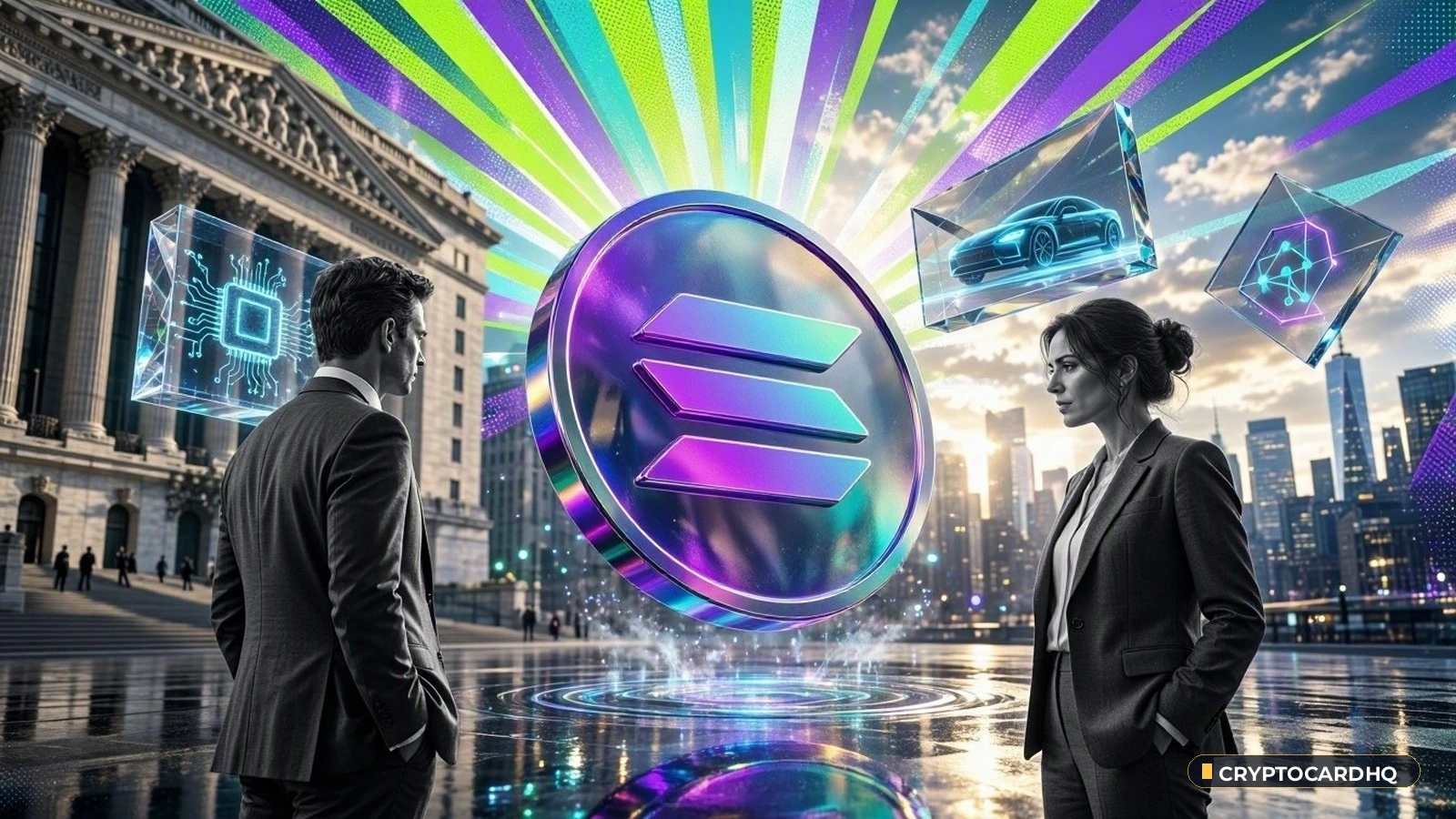
Securitize has officially started minting Wall Street’s three heaviest tech darlings—Apple (AAPL), Nvidia (NVDA), and Tesla (TSLA)—directly as tokenized shares on the Solana blockchain. This rollout marks an aggressive push into production-grade tokenized equities on high-throughput rails, establishing a public ledger bridge ahead of planned digital trading integrations across the New York Stock Exchange (NYSE), Intercontinental Exchange (ICE) venues, and crypto native exchange OKX.
The 30-Second Executive Brief:
• The Catalyst: Securitize mints compliant tokenized shares of Apple, Nvidia, and Tesla on Solana, engineering an institutional bridge toward secondary trading venues across the NYSE, ICE, and OKX. > • The Money Flow: Trillions of dollars in traditional equity capital meet Solana's onchain execution speed, giving traders direct exposure to US mega-cap technology without standard broker delays.
• The Market Reaction: Spot tokens absorbed the news quietly. Solana held near $112.29 (-3.48% 24h) while Bitcoin consolidated around $82,406.01 (-1.21% 24h) as desks evaluated the institutional plumbing over short-term speculative hype. > • The Invalidation Trigger: Direct regulatory pushback on secondary tokenized NMS equity transfers or severe order-routing bottlenecks during exchange integration tests.
Market Snapshot at Time of Reporting: At the time of reporting, BTC trades at $82,406.01 (-1.21% 24h | Range: $81,989.44 - $83,681.91), while SOL sits at $112.29 (-3.48% 24h | Range: $111.75 - $117.23). The broader market fear and greed index registers 64 (Greed).
Immediate Market Reaction and Liquidation Timeline
When the announcement hit terminals, order books across major decentralized exchanges on Solana barely blinked at first. Spot prices didn't go vertical. Instead, capital settled into methodical consolidation. Solana traded inside an intraday corridor between $111.75 and $117.23, demonstrating that institutional news during mature cycle phases rarely sparks instant retail mania.
Derivatives desks responded with far more precision. Funding rates across Solana perpetual contracts flattened out as institutional participants hedged spot exposure, rotating focus into real-world asset infrastructure tokens. Macro liquidity remains selective. Institutional managers reading coverage in our Bitcoin News category see a clear shift: balance sheets are avoiding speculative altcoin bets and hunting for assets backed by proven enterprise earnings and cash flows.
For traders managing active positions on decentralized protocols, the immediate 24 to 48 hours present unique operational friction. Traditional equities close at 4:00 PM Eastern. Solana does not sleep. When weekend geopolitical headlines or macroeconomic updates hit the tape, onchain AAPL, NVDA, and TSLA tokens will absorb price shocks in real time while physical trading floors in New York remain dark. This continuous price discovery creates pronounced basis risk and potential opening gaps when cash equity sessions resume on Monday morning.
Core Event Breakdown: Securitize Bridges Big Tech to Solana
Securitize is tackling a problem that has plagued digital securities for over a decade: moving from illiquid private-placement tokens to actual public equities with real liquidity. As originally reported by CoinDesk, the company's deployment on Solana sets the stage for institutional order books to meet decentralized settlement engines.
Under this operational setup, each tokenized share corresponds to real common stock held by SEC-registered qualified custodians and transfer agents. Token holders don't just own a synthetic derivative or an offshore CFD contract. They hold a legally recognized tokenized security that reflects economic rights, cash dividend distributions, and corporate actions.
The real breakthrough lies in the downstream distribution roadmap. Securitize didn't design these tokens to sit quietly in a single private wallet app. The deployment lays the technical groundwork for execution routing into OKX, followed by institutional trading environments currently being developed by the Intercontinental Exchange (ICE) and the New York Stock Exchange. Merging sub-second decentralized settlement with the deepest institutional equity books in the world represents a structural shift that legacy transfer agents can no longer dismiss.
By building directly on Solana, Securitize skips the multi-day clearing plumbing of legacy equity markets. While the Depository Trust & Clearing Corporation (DTCC) fought hard to transition US equities from T+2 to T+1 settlement in 2024, onchain execution achieves atomic settlement within fractions of a second. That eliminates broker credit risk, slashes margin lockups, and removes clearinghouse intermediaries entirely.
Market and Structural Context: The Institutional RWA Acceleration
The narrative around real-world assets has spent years focused on tokenized US Treasury bills. Offerings like BlackRock's BUIDL fund soaked up billions in onchain capital because crypto native treasuries needed safe, dollar-denominated yields during bear markets. But Treasury bills are passive debt instruments. Equities are dynamic growth engines governed by stringent National Market System (NMS) rules, making them significantly harder to put onchain.
Securitize’s move builds on regulatory precedents detailed in CryptoCardHQ's analysis of how the SEC unlocked tokenized NMS stocks for Wall Street. Regulators are slowly conceding that public ledgers can handle settlement and compliance checks without sacrificing investor protections.
Solana's architecture offers a decisive advantage over Ethereum in this specific arena. On Ethereum, equity settlement requires complex Layer-2 rollups or permissioned subnets, fracturing liquidity across disparate bridges. When US jobs data drops or Nvidia releases earnings, gas fees on Ethereum mainnet can spike tenfold within minutes. Solana runs on a single global state machine with localized fee markets. High-frequency equity swaps can clear alongside microtransactions without driving fees through the roof or breaking execution pipelines.
Key Figures & Operational Breakdown
The differences between clearing stocks through traditional prime brokerage accounts and settling them on Solana reveal why major exchanges are investing in digital infrastructure.
| Operational Parameter | Legacy Equity Clearing (DTCC) | Securitize on Solana Framework | Practical Market Impact |
|---|---|---|---|
| Settlement Velocity | T+1 business day clearing cycle | Sub-second atomic ledger finality | Completely removes overnight settlement credit risk for trading firms |
| Trading Availability | Monday–Friday, 9:30 AM – 4:00 PM EST | 24/7/365 uninterrupted ledger availability | Continuous price discovery through international crises and weekend earnings events |
| Settlement Rail | Centralized clearinghouses & custodial trust banks | Solana public layer-1 blockchain | Enables programmable composition across regulated DeFi lending and trading protocols |
| Targeted Liquidity Venues | Closed exchange floors (NYSE, NASDAQ) | Hybrid multi-venue routing: OKX, ICE Digital, Solana DEXs | Unifies institutional Wall Street books with global retail digital asset liquidity |
| Collateral Flexibility | Restricted to centralized broker margin accounts | Transferable cryptographic asset tokens | Unlocks instant borrowing utility across institutional decentralized money markets |
Strategic Implications and Counterparty Risks
Despite the clear technological leaps, tokenized equities introduce a distinct set of operational and structural hazards that every participant must account for.
- 1Custodial Counterparty Centralization: A token on Solana is only as solid as the offchain shares backing it. The actual common stock rests in qualified custodian bank vaults. If a custodian encounters legal freezes, operational disputes, or regulatory audits, redemption gateways can halt immediately. During market panic, a broken redemption window can cause onchain tokens to trade at a steep discount to their offchain net asset value.
- 2Regulatory Red Tape on Secondary Trading: Securitize holds broker-dealer, Alternative Trading System (ATS), and transfer agent registrations. Still, distributing US public equity tokens across an open, pseudonymous network presents massive compliance headaches. Enforcing sanctions screening, accredited investor standards, and geographic transfer restrictions on permissionless ledgers requires smart-contract whitelisting. If an unlicensed address acquires a token, protocols could face sudden enforcement action.
- 3Network Congestion and Execution Gaps: Solana has proven resilient after recent client upgrades, but the network has previously wrestled with severe congestion during extreme meme coin mania, as documented in our report on stealth DEX whale accumulation on Solana. Equity markets demand flawless uptime. If high-frequency trading bots swamp Solana during an earnings announcement, delayed transactions could trigger unfair liquidations on decentralized loan positions.
- 4Oracle Latency and Off-Market Arbitrage: Decentralized automated market makers rely on fast price feeds to reflect lit-market equity quotes. If an oracle feed lags by even three seconds during opening bell volatility, latency arbitrageurs will pick off liquidity providers, leaving retail market makers holding underwater positions.
Crypto Cards and Everyday Spending Analysis
The arrival of tokenized Apple, Nvidia, and Tesla shares changes the utility math for Web3 payments and digital asset cards. For years, crypto debit card users faced a frustrating choice: either spend hard money like Bitcoin and surrender future price appreciation, or sit in fiat-pegged stablecoins that lose purchasing power to inflation.
Tokenized equities solve this trade-off by introducing productive, dividend-bearing corporate equity as direct card spending collateral. As detailed in our Best Crypto Cards guide, modern card programs are transitioning toward flexible multi-collateral accounts. Soon, users will be able to hold tokenized shares of Apple or Nvidia, earn corporate growth, and borrow against that equity at point-of-sale terminals to pay for groceries, travel, or recurring software bills.
This shift brings measurable benefits to daily card spending economics:
- Higher Limits Through Deep Liquidity: Tokenized mega-caps carry hundreds of billions in global market depth. Card issuers that liquidate AAPL or NVDA collateral to settle fiat merchant charges face virtually zero slippage, allowing them to raise daily spending caps for high-net-worth cardholders.
- Direct Dividend Auto-Settlement: When Apple or Nvidia pays quarterly dividends, the custodian converts those funds into yield-bearing stablecoins and drops them directly into the user's wallet. Card applications can automatically use these dividend streams to cover recurring monthly subscriptions without liquidating principal equity holdings.
- Bypassing Costly Cross-Border Brokerage Fees: Non-US retail investors often battle high currency conversion fees, international wire charges, and restrictive local brokerage apps just to get exposure to US tech companies. Holding fractional tokenized shares on Solana eliminates those middlemen entirely. Users can hold Apple, earn returns, and spend against it at local merchants across Europe, Latin America, or Southeast Asia without opening an offshore brokerage account.
Catalysts & What to Watch Next
Over the coming quarters, several concrete milestones will dictate whether this launch scales into a multi-billion-dollar market or remains a niche experiment:
- Live Trading on NYSE and ICE Venues: Market participants must monitor firm launch dates for secondary trading across the New York Stock Exchange's digital initiative and OKX. Order book depth on these venues will show whether traditional market makers are willing to commit serious capital.
- DeFi Lending Protocol Governance Approvals: Watch for governance proposals across major Solana money markets. If lending protocols approve Securitize equity tokens as accepted collateral for borrowing stablecoins, onchain capital efficiency will skyrocket.
- SEC Division Guidance on Secondary Global Distribution: The SEC’s Division of Corporation Finance will eventually weigh in on how tokenized US equities can be traded by non-US residents on public chains. Any formal exemptive relief or enforcement action will set the tone for the entire RWA sector.
- Onchain Shareholder Proxy Voting Execution: Real stock ownership includes voting rights. Securitize will need to prove that token holders can participate in annual proxy votes for Apple, Nvidia, and Tesla directly through cryptographic signatures.