

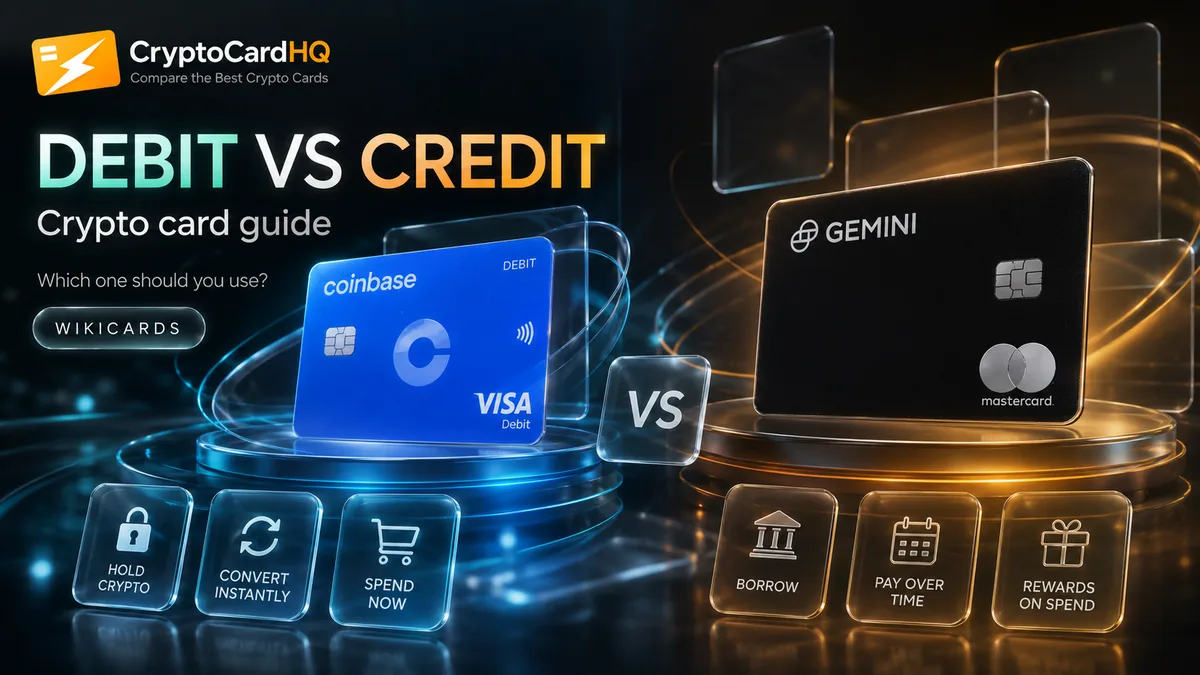
Crypto Debit Card vs Crypto Credit Card: Which One Should You Use?
Most crypto users should use a prepaid crypto card (RedotPay, Kast). Crypto credit cards make sense only for US users who want rewards without selling crypto. Avoid crypto-backed credit cards unless you fully understand liquidation risk.
Best for each use case
Use prepaid/debit
Most crypto users
Use crypto credit
US-based rewards seekers
Avoid
Crypto-backed credit
Best prepaid overall
RedotPay
Not sure which card to pick?
Our card finder asks 3 quick questions and recommends the right card.
| Card | USDT Support | Top-Up Fee | FX Fee | ATM Fee | Apple Pay | Countries | KYC | Verdict |
|---|---|---|---|---|---|---|---|---|
 RedotPay (Prepaid)★ Best RedotPay (Prepaid)★ Best | Native USDT/USDC | 0% | 1% | $2 | 180+ | Standard ID | Best global prepaid | |
 Kast (Prepaid) Kast (Prepaid) | Native USDT/USDC | 0% | 1.5% | Limited | ~80 | Standard ID | Best rewards prepaid | |
 Nexo Card (Credit-backed) Nexo Card (Credit-backed) | Collateral-backed | 0% | 0% (first $20k) | $3.50 | 200+ | Full KYC | Best for HODLers | |
 Gemini Credit Card Gemini Credit Card | N/A (fiat credit) | N/A | Varies | N/A | US only | Credit check + ID | Best US crypto rewards |
What are the three actual card models that get called 'crypto cards'?
Model 1: Prepaid cards. You load crypto (or fiat) onto the card, it sits as your balance, and spending draws down that balance. RedotPay and Kast are both prepaid cards. No credit check, no borrowing — you can only spend what you've loaded. This is the simplest model and what most people mean when they say "crypto card."
Model 2: Crypto-backed credit cards. You deposit crypto as collateral, the card issuer extends a credit line based on that collateral, and you spend against the credit line. Nexo Card works this way. The appeal is that you don't have to sell your crypto to spend — your BTC stays in your portfolio while you spend against it. The risk is that if crypto prices drop, your collateral value drops, and you may face a margin call or automatic liquidation.
Model 3: Crypto reward credit cards. Standard credit cards that pay rewards in crypto rather than airline miles or cashback. Gemini Credit Card is the most prominent example — it's a regular Mastercard credit card with a credit check, monthly billing, and rewards paid in Bitcoin or other crypto. No crypto spending required; you earn crypto on regular fiat purchases.
Why are most crypto cards actually prepaid cards, not true debit cards?
True debit cards pull directly from a bank account in real time. Prepaid cards draw from a pre-loaded balance. Most crypto cards are prepaid because connecting to a live on-chain balance at point-of-sale is technically complex and slow — blockchain confirmation times don't work at checkout speed. Instead, the card provider holds your crypto, converts it to fiat, and gives you a prepaid balance to spend.
This design choice means the card provider is always in custody of your funds. When you load $500 USDT to RedotPay, that $500 lives in RedotPay's system — not in your wallet. This is the same as loading cash onto a prepaid travel card: the card company holds it until you spend it. The practical difference from a true debit card is minimal for most users, but the custody risk is different.
Gnosis Pay is the notable exception — it operates as a card connected to a self-custodial Gnosis Chain wallet. Spending settlements happen on-chain. This means you're not trusting Gnosis Pay to hold your funds; the smart contract manages it. But the setup complexity is significantly higher than a standard prepaid card, and Gnosis Pay is EU-focused with limited coverage.
When does a crypto credit card actually make sense?
A crypto reward credit card like Gemini Credit makes sense if you're US-based, want to accumulate crypto as rewards on regular spending, and you pay your credit card balance in full each month. You don't spend crypto — you spend fiat, and Gemini pays you rewards in Bitcoin or crypto of your choice. This is a simple way to dollar-cost average into crypto passively.
The Nexo crypto-backed credit card makes sense if you have a large crypto portfolio and you need liquidity without selling. Instead of selling BTC to fund a purchase, you use Nexo's credit line backed by your BTC. You can repay the credit line later without having created a taxable disposal event. This is a legitimate tax strategy for long-term holders in certain jurisdictions.
Neither model is appropriate for users who want to spend stablecoins or use their crypto card internationally with minimal fees. For that use case, prepaid cards (RedotPay, Kast) are the right product. The credit models are for specific financial strategies, not everyday crypto spending.
What is the liquidation risk of crypto-backed credit cards?
Crypto-backed credit cards extend credit based on the value of your collateral. If you deposit $10,000 in BTC and receive a $5,000 credit line, your loan-to-value ratio is 50%. If BTC drops 40%, your collateral is now worth $6,000, and your LTV rises to 83%. At some threshold — often 80–90% LTV — the card provider automatically liquidates some of your collateral to bring the ratio back into acceptable range. You lose crypto in a market downturn, at the worst possible time.
Nexo's automatic liquidation feature is clearly disclosed in their terms. It's not hidden. But many users underestimate how quickly a crypto price drop can trigger it. In a fast-moving market — say, a 30% overnight drop — you might wake up to find your collateral partially liquidated and your credit line reduced. The risk is real and has affected real users.
The rule of thumb: if you use a crypto-backed credit card, your collateral should be crypto you would hold regardless (not crypto you're speculating on), and your credit utilization should be low enough that a 50% price drop wouldn't trigger liquidation. If you can't stomach that scenario, use a prepaid card instead.
Which card model is right for which type of user?
Crypto newbies and global travelers: prepaid card. Start with RedotPay. No credit check, no collateral, no risk beyond what you've loaded. Broad country coverage. Simple. This is the right product for 80% of people who search for "crypto card."
US-based earners who want crypto exposure: Gemini Credit Card. Spend fiat, earn crypto rewards. No need to buy crypto directly, no taxable events from spending (you're spending USD, not crypto). Treat the rewards as a low-friction way to accumulate. Requires good credit for approval.
Long-term crypto holders with a portfolio and a tax optimization goal: Nexo Credit. Use your BTC or ETH as collateral without selling. Spend against the credit line. Repay when convenient. But: only do this if you understand LTV ratios, liquidation thresholds, and are prepared to manage your collateral actively. This is not a set-and-forget product.
Ready to decide?
Find your perfect crypto card
Use our tools to compare fees, cashback, and availability side by side.



Last verified May 2026. This is not financial advice.
CryptoCardHQ may earn a referral fee when you apply for cards through links on this site. This does not influence our editorial rankings or comparisons. We only recommend cards we have independently researched and verified.