

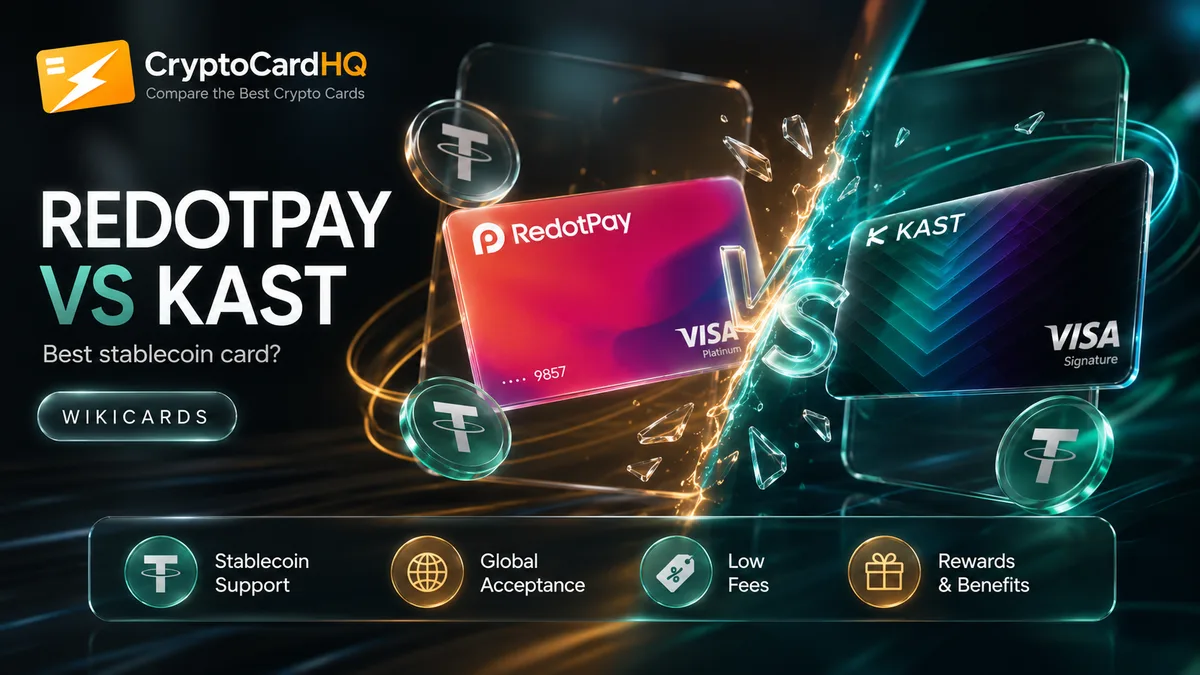
RedotPay vs Kast Card: Which Stablecoin Crypto Card Is Better?
RedotPay is better for most users — broader country support, lower FX fees, and simpler onboarding. Kast is the better choice if you want cashback rewards and primarily use Apple Pay in a supported country.
Best for each use case
Better for beginners
RedotPay
Better for rewards
Kast
Better global reach
RedotPay
Better for stablecoin-heavy users
Tied
Not sure which card to pick?
Our card finder asks 3 quick questions and recommends the right card.
| Card | USDT Support | Top-Up Fee | FX Fee | ATM Fee | Apple Pay | Countries | KYC | Verdict |
|---|---|---|---|---|---|---|---|---|
 RedotPay★ Best RedotPay★ Best | Native (USDT/USDC) | 0% | 1% | $2 | 180+ | Standard ID | Best overall reach | |
 Kast Kast | Native (USDT/USDC) | 0% | 1.5% | Limited | ~80 | Standard ID | Best rewards & UX |
Pros
- RedotPay: 0% top-up fee across all tiers
- RedotPay: 180+ country coverage — strongest in the market
- RedotPay: $2 flat ATM fee with broad ATM support
- Kast: Real USD cashback on all purchases
- Kast: Instant virtual card — no waiting for physical delivery
- Kast: Clear, published fee table with no hidden surprises
Cons
- RedotPay: No cashback or rewards program
- RedotPay: App polish is below Kast's standard
- RedotPay: 1% FX applies to every foreign currency transaction
- Kast: Only ~80 countries — gaps in emerging markets
- Kast: 1.5% FX is higher than RedotPay
- Kast: Premium tiers are expensive relative to the savings
What is the fundamental difference in philosophy between RedotPay and Kast?
RedotPay is built around global reach first. The product decision to support 180+ countries shapes everything — the fee structure is kept simple and flat because operating across that many markets requires uniformity. It's a card designed to work everywhere, even if it doesn't have the bells and whistles of a more focused product.
Kast is built around the rewards-first experience for a focused set of supported markets. The cashback, the clean app design, the instant virtual card — these are deliberate product choices for users who care about their spending returning value, even at a slightly higher FX cost. Kast is a card you choose; RedotPay is a card you rely on.
Neither philosophy is wrong. If your life involves frequent travel to unpredictable destinations and you need a card that just works, RedotPay is the right philosophy. If you're spending primarily in supported markets and you want every transaction to earn something back, Kast's approach rewards that behavior.
How do the fees compare between RedotPay and Kast in real use?
On top-up fees, both cards charge 0% — no cost to load. On FX, RedotPay charges 1% and Kast Standard charges 1.5%. On $3,000 of monthly foreign spending, that's $30 vs $45 — a $15/month difference. Over a year, RedotPay saves you $180 in FX fees compared to Kast Standard.
Kast's cashback partially offsets this. At 1% cashback on $3,000/month spending, you earn $30 back — which more than covers the $15 FX disadvantage vs RedotPay. But cashback is usually paid in USDC or USDT and may have caps. Verify the current cashback rate and maximum before assuming the math works in Kast's favor for your spend level.
On ATM fees, RedotPay charges $2 per withdrawal with broad ATM support. Kast has limited ATM support — if you need cash regularly, RedotPay wins this category outright. For travelers who use ATMs more than twice a month, the ATM fee difference alone can tip the calculation in favor of RedotPay.
How significant is the country availability gap between the two cards?
The gap is meaningful for any user who travels outside Western Europe and major Asian financial centers. RedotPay's 180+ countries include Nigeria, Kenya, Colombia, Vietnam, Egypt, and dozens of other markets where Kast's ~80-country footprint doesn't reach. If your travel or living situation includes emerging markets, the choice is effectively made for you.
For users based in Europe or the UK who travel within the EU and occasionally to Southeast Asia or North America, Kast's country list covers all of their destinations. The 80-country gap only matters if you step outside Kast's footprint — which for many users in developed markets, you never will.
Check the exact country list on each provider's website before deciding. Both lists change over time as new markets are added. If you're planning a specific trip to an unusual destination, verify your card works there before departure rather than discovering the issue at a foreign payment terminal.
Who should pick RedotPay and who should pick Kast?
Pick RedotPay if: you travel frequently across multiple continents, you need ATM access abroad, your destination list includes emerging markets, or you want the lowest possible fee floor without worrying about rewards complexity. RedotPay is also the better choice if you're new to crypto cards and want the most reliable, lowest-friction experience.
Pick Kast if: you spend primarily in supported countries, you want cashback on everyday purchases, you're iOS-first and want the best Apple Pay experience from day one, or you're in a market where RedotPay's support isn't as strong. Kast is also better if you care about app design and a polished user experience.
Many experienced crypto card users run both — RedotPay as the primary card for travel and broad use, Kast for domestic or regional spending where the rewards accrue meaningfully. The two cards don't conflict; they complement each other for different spending contexts.
What would make you switch from one card to the other?
If you're on RedotPay and you start spending primarily in Kast-supported countries with consistent monthly spend above $1,000, the cashback argument for Kast becomes harder to ignore. At $1,000/month, Kast's 1% cashback returns $10 — partially offsetting the $5 FX disadvantage. Above $2,000/month in supported markets, Kast becomes the financially superior card.
If you're on Kast and you start traveling to markets outside their coverage list — or you need regular ATM withdrawals — you'll feel the gap immediately. A single trip to Vietnam or Nigeria where your Kast card doesn't work is enough motivation to add RedotPay.
Switching between the two is easy since neither charges exit fees or requires long commitments. Both are free to sign up at the base tier. The practical advice: start with RedotPay for the broader foundation, add Kast when you're spending consistently enough in supported markets for the cashback to matter.
Ready to decide?
Find your perfect crypto card
Use our tools to compare fees, cashback, and availability side by side.


Last verified May 2026. This is not financial advice.
CryptoCardHQ may earn a referral fee when you apply for cards through links on this site. This does not influence our editorial rankings or comparisons. We only recommend cards we have independently researched and verified.